
Is Web Scraping Ecommerce Sites Legal in 2026?
The Legal Landscape for Ecommerce Scraping
The legality of web scraping hinges on several factors: the type of data collected, the method of access, and the jurisdiction involved. Publicly listed product prices, descriptions, and availability data on ecommerce platforms are generally fair game. Problems arise when scrapers bypass login walls, collect personally identifiable information without consent, or overwhelm servers with aggressive request volumes.
For CEOs evaluating competitive intelligence strategies in 2026, understanding these boundaries is not optional, legal exposure from poorly managed scraping operations can result in costly litigation and reputational damage.
Key Court Cases Every CEO Should Know
hiQ Labs v. LinkedIn
The hiQ Labs v. LinkedIn case remains the most significant ruling on web scraping legality. The U.S. Ninth Circuit Court of Appeals held that scraping publicly available data does not constitute a violation of the Computer Fraud and Abuse Act (CFAA). The court reasoned that accessing information available to any internet user does not involve "unauthorized access" under the statute.
Ryanair v. PR Aviation
In the European Union, the Ryanair v. PR Aviation ruling established that database rights and contractual terms can restrict scraping under certain conditions. EU-based businesses should pay careful attention to database directive protections that do not exist in U.S. law.
These cases highlight a core principle: legality depends on context. A compliant scraping partner like Clymin evaluates each project against the latest case law before extracting a single data point.
The Computer Fraud and Abuse Act (CFAA)
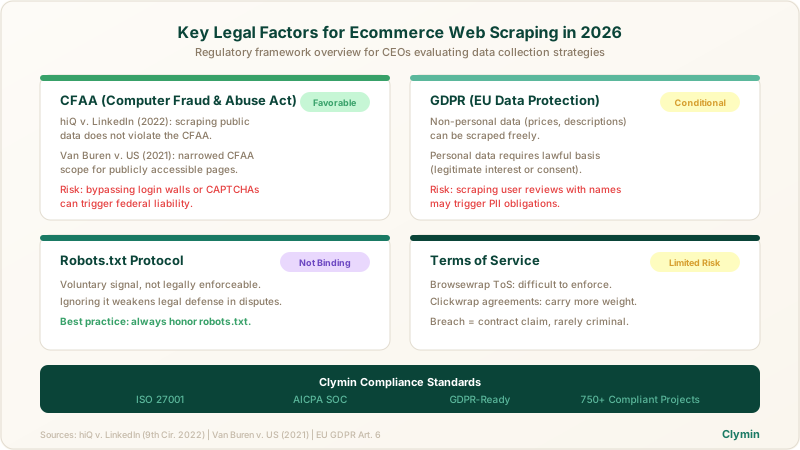
The CFAA prohibits accessing a computer system "without authorization." After the U.S. Supreme Court's Van Buren v. United States (2021) decision, the scope of the CFAA has narrowed. Accessing publicly available web pages through standard HTTP requests generally falls outside the statute's reach. Scraping becomes legally risky when it involves:
- Bypassing password-protected pages or CAPTCHAs
- Ignoring cease-and-desist orders after receiving explicit notice
- Using stolen credentials to access restricted data
CEOs should ensure their data vendors never cross these lines. A single misstep can transform a routine intelligence operation into a federal case.
GDPR and International Privacy Rules
Web scraping legal issues extend beyond the CFAA when personal data enters the picture. Under GDPR, any collection of personal data belonging to EU residents requires a lawful processing basis, typically legitimate interest or consent. Scraping product prices, stock levels, and category structures does not trigger GDPR obligations because no personal data is involved.
For ecommerce intelligence projects, the practical impact is manageable. Most competitive pricing and assortment data is entirely non-personal. Clymin's GDPR-ready framework ensures that every project undergoes a data classification review before collection begins, separating personal from non-personal data at the architecture level.
Robots.txt and Terms of Service
Robots.txt
The robots.txt file is a voluntary protocol that signals a website's crawling preferences. While not legally binding on its own, ignoring robots.txt directives can weaken a legal defense if disputes arise. Responsible scraping operations honor these signals as a baseline standard of conduct.
Terms of Service
Website Terms of Service (ToS) frequently include anti-scraping clauses. However, courts have drawn a sharp distinction between enforceable clickwrap agreements, where users actively agree to terms, and browsewrap terms that most visitors never read. Breaching a ToS may give rise to a contract claim, but rarely constitutes criminal liability.
How Clymin Ensures Compliant Ecommerce Scraping
Clymin has built compliance into every layer of its ecommerce price scraping service. With ISO 27001 certification, AICPA SOC compliance, and GDPR-ready infrastructure, every project follows a structured review process:
- Jurisdictional analysis, Legal requirements are mapped before any scraping begins
- Robots.txt adherence, Crawling policies are respected by default
- Rate limiting, Request volumes are throttled to avoid server disruption
- Data minimization, Only the data points you need are collected and stored
- Ongoing monitoring, Regulatory changes are tracked so your pipeline stays compliant
With 40+ customers and hundreds of projects delivered, Clymin's managed approach removes the legal guesswork that keeps CEOs up at night. Whether you need pricing intelligence or want to monitor competitor prices automatically, every engagement starts with a compliance-first assessment.
The Bottom Line for CEOs
Web scraping ecommerce sites is legal when executed responsibly. Publicly available commercial data, prices, product listings, availability, can be collected without violating the CFAA, GDPR, or most jurisdictions' privacy frameworks. The risk lies in execution: bypassing access controls, collecting personal data without a lawful basis, or ignoring clear legal signals.
Partnering with a compliant, experienced provider eliminates that risk entirely.
Ready to collect ecommerce data the right way? Book a consultation with Clymin or reach out at contact@clymin.com to discuss your next project.