
Why Tracking Competitor Delivery Zones Matters in 2026
Food delivery coverage maps are among the most valuable competitive intelligence assets in 2026. According to McKinsey's 2025 delivery economics analysis, platforms that expand into underserved zones before competitors achieve 30-40% higher order density in those areas within the first six months. Coverage data directly drives expansion strategy, driver allocation, and partnership decisions.
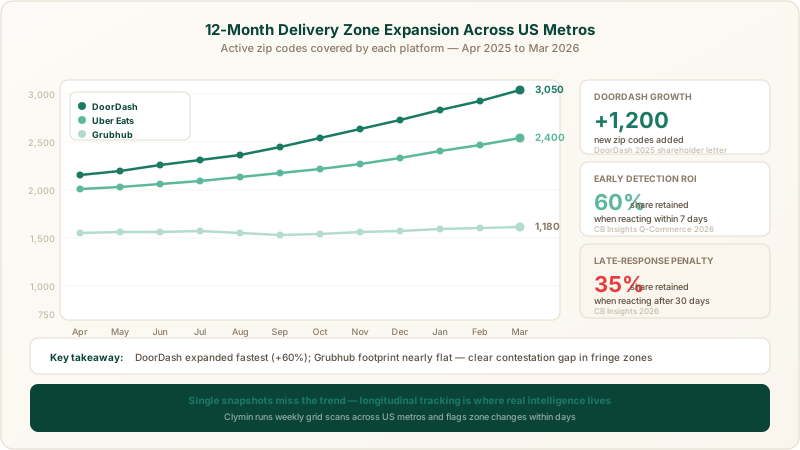
The challenge is that delivery zones are not static. DoorDash expanded into 1,200 new zip codes in the United States during 2025 alone, according to its annual shareholder letter. Uber Eats and Grubhub made similar moves. Without automated tracking, product managers and strategy directors are working with outdated assumptions about where competitors operate.
For food delivery platforms and restaurant chains in cities like San Francisco, New York, and Chicago, knowing exactly which neighborhoods a competitor covers, and which they do not, is the difference between strategic expansion and wasted investment.
How to Map Competitor Delivery Coverage Step by Step
Mapping a competitor's delivery coverage area requires a systematic, address-based querying approach that goes far beyond checking a few sample addresses manually.
Define your geographic grid
Start by creating a grid of latitude/longitude coordinates or zip codes covering your target market. For a city like San Francisco, a grid with points every 0.5 miles produces approximately 400-600 query points that capture neighborhood-level coverage detail.
Query each platform with address inputs
For every grid point, submit a delivery address query to each competitor platform. The platform returns whether delivery is available, which restaurants are listed, estimated delivery times, and applicable fees. Clymin's AI agents automate this process across thousands of coordinates simultaneously.
Structure and normalize the data
Raw availability responses from DoorDash, Uber Eats, and Grubhub differ in format. Normalize responses into a consistent schema: coordinates, platform name, availability (yes/no), restaurant count, average delivery fee, and estimated delivery time.
Visualize coverage boundaries
Plot the structured data on geographic heatmaps to reveal each competitor's exact delivery footprint. Overlay multiple competitors to identify zones where only one platform operates, areas of heavy competition, and underserved neighborhoods.
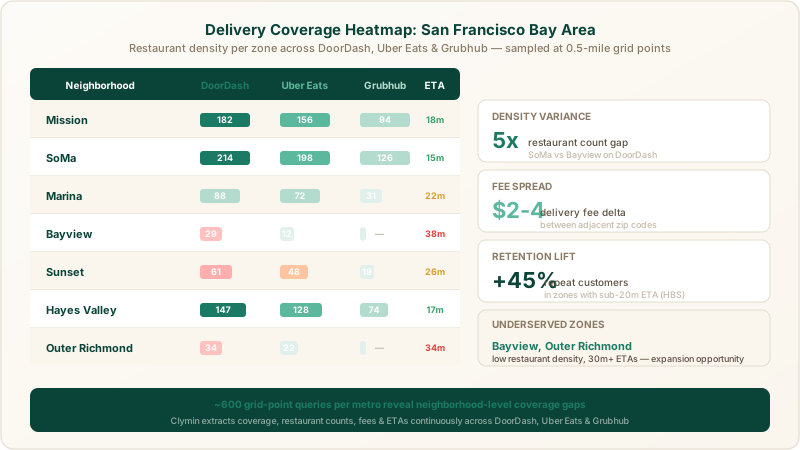
Delivery coverage heatmap comparing competitor zones across a US metro area
What Data Points to Extract From Competitor Coverage Zones
Delivery zone boundaries alone tell only part of the story. The most actionable competitive intelligence comes from pairing coverage data with operational metrics extracted at each geographic point.
Evidence supporting this:
- Restaurant density per zone varies by as much as 5x between neighborhoods on the same platform, according to Second Measure's 2025 delivery market analysis
- Delivery fee differences of $2-4 between adjacent zip codes are common on DoorDash and Uber Eats, reflecting zone-specific pricing strategies (Clymin internal benchmarking, Q1 2026)
- Platforms with sub-20-minute average delivery times in a zone retain 45% more repeat customers than those averaging 30+ minutes, per a 2025 Harvard Business School marketplace dynamics study
The key data points to extract alongside coverage boundaries include: number of active restaurants per zone, average and range of delivery fees, estimated delivery time windows, minimum order thresholds, promotional offers by zone, and peak-hour availability changes. This granular data transforms a simple coverage map into an actionable expansion playbook.
How to Detect When Competitors Expand Into New Areas
Competitor coverage zones shift frequently, and detecting expansions early provides a critical first-mover advantage. A structured monitoring cadence is essential.
Weekly automated scans of your target market grid reveal new zip codes or neighborhoods where a competitor was previously absent but now shows active delivery. Clymin runs these scans continuously, flagging coverage changes and delivering alerts so operators can respond within days rather than weeks.
Expansion signals to watch for include new restaurant listings appearing in previously uncovered zones, reduced delivery fees in fringe areas (a common tactic to stimulate demand in new zones), and marketing promotions targeting specific neighborhoods. According to CB Insights' 2026 Quick Commerce Report, platforms that detected competitor expansions within 7 days and responded with targeted promotions retained 60% of their market share in contested zones, compared to just 35% for platforms that reacted after 30 days.
Pairing coverage expansion data with food delivery industry trend analysis gives operators a comprehensive view of where the market is heading and which competitors are most aggressively expanding.
Common Mistakes When Tracking Delivery Coverage Areas
Many operators attempt delivery zone tracking but make errors that produce incomplete or misleading data.
Sampling too few addresses. Checking 10-20 addresses per city misses the neighborhood-level variation that drives real strategy decisions. Effective coverage mapping requires hundreds of query points per metro area, spaced at regular intervals across the entire geographic footprint.
Ignoring time-based variation. Delivery coverage often contracts during off-peak hours when fewer drivers are available. A zone that shows full coverage at 6 PM may show no availability at 2 PM. Effective tracking requires querying at multiple times of day across at least a full week.
Treating coverage as binary. A zone marked as "available" with only 3 restaurants and 45-minute delivery times is functionally different from one with 150 restaurants and 15-minute delivery times. Capturing operational quality metrics alongside availability is what separates useful intelligence from surface-level data.
Not tracking over time. A single snapshot of competitor coverage is useful but limited. The real value comes from longitudinal tracking that reveals expansion patterns, seasonal contraction, and strategic priorities. With hundreds of data extraction projects delivered across industries, Clymin builds longitudinal datasets that capture these trends automatically.
Twelve-month competitor delivery zone expansion timeline across US metro areas
How Clymin Helps Track Delivery Coverage at Scale
Clymin provides food delivery operators with fully managed coverage zone extraction and monitoring. Rather than building and maintaining address-querying infrastructure in-house, operators receive structured coverage datasets on their preferred schedule, daily, weekly, or in real time via API.
With over a decade of experience and over 100 billion data points extracted, Clymin's AI agents handle anti-blocking, format normalization, and source changes automatically. Data arrives in JSON, CSV, or via direct database integration, ready to feed into mapping tools and strategy dashboards. For operators also tracking competitor menu pricing on delivery apps, Clymin combines coverage and pricing data into unified competitive intelligence datasets.