
Why Manual Rate Monitoring Fails
Revenue managers who rely on manual rate checks face an impossible math problem. A typical urban hotel competes with 15 to 30 properties, each listed on 10 or more OTAs, across 90 days of forward availability. Checking every combination manually requires thousands of individual searches per day.
Manual monitoring captures a snapshot, not a picture. Competitor rates change multiple times daily based on demand signals, algorithmic adjustments, and promotional activity. A rate checked at 9 AM may be irrelevant by noon.
According to a 2025 study published by Cornell's School of Hotel Administration, hotels that rely primarily on manual rate checks miss 67% of meaningful competitor pricing moves. Automated monitoring eliminates these gaps by collecting data continuously across all channels and competitors.
Step 1: Define Your Competitive Set
Before setting up any automated monitoring, define exactly which properties and channels you need to track. A clear competitive set prevents data overload and keeps monitoring costs manageable.
Identify direct competitors based on proximity, star rating, and target guest segment. Most properties should monitor 10 to 25 competitors. Include properties that frequently appear alongside yours in OTA search results, even if they differ in category or positioning.
List every booking channel where your competitors appear. Major OTAs like Booking.com, Expedia, Agoda, and Trip.com are essential. Add metasearch platforms and any regional OTAs relevant to your market. Direct competitor websites provide another valuable data source.
Document the specific data fields you need beyond basic rates. Room type details, cancellation policies, meal inclusions, and promotional terms all add competitive context that makes pricing decisions more informed.
Step 2: Choose Your Monitoring Approach
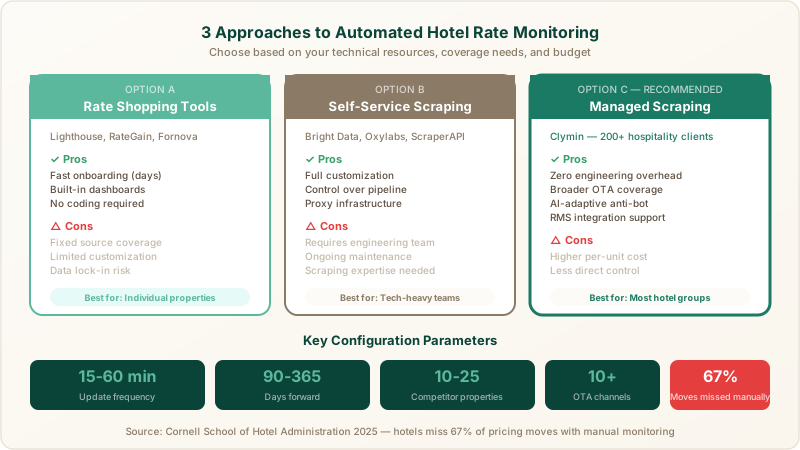
Option A: Rate Shopping SaaS Tools
Rate shopping tools like Lighthouse (formerly OTA Insight), RateGain, and Fornova provide pre-built dashboards for competitor rate monitoring. Setup takes days, and the user interface is designed for non-technical revenue managers.
Advantages include fast onboarding, built-in visualization, and integrated pricing recommendations. Limitations include fixed data source coverage, limited customization, and data lock-in that makes switching providers difficult.
Rate shopping tools work well for individual properties or small hotel groups that need basic competitive monitoring without technical complexity.
Option B: Self-Service Scraping Platforms
Platforms like Bright Data, Oxylabs, and ScraperAPI provide the infrastructure for building custom scraping solutions. Your team writes crawlers that extract competitor data from target websites using the platform's proxy networks and anti-bot tools.
Advantages include full customization and control over data collection logic. Limitations include significant engineering effort, ongoing maintenance burden, and the need for specialized scraping expertise.
Self-service scraping works for organizations with dedicated engineering teams that want full control over their data pipeline.
Option C: Managed Scraping Services
Managed services like Clymin handle the entire monitoring pipeline from crawler development through clean data delivery. You define your requirements, and the provider manages all technical operations.
Clymin's managed approach eliminates engineering overhead while providing broader coverage and deeper customization than rate shopping tools. With dozens of hospitality customers and over a decade of travel scraping expertise, Clymin has refined its hotel rate monitoring to handle the full complexity of modern OTA data extraction.
Step 3: Configure Data Collection Parameters
Regardless of which approach you choose, configure these key parameters for effective monitoring.
Update frequency: Balance data freshness against cost. Hourly updates suit most properties. High-competition urban markets may warrant 15 to 30-minute intervals for top competitors. Daily updates suffice for broader market tracking.
Date range: Monitor at minimum 90 days of forward availability. Revenue managers at larger properties often track 180 to 365 days forward to support group pricing and long-term strategy.
Room types: Track room categories that directly compete with your inventory. Standard king, double queen, and suite categories cover most competitive scenarios. Add specialty room types if they represent significant revenue segments.
Occupancy configurations: Single and double occupancy represent the baseline. Add family configurations if relevant to your market segment.
Step 4: Set Up Data Delivery and Integration
Automated monitoring only delivers value when data reaches the people and systems that act on it. Configure delivery channels that match your operational workflow.
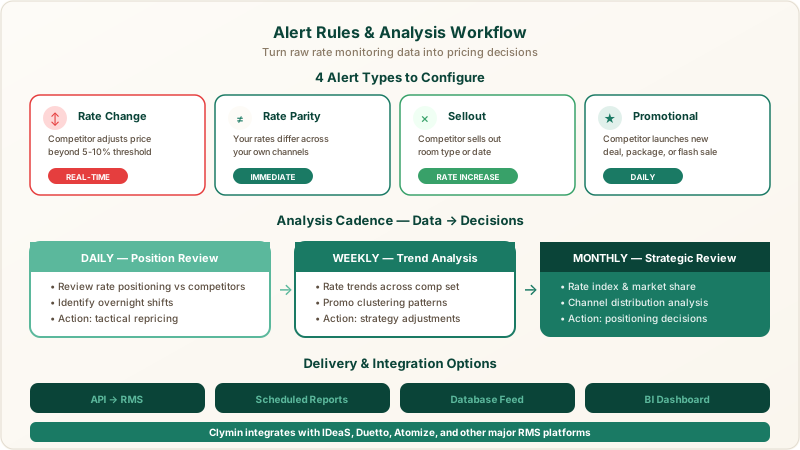
API integration connects monitoring data directly to your revenue management system or business intelligence platform. Real-time API access enables automated pricing rules that respond to competitor moves within minutes.
Scheduled reports via email or messaging platforms keep revenue managers informed without requiring them to check dashboards. Configure daily summary reports and real-time alerts for significant competitive events.
Database integration supports advanced analytics by loading monitoring data into your data warehouse. SQL-accessible competitive data enables custom analysis that goes beyond any dashboard's capabilities.
Clymin supports all three delivery methods and provides technical assistance for integration with major RMS platforms including IDeaS, Duetto, and Atomize. The hotel rate scraping service page details Clymin's specific integration capabilities.
Step 5: Establish Alert Rules
Automated alerts transform raw monitoring data into actionable intelligence. Configure alerts for the competitive events that demand immediate attention.
Rate change alerts trigger when a competitor adjusts pricing by more than a defined threshold, typically 5-10% for primary competitors. Fine-tune thresholds to minimize noise while catching meaningful moves.
Rate parity alerts flag instances where your own rates differ across channels, indicating distribution issues that need immediate resolution.
Sellout alerts notify your team when competitors sell out specific room types or dates, signaling demand spikes that may support rate increases.
Promotional alerts detect when competitors launch new deals, packages, or flash sales that could impact your competitive positioning.
Step 6: Build Analysis Workflows
Data collection is the foundation. Analysis workflows turn raw competitive data into pricing decisions.
Daily competitive position review: Each morning, review your rate positioning relative to primary competitors across key channels. Identify dates where your positioning has shifted due to competitor moves overnight.
Weekly trend analysis: Review rate trends across your competitive set to identify emerging patterns. Are competitors gradually increasing rates for a specific date range? Are promotional offers clustering around certain periods?
Monthly strategic review: Analyze longer-term competitive dynamics including rate index trends, market share implications, and channel distribution patterns. Monthly analysis informs strategic decisions about positioning and distribution.
For teams looking to understand the technical details of hotel data extraction, the guide on how to scrape hotel prices from OTA platforms provides deeper context. Broader industry context is available in the travel industry data trends 2026 analysis.
Common Pitfalls and How to Avoid Them
Monitoring too many competitors: Focus on the 10 to 25 properties that truly compete for your demand. Monitoring 100 competitors creates noise that obscures actionable intelligence.
Ignoring data quality: Automated monitoring can produce errors. Validate data quality regularly by spot-checking extracted rates against actual OTA listings. Clymin's built-in quality assurance catches 99.7% of data issues automatically.
Failing to act on data: Monitoring without action is wasted investment. Establish clear decision frameworks that translate competitive data into pricing moves. Define when to match, when to undercut, and when to maintain premium positioning.
Overlooking non-rate competitive factors: Rates alone do not tell the complete competitive story. Monitor cancellation policies, breakfast inclusions, loyalty program benefits, and other value-adds that influence booking decisions.
Sources
- Cornell School of Hotel Administration, "Automated vs Manual Competitive Rate Monitoring," 2025
- Skift Research, "Revenue Management Technology Adoption Report 2025"
- Phocuswright, "Hotel Distribution Channel Analysis 2025"
Next Steps
Ready to automate your competitor rate monitoring? Book a consultation with Clymin's hotel data team to scope your monitoring requirements. Contact us at contact@clymin.com or visit clymin.com to learn more.