
Why Websites Use Anti-Bot Systems
Anti-bot defenses exist to protect infrastructure, data, and users, not only to stop scrapers. Automated traffic is now a large share of all web requests. According to Imperva's 2024 Bad Bot Report, automated traffic made up nearly half of all internet traffic in 2023, so sites invest heavily in telling good automation from abusive automation.
Understanding that intent changes how you approach collection. A scraper that behaves like abusive traffic, hammering pages, ignoring signals, and hiding its behavior, gets treated as a threat. A scraper that collects public data at a respectful pace looks like ordinary use and is far less likely to be blocked. The goal is reliable, responsible collection, not evasion for its own sake.
According to Akamai's 2024 State of the Internet research, bot-driven scraping and attacks have grown in both volume and sophistication, with more automated traffic engineered to mimic real browsers. That trend is why defenses have become more layered, and why respectful collection, rather than a single trick, is what stays reliable over time.
Common Types of Anti-Bot Defenses
Anti-bot systems layer several techniques, and knowing them helps you understand why blocks happen. The categories below are descriptive, so you can diagnose issues and collect more considerately.
The main defense layers you will encounter:
- Rate limiting. Caps on how many requests an IP or account can make in a window.
- IP reputation. Blocking or challenging traffic from flagged datacenter ranges.
- Browser fingerprinting. Checking whether a client looks like a real browser.
- Behavioral analysis. Watching for non-human patterns like perfectly timed requests.
- JavaScript challenges and CAPTCHAs. Tests that ask the client to prove it is a real user.
These defenses rarely work in isolation. A site might allow a slow trickle of requests but challenge anything faster, or serve normal pages to real browsers while feeding altered content to clients it suspects are automated. Because the layers combine and change over time, the same source can behave differently from one day to the next, which is why brittle scrapers break and why steady, respectful collection holds up. For how a request actually reaches a page through this stack, see our explainer on what a web scraping API is.
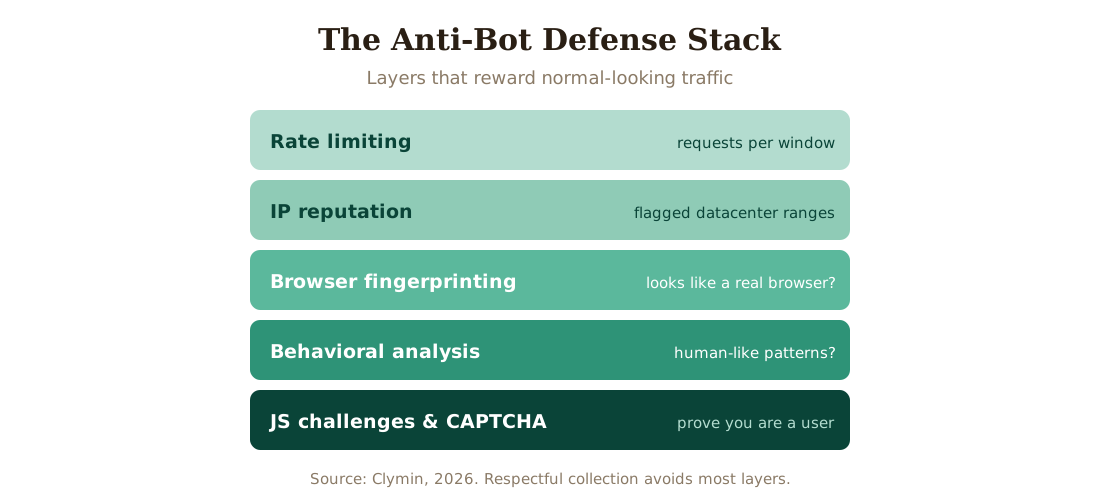 Anti-bot systems stack layers that reward normal-looking traffic and challenge patterns that look automated or abusive.
Why Scrapers Get Blocked
Most blocks trace back to a handful of avoidable mistakes rather than sophisticated detection. Requesting too fast is the biggest one: a scraper that fires hundreds of requests a second from one IP looks nothing like a human. Ignoring robots.txt, sending obviously automated headers, and re-fetching the same pages needlessly all raise flags too.
The fix for these is not a clever trick; it is behaving like a considerate visitor. Collecting at a reasonable rate, honoring the signals a site publishes, and spreading load over time prevents the majority of blocks before any special infrastructure is involved.
How to Diagnose Why You Are Getting Blocked
When collection starts failing, the response usually tells you which layer tripped. A sudden run of 429 statuses means you hit a rate limit, so slow down. A 403 or a block page often points to IP reputation or fingerprinting. A CAPTCHA or JavaScript challenge means the site wants proof of a real user. Empty or altered responses can mean the page changed or served different content to suspected bots.
Reading these signals turns guesswork into a fix: throttle for rate limits, cut request volume for reputation issues, and reconsider whether a source is worth the effort if it challenges every visit. Logging status codes and response sizes over time is the fastest way to see which layer is causing the problem before changing anything else.
How to Collect Public Data Responsibly
The most reliable way to handle anti-bot systems is to be a good citizen of the web. Responsible collection is also more stable, because it does not trigger the defenses in the first place.
Practices that keep public-data collection reliable and respectful:
- Honor robots.txt and rate limits. Treat them as the site's stated preferences and stay within them.
- Prefer an official API. If the data is available through a documented API, use it instead of scraping.
- Pace and spread requests. Add delays and distribute load rather than bursting.
- Cache and deduplicate. Do not re-fetch pages you already have.
- Handle errors gracefully. Back off on failures instead of retrying aggressively.
- Avoid authenticated and personal data. Collect public information, not logged-in or sensitive content.
Doing this well at scale, across many sources that each change over time, is real engineering work. For the category that packages it, see what managed web scraping is.
Reading Robots.txt and a Site's Rate Limits
The clearest signals a site gives are the ones it publishes. A site's robots.txt file, at the root of the domain, states which paths crawlers are asked to avoid and sometimes a crawl-delay. Treating it as the operator's stated preference is both the respectful choice and a practical one, because ignoring it is a fast way to be flagged.
Rate limits are usually communicated in the response rather than a file. A 429 status, a Retry-After header, or a sudden drop in success rate all tell you that you are moving faster than the site wants. Reading and honoring these signals keeps collection sustainable. It also keeps your footprint small, which matters: a considerate crawler that a site barely notices is far less likely to trigger the heavier defenses in the first place.
When a source offers a documented API or a data feed, that is almost always the better path than scraping the front end. Official endpoints are more stable, clearly permitted, and cheaper to maintain. Scraping is best reserved for public data that has no official access route.
When to Use a Managed Service
Some public sources are defended aggressively enough that reliable collection requires maintained infrastructure: rotating proxies, headless rendering, monitoring, and constant adaptation as defenses change. Building and maintaining that in-house pulls engineers away from using the data.
A managed service absorbs that work. Clymin maintains the collection infrastructure, adapts to source changes, and delivers clean data, so anti-bot resilience is the provider's problem rather than yours. For how the managed model compares to running a tool, see web scraping API vs managed service.
The economics usually favor this once collection is continuous. A team that spends engineering hours every week diagnosing blocks, rotating infrastructure, and patching parsers is paying for anti-bot resilience whether or not it shows up as a line item. A managed provider spreads that cost across many customers and many sources, and folds it into a single per-record price, so the maintenance burden does not scale with every new source you add.
How Clymin Fits In
Clymin is a managed data extraction service operating from offices in San Francisco and Hyderabad, serving customers across the United States, India, and globally. With 12+ years on the hardest sources, including sites with strong anti-bot defenses and mobile apps, Clymin keeps public-data collection reliable at 99.9% pipeline uptime.
Clymin collects only public data, respects robots.txt and rate limits, and adapts as sources change, so you get consistent, compliant data without maintaining scrapers or chasing blocks. See the approach on Clymin's main data extraction service.
Ready to Collect Data Without Fighting Blocks?
Tell us the public sources you need, and Clymin will run a free pilot and deliver clean data reliably, handling the anti-bot work for you, before you pay anything. Email contact@clymin.com or start a free pilot, one metric, cost per record delivered, no setup fees.