
Why Property Data Freshness Matters More in 2026
Real estate markets move faster than ever. According to the National Association of Realtors (NAR), the median days-on-market for residential properties dropped to 22 days nationally in early 2026, with competitive metros like San Francisco averaging under 12 days. When a listing can go from active to under-contract in a single afternoon, property data that is 48 hours old is already a liability.
Data analysts at real estate firms, proptech companies, and investment groups rely on accurate listing statuses, pricing shifts, and inventory counts to drive decisions. A dataset refreshed weekly might show 200 "active" listings when 60 of them are already pending or sold. That kind of inaccuracy cascades into flawed market reports, wasted agent outreach, and mispriced investment models.
The push toward real estate data update frequency optimization is also driven by competitive pressure. Firms that operate on fresher data consistently outperform those relying on weekly or manual pulls. According to McKinsey's 2025 Real Estate Technology Report, data-driven real estate firms achieved 20-30% higher returns on property investments compared to peers using traditional research methods.
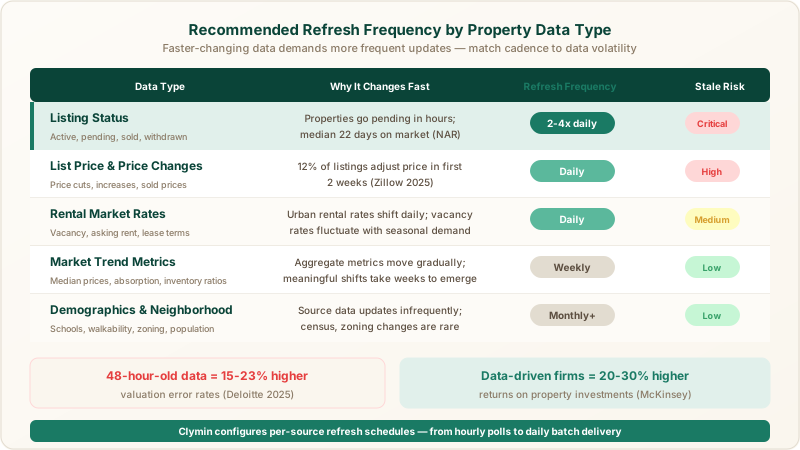
Recommended refresh frequencies by property data type, faster-changing data demands more frequent updates.
What Is the Right Refresh Frequency for Each Property Data Type?
Not all property data ages at the same rate. Matching your refresh cadence to each data category prevents both stale datasets and unnecessary extraction overhead. Here is a practical breakdown real estate data analysts can apply immediately.
Listing status and availability change fastest. Properties can shift from active to pending within hours on platforms like Zillow, Redfin, and Realtor.com. For teams tracking active inventory in metros like San Francisco or Hyderabad, refreshing listing status 2-4 times daily prevents false positives in outreach lists and portfolio screening tools.
Pricing data, including list price changes, price cuts, and sold prices, should be refreshed at least once daily. According to Zillow's 2025 Housing Data Report, approximately 12% of active listings experience at least one price adjustment within the first two weeks. Missing a price reduction by even a day can mean a missed acquisition opportunity for investment analysts.
Rental market rates follow a similar cadence. Vacancy rates, asking rents, and lease terms shift frequently in urban markets. Daily extraction ensures rental comps stay accurate for appraisals and investor underwriting. Clymin's rental market data extraction pipelines are built for exactly this frequency, polling rental platforms on automated schedules.
Market trend data, median sale prices, absorption rates, inventory-to-sales ratios, can be refreshed weekly. These metrics aggregate over time and do not swing dramatically day-to-day.
Demographic and neighborhood data, population growth, school ratings, walkability scores, zoning changes, update infrequently at their sources. Monthly or quarterly refreshes are sufficient for most analytical models.
How Stale Data Creates Costly Blind Spots
The real cost of outdated property data is not abstract. Stale datasets introduce specific, measurable errors into real estate workflows that compound across teams and decisions.
Portfolio screening failures happen when listing status data lags. An investment analyst filtering for active single-family homes priced below $500,000 in Austin may build a shortlist of 40 properties. If the dataset is three days old, research from Redfin's 2026 Market Speed Index suggests that 15-20% of those listings may already be under contract in fast markets. That translates to wasted due diligence hours and slower deal velocity.
Comparative market analysis (CMA) errors emerge from stale pricing data. When agents or analysts pull comps for a property valuation, prices that are even one week old can distort the output. In appreciating markets, stale comps undervalue properties. In declining markets, they overvalue. Neither outcome serves the client well.
Missed rental arbitrage windows close quickly. A data analyst monitoring short-term rental yields across neighborhoods needs current occupancy and rate data. Platforms like Airbnb and Vrbo update availability in real time, a weekly data pull misses rate fluctuations tied to local events, seasonal demand, and competitor pricing adjustments.
Emily W., a Real Estate Consultant, noted that "data collection efficiency improved by 35% with Clymin's automated property listing extraction." That efficiency gain is directly tied to freshness, automated pipelines eliminate the lag between a listing change and its appearance in the working dataset.
How to Build a Property Data Refresh Strategy
Building an effective refresh strategy starts with auditing your data consumption patterns. Data analysts should map each dataset to its downstream use case and required latency tolerance.
Classify data by volatility
Group your property data fields into high-frequency (status, price, availability), medium-frequency (market trends, sold records), and low-frequency (demographics, zoning) tiers. Each tier gets a different refresh schedule.
Match refresh cadence to decision speed
If your team makes offers within 24 hours of identifying a target property, your listing data cannot be more than a few hours old. If your reports are generated weekly for investors, daily refreshes may suffice.
Automate extraction across sources
Manually pulling data from Zillow, Redfin, MLS feeds, Realtor.com, and county assessor sites is not scalable. Automated scraping pipelines that poll multiple sources on staggered schedules produce unified, timestamped datasets. Clymin's real estate data scraping service handles multi-source extraction with configurable refresh intervals, from hourly polling to daily batch delivery.
Validate freshness with timestamps
Every record in your property dataset should carry a "last_updated" timestamp from the source and a "last_scraped" timestamp from your pipeline. Monitoring the gap between these two values reveals data freshness bottlenecks before they affect downstream analysis.
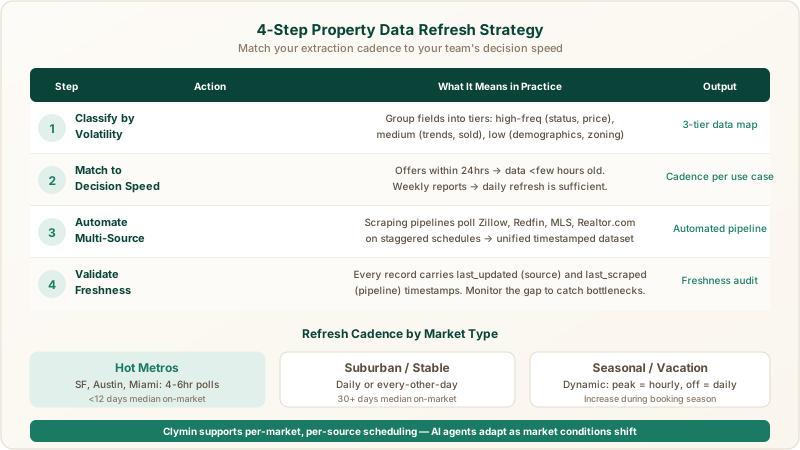
A four-step framework for building a property data refresh strategy tailored to your team's decision speed.
How Market Conditions Change Optimal Refresh Rates
Property data freshness is not a fixed setting. The right refresh cadence shifts based on macro conditions, seasonality, and geographic factors that data analysts should actively monitor.
During seller's markets with low inventory, listings move faster. The National Association of Realtors reported that 28% of homes sold above asking price in Q1 2026 nationally, rising to 45% in tech-hub metros. In these conditions, refreshing listing data just once daily is insufficient for competitive buyers or investment firms, 4-6 hour polling intervals become the operational standard.
Seasonal patterns also play a role. Spring and summer see higher transaction volumes in most North American markets. A refresh cadence that works in January may leave gaps in June. Real estate teams should build dynamic schedules that increase extraction frequency during peak months and scale back during slower periods to manage pipeline costs efficiently.
Geographic variation matters equally. San Francisco's median days-on-market differs dramatically from a mid-size Midwestern city. Firms operating across multiple markets benefit from per-market refresh configurations rather than a blanket national schedule. Clymin's AI-agentic scraping approach supports this kind of granular, per-source scheduling without requiring manual reconfiguration as market conditions shift.
How Clymin Helps Real Estate Teams Maintain Fresh Data
Clymin provides fully managed property data extraction pipelines that handle multi-source scraping, data cleansing, and scheduled delivery, so real estate data analysts focus on analysis rather than infrastructure. With over a decade of experience, hundreds of completed projects, and ISO 27001 and GDPR compliance, Clymin delivers structured property datasets on the schedule your business requires, from multiple daily refreshes to real-time streaming.
The platform's AI agents adapt automatically when listing sites change their structure or deploy new anti-scraping measures, eliminating the maintenance overhead that derails in-house scraping efforts. Whether your team needs hourly listing status polls across 15 sources or daily batch pricing data for 50 metros, Clymin configures the pipeline to match your freshness requirements.