
Why Financial Teams Struggle With News Data in 2026
Financial markets move on information. A single earnings surprise, regulatory announcement, or geopolitical development can shift asset prices within minutes. Yet most financial teams face a growing data bottleneck when it comes to news.
According to Accenture's 2025 Capital Markets Technology report, the volume of market-relevant digital content grew 34% year-over-year between 2023 and 2025. Traditional terminal-based news feeds cover major wire services but miss regional outlets, niche trade publications, and the growing universe of alternative news sources that quantitative strategies depend on.
Manual monitoring cannot scale. A Bloomberg terminal subscription costs $24,000 to $27,000 per user annually, and even premium terminals only cover a curated subset of global financial media. Analysts spend an estimated 30% of their workday gathering and organizing information rather than analyzing it, according to a 2025 McKinsey study on productivity in financial services.
Clymin eliminates this bottleneck by automating the entire news collection, structuring, and delivery pipeline across a far broader source universe than any single terminal provides.
What Sets Clymin's Financial News Aggregation Apart
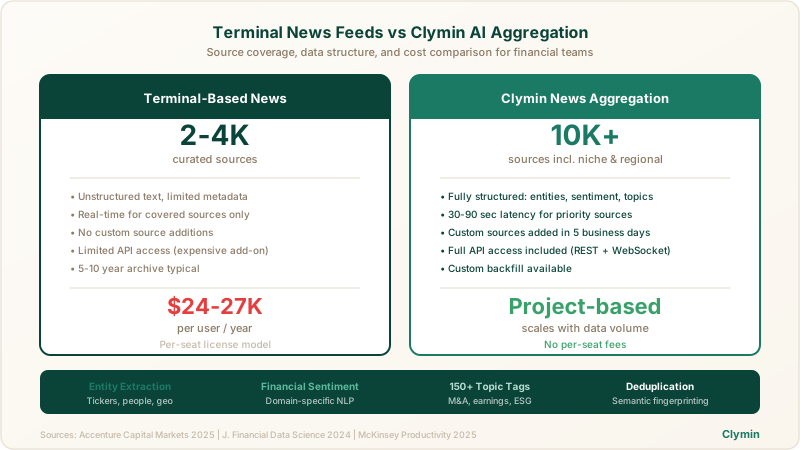
Traditional terminal feeds versus Clymin's multi-source AI aggregation pipeline
Clymin's financial news aggregation service goes beyond simple RSS collection. Every article passes through an AI enrichment pipeline that transforms raw text into structured, queryable data points ready for quantitative analysis.
Entity extraction and linking identifies every company, person, ticker symbol, and geographic entity mentioned in an article and maps them to canonical identifiers. Clymin's entity resolution handles abbreviations, alternate names, and multilingual references, linking "AAPL," "Apple Inc.," and "Apple Computer" to a single entity record.
Financial sentiment analysis applies domain-specific NLP models trained on financial language. General-purpose sentiment tools misclassify financial text roughly 35% of the time according to a 2024 Journal of Financial Data Science study. Clymin's models distinguish between negative market sentiment and routine risk disclosure language, delivering sentiment scores that quantitative teams can actually trade on.
Topic classification tags every article across 150+ financial topic categories including M&A activity, earnings results, regulatory actions, macroeconomic indicators, ESG developments, and sector-specific events. Custom taxonomies can be configured for specialized investment strategies.
How Financial Firms Use Clymin's News Aggregation Data
Financial news aggregation serves different use cases across the investment lifecycle. Clymin's structured news feeds power a range of applications for buy-side and sell-side firms.
Quantitative trading signals. Systematic funds incorporate Clymin's sentiment and entity data into alpha-generating models. News sentiment momentum, event-driven signals, and attention metrics derived from article volume and source authority feed directly into trading algorithms. According to Greenwich Associates' 2025 Alternative Data Survey, 67% of systematic hedge funds now use news sentiment as a signal input, up from 41% in 2022.
Fundamental research acceleration. Discretionary analysts use Clymin's aggregated feeds to monitor portfolio companies and sectors without manually checking dozens of sources. Filtered feeds deliver only relevant articles for specific tickers, sectors, or themes, reducing information overload while ensuring nothing material is missed.
Risk and compliance monitoring. Compliance teams track regulatory news, enforcement actions, and adverse media mentions across their portfolio and counterparty universe. Clymin's real-time alerts flag material developments within minutes of publication, supporting obligations under MiFID II, Dodd-Frank, and other regulatory frameworks.
Lisa R., a client in the financial services sector, reported that decision-making speed improved by 25% after implementing Clymin's structured data extraction services. Faster access to organized news data directly accelerates the research-to-decision pipeline.
What Sources Does Clymin's Financial News Aggregation Cover?
Clymin's source coverage spans the full spectrum of financial media, far exceeding what any single terminal or news vendor provides.
Tier 1 wire services and major outlets include Reuters, Associated Press, Dow Jones Newswires, Financial Times, Wall Street Journal, Bloomberg News, and CNBC. These form the baseline that most financial teams already monitor.
Regional and local financial media is where Clymin adds significant incremental value. Clymin monitors over 3,000 regional financial outlets across North America, Europe, Asia-Pacific, and emerging markets. Regional newspapers often break local company news, regulatory developments, and economic data hours before wire services pick up the story.
Regulatory and government sources include SEC EDGAR filings, European Securities and Markets Authority publications, central bank press releases, patent office filings, and government procurement databases. Clymin extracts and structures data from these primary sources in real time.
Specialized financial publications cover sector-specific trade journals, energy market reports, commodities newsletters, fintech industry blogs, and academic working papers. These niche sources provide differentiated information that broader news aggregators miss entirely.
Clymin can add custom sources to your monitoring set within five business days. For firms exploring broader alternative data extraction for financial analysis, news aggregation often serves as the foundational data layer.
How Clymin Delivers Financial News Data
Clymin's delivery infrastructure is designed for the low-latency, high-reliability requirements of financial data consumers. Structured news data reaches your systems through multiple integration options.
Streaming API delivers articles in real time via WebSocket connections with sub-second latency for priority sources. Each article arrives as a structured JSON payload with all enrichment fields populated, ready for immediate ingestion into your data platform.
REST API supports on-demand queries with filtering by source, entity, topic, sentiment range, date range, and custom parameters. Pagination and bulk export endpoints handle historical backfill requests efficiently.
Cloud storage delivery pushes batched data files to Amazon S3, Google Cloud Storage, or Azure Blob Storage on configurable schedules. Parquet, JSON, and CSV formats are supported for direct compatibility with data lake architectures.
Clymin's platform has processed over 100 billion data points across all client engagements. The financial news aggregation infrastructure runs on dedicated, geographically distributed collection nodes to minimize latency and maximize source coverage reliability.
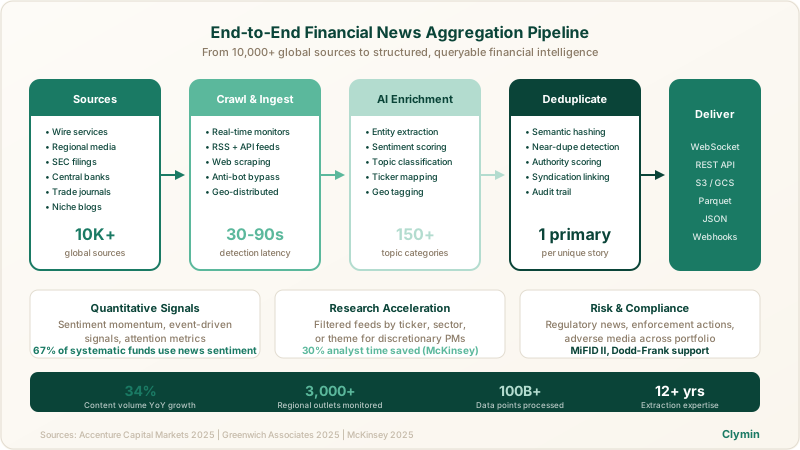
Clymin's end-to-end financial news aggregation pipeline from source to delivery
How Does Financial News Aggregation Compare to Terminal Subscriptions?
Financial teams evaluating a financial news aggregation service often weigh it against expanding terminal seat licenses. The comparison favors dedicated aggregation for most data-intensive use cases.
| Factor | Terminal-Based News | Clymin News Aggregation |
|---|---|---|
| Source count | 2,000-4,000 curated sources | 10,000+ sources including niche and regional |
| Data structure | Unstructured text, limited metadata | Fully structured with entities, sentiment, topics |
| Latency | Real-time for covered sources | 30-90 seconds for priority, 5-minute batches for broad |
| Custom sources | Not available | Added within 5 business days |
| Cost per user | $24,000-$27,000/year per seat | Project-based pricing, scales with data volume |
| API access | Limited, expensive add-on | Full API access included |
| Historical data | Typically 5-10 year archive | Custom backfill available |
For hedge funds and quantitative firms that need structured, API-accessible news data at scale, a managed aggregation service delivers more data at lower total cost than adding terminal seats. Firms exploring this decision may also find value in our comparison of web scraping versus Bloomberg terminal for market data.
Compliance and Data Quality in Financial News Aggregation
Data quality and regulatory compliance are non-negotiable for financial services clients. Clymin addresses both with infrastructure-level safeguards built specifically for the financial sector.
Data accuracy is maintained through automated validation at every pipeline stage. Clymin's quality assurance system checks for completeness, consistency, and anomalies across all extracted fields. Deduplication algorithms using semantic fingerprinting ensure each unique story appears only once in client feeds, with syndication links preserved for audit purposes.
Clymin is ISO 27001 certified, AICPA SOC compliant, and GDPR ready. Financial clients receive dedicated data handling protocols including encrypted transmission, access logging, and data retention controls aligned with their internal compliance requirements.
Content licensing considerations are handled transparently. Clymin extracts factual data and metadata from published articles in compliance with fair use principles and applicable data extraction regulations. Clients requiring full-text article access for specific sources can configure licensed content integrations through Clymin's partnership network.
Sources
- Accenture, "Capital Markets Technology Vision Report," 2025
- McKinsey & Company, "Productivity in Financial Services: The Data Bottleneck," 2025
- Greenwich Associates, "Alternative Data in Systematic Strategies Survey," 2025
- Journal of Financial Data Science, "Sentiment Analysis Accuracy in Financial Text," 2024
Start Aggregating Financial News Data Today
Clymin's financial news aggregation service gives your team structured, real-time access to the broadest source coverage available in a managed service. With 12 years of data extraction expertise and hundreds of projects delivered, Clymin handles the technical complexity so your analysts can focus on generating alpha. Book a consultation with Clymin's financial data team or reach out at contact@clymin.com to scope your news aggregation requirements.