
Why Financial Firms Need Alternative Data in 2026
Traditional financial data, earnings reports, balance sheets, market prices, reaches every analyst simultaneously. Alpha generation increasingly depends on signals that arrive before consensus forms. Alternative data extracted from the public web provides that informational edge.
According to Grand View Research's 2025 report, the global alternative data market reached $7.2 billion in 2024 and is projected to grow at 52.1% CAGR through 2030. Deloitte's 2025 Alternative Data Survey found that 78% of hedge funds now use at least one alternative data source, up from 52% in 2020. The signal is clear: firms without alternative data pipelines operate at an increasing disadvantage.
Financial analysts at hedge funds, asset managers, and fintech companies face a common bottleneck. Valuable signals exist across millions of web pages, product pricing on e-commerce platforms, job posting volumes on hiring sites, consumer sentiment across review platforms, but extracting, normalizing, and maintaining these feeds requires engineering resources that most investment teams lack.
What Alternative Data Signals Can Web Scraping Capture?
Alternative data extraction for finance covers a broad range of web-sourced signals that traditional feeds ignore. Each signal type serves distinct analytical purposes across investment strategies.
Consumer demand signals extracted from e-commerce platforms reveal purchasing patterns weeks before they appear in quarterly earnings. Tracking price changes, stock availability, product launches, and promotional activity across Amazon, Walmart, and category-specific retailers provides real-time demand proxies. Clymin currently monitors pricing data across thousands of e-commerce sites for financial clients, learn more about e-commerce price scraping capabilities that support this use case.
Employment and economic indicators derived from job posting data on LinkedIn, Indeed, Glassdoor, and company career pages signal corporate expansion or contraction before official reports. A surge in engineering hires at a public company often precedes product launches that move stock prices.
Key alternative data categories extracted by Clymin for financial analysis in 2026
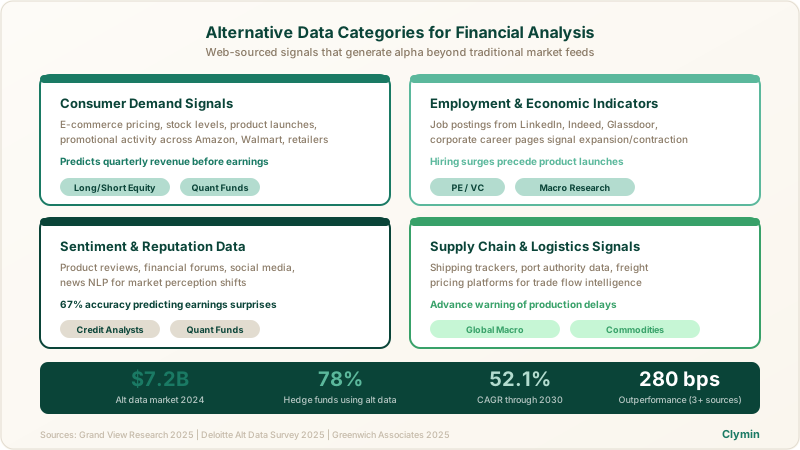
Sentiment and reputation data scraped from product reviews, financial forums, social media, and news sources quantifies market perception shifts. Natural language processing applied to scraped text generates sentiment scores that correlate with stock price movements. A 2025 study published in the Journal of Financial Economics found that aggregated review sentiment predicted earnings surprises with 67% accuracy when combined with fundamental analysis.
Supply chain and logistics signals from shipping trackers, port authority data, and freight pricing platforms reveal bottlenecks and demand shifts in global trade. These signals proved especially valuable during recent supply chain disruptions, giving positioned investors advance warning of production delays.
How Clymin Builds Alternative Data Pipelines for Financial Clients
Building reliable alternative data feeds for finance demands more than basic web scraping. Financial-grade data requires institutional accuracy, consistent delivery, and full audit trails. Clymin's AI-agentic approach means intelligent agents adapt to source changes automatically, maintaining data continuity without manual intervention.
A typical Clymin engagement for a financial client follows three phases. First, Clymin's data specialists work with your research team to identify the specific signals, sources, and delivery cadence that align with your investment thesis. Second, Clymin deploys AI agents configured for each target source, handling anti-bot measures, JavaScript rendering, and data normalization. Third, structured data flows into your analytics environment on schedule, with ongoing monitoring and maintenance handled entirely by Clymin.
Lisa R., a client at a Financial Services firm, reported that decision-making speed improved by 25% after implementing Clymin's structured financial data extraction services. That improvement came from eliminating the weeks-long lag between identifying a valuable data source and receiving production-quality feeds.
Data Quality and Compliance Requirements for Financial Alternative Data
Financial firms face stricter data quality and compliance requirements than most industries. Inaccurate data leads to flawed models. Non-compliant collection practices create regulatory and legal exposure.
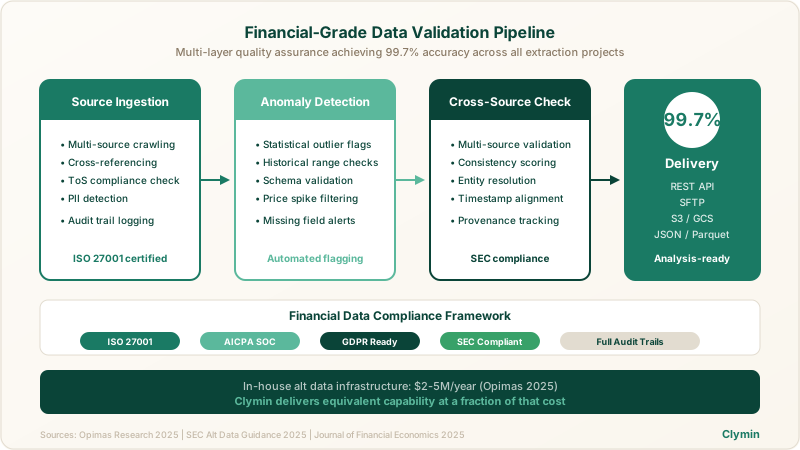
Clymin addresses data quality through multi-layer validation. Every record passes through automated anomaly detection, schema validation, and cross-source consistency checks. Clymin maintains a 99.7% accuracy rate across extraction projects, validated through regular manual audits alongside automated monitoring.
Compliance is built into every financial data engagement. Key compliance measures include:
- ISO 27001 certification and AICPA SOC compliance for data handling security
- Pre-engagement review of each data source against terms of service and regulatory requirements
- PII detection and redaction for datasets that may inadvertently contain personal information
- Complete audit trails documenting collection methodology, source URLs, timestamps, and data transformations
- Adherence to SEC guidelines regarding material nonpublic information, Clymin only extracts publicly available data
According to the SEC's 2025 guidance on alternative data usage, investment firms bear responsibility for ensuring their data sources do not contain material nonpublic information. Clymin's compliance framework helps financial clients meet this obligation by providing full transparency into data provenance.
Clymin's multi-layer validation ensures financial-grade data accuracy across all alternative data feeds
Alternative Data Use Cases Across Financial Strategies
Different investment strategies derive value from different alternative data signals. Clymin tailors extraction pipelines to the specific strategy and asset class.
Long/short equity funds use consumer demand signals and sentiment data to identify companies outperforming or underperforming market expectations before earnings announcements. Tracking real-time product pricing and availability across retail platforms provides revenue proxies that supplement traditional channel checks.
Quantitative and systematic funds incorporate alternative data features into multi-factor models. Web-scraped signals like job posting velocity, app download trends, and pricing elasticity become alpha factors when combined with traditional financial data. According to Greenwich Associates' 2025 survey, quantitative funds using three or more alternative data sources outperformed peers by an average of 280 basis points annually.
Credit and fixed income analysts leverage alternative data to assess borrower health beyond financial statements. Consumer sentiment shifts, employee review trends on Glassdoor, and supplier payment data scraped from public filings provide early warning signals for credit deterioration.
Private equity and venture capital firms use web-scraped data for deal sourcing and due diligence. Tracking startup hiring patterns, product traction signals, and competitive landscape data helps identify investment opportunities and validate growth trajectories before committing capital.
Why Financial Firms Choose Clymin Over Building In-House
Building and maintaining alternative data infrastructure in-house requires a dedicated engineering team, proxy infrastructure, anti-bot expertise, and ongoing maintenance as source websites change. Most financial firms find that this distraction from core investment activities is not worth the overhead.
Clymin eliminates technical complexity entirely. Financial clients receive production-quality alternative data feeds without hiring scrapers, managing infrastructure, or troubleshooting broken crawlers. Clymin has served 40+ customers and completed hundreds of projects across industries, accumulating extraction expertise that no single in-house team can replicate.
The cost comparison reinforces the managed service model. A 2025 Opimas research report estimated that building an in-house alternative data capability costs financial firms $2-5 million annually when accounting for engineering headcount, infrastructure, data quality assurance, and compliance overhead. Clymin's project-based pricing delivers equivalent capability at a fraction of that cost.
Sources
- Grand View Research, "Alternative Data Market Size, Share & Trends Analysis Report," 2025
- Deloitte, "Alternative Data in Investment Management Survey," 2025
- Journal of Financial Economics, "Sentiment-Driven Earnings Prediction Using Web-Sourced Data," 2025
- SEC, "Commission Guidance on Alternative Data and Material Nonpublic Information," 2025
- Greenwich Associates, "Alternative Data Adoption and Performance Impact in Quantitative Funds," 2025
- Opimas Research, "The Cost of Building Alternative Data Infrastructure," 2025
Start Building Your Alternative Data Pipeline
Book a consultation with Clymin's financial data team to scope the alternative data signals that align with your investment strategy. Reach out directly at contact@clymin.com for a free assessment of your current data gaps. Clymin delivers the web-sourced intelligence that financial firms need to generate alpha in 2026, structured, compliant, and ready for analysis.