
Why Price Monitoring Matters More in 2026 Than Ever Before
Online retail pricing has become a moving target. Amazon adjusts prices on millions of products several times daily, and mid-market competitors increasingly deploy their own dynamic pricing engines. According to Statista's 2025 Global Ecommerce Forecast, the average online product category now has 30 to 50 active sellers competing on price at any given time.
For ecommerce startup CEOs, the implication is stark: pricing decisions based on weekly or monthly competitor checks are decisions based on outdated data. A Forrester 2024 study on pricing automation found that retailers relying on periodic manual reviews leave 2% to 7% of margin on the table compared to those with continuous price intelligence.
The shift is not optional. Deloitte's 2025 Retail Industry Outlook reported that 71% of online shoppers compare prices across at least three stores before purchasing. Stores that cannot match or strategically respond to competitor price changes lose these buyers at checkout.
How Does Price Monitoring Improve Profit Margins?
Automated price monitoring improves margins through three direct mechanisms: competitive repricing, MAP violation detection, and promotional timing.
Competitive repricing allows stores to adjust prices based on real-time competitor data rather than gut instinct. A 2024 McKinsey pricing study found that data-driven repricing increases gross margins by an average of 3.5% within the first six months. For an online store generating $10 million in annual revenue, that represents $350,000 in recovered profit.
MAP (Minimum Advertised Price) violation detection protects brand value. When competitors undercut MAP agreements, monitoring tools flag the violation immediately, enabling enforcement action before discounted prices erode perceived product value across the market.
Promotional timing intelligence reveals when competitors launch sales, clear inventory, or raise prices due to stock constraints. Stores that detect a competitor's stockout can temporarily increase their own price on the same product, capturing higher margin while demand shifts to available sellers.
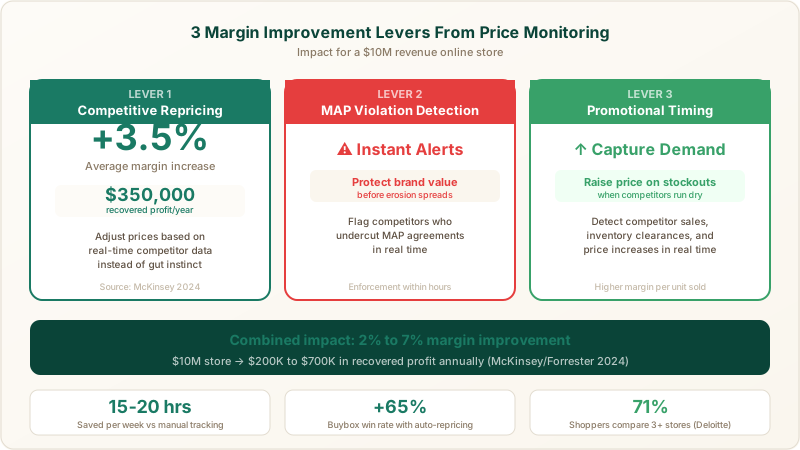
Three direct margin improvement levers from automated price monitoring for a $10M revenue online store.
What Operational Benefits Does Price Monitoring Deliver?
Beyond margin gains, price monitoring eliminates a significant operational burden. Pricing teams at mid-size online retailers spend 15 to 20 hours per week manually checking competitor sites, copying prices into spreadsheets, and formatting data for analysis. Automating this process frees that time for strategic work, analyzing trends, planning promotions, and negotiating with suppliers.
Data quality improves dramatically as well. Manual price checks suffer from human error, inconsistent timing, and limited coverage. An automated system captures every price change, including off-hours adjustments that happen overnight or on weekends when no one is watching.
Clymin's ecommerce price scraping service delivers this operational advantage as a fully managed solution. AI agents handle site changes, anti-bot protections, and data normalization, so pricing teams receive clean, structured datasets without maintaining any scraping infrastructure internally.
Why Monitor Competitor Prices for Buybox and Marketplace Wins?
Marketplace sellers on Amazon, Walmart, and similar platforms compete directly for the buybox, the default purchase option that captures roughly 80% of sales on a given product listing. Buybox algorithms weigh price heavily alongside fulfillment speed and seller rating.
Price monitoring gives marketplace sellers the visibility to adjust pricing within the competitive band that wins the buybox without sacrificing margin unnecessarily. According to Feedvisor's 2024 Amazon Seller Report, sellers using automated repricing tools win the buybox 65% more often than those repricing manually.
For multi-channel retailers selling on their own site and on marketplaces, monitoring also prevents channel conflict. Consistent pricing across channels protects brand trust and avoids marketplace policy violations that can result in listing suppression.
How Can Startups Build a Business Case for Price Monitoring?
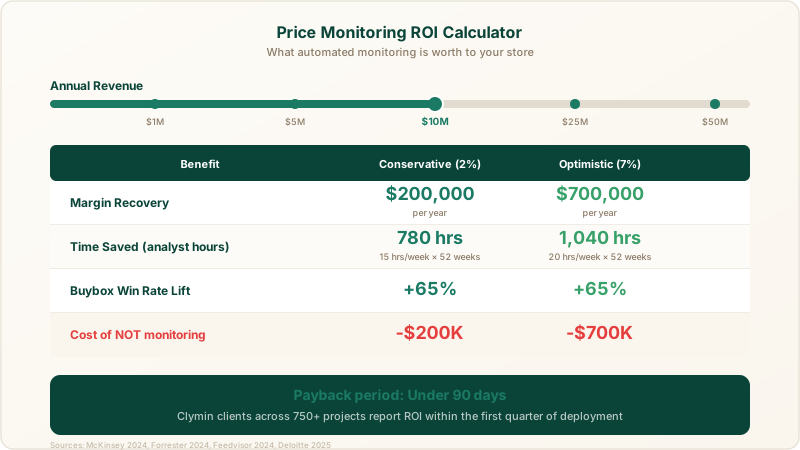
Ecommerce startup CEOs evaluating price monitoring should frame the investment against three measurable outcomes: margin recovery, time savings, and competitive win rate.
Evidence supporting the business case:
- McKinsey's 2024 pricing research: data-driven pricing lifts margins 2% to 7%
- Forrester's 2024 automation study: automated tracking saves 15-20 hours/week per pricing team
- Feedvisor's 2024 marketplace analysis: automated repricing increases buybox win rate by 65%
The cost of not monitoring is equally quantifiable. A startup with $5 million in revenue leaving 3% margin on the table forfeits $150,000 annually, likely more than the cost of a managed price monitoring service. Clymin's clients across hundreds of projects have consistently reported that structured pricing intelligence pays for itself within the first quarter of deployment.
"Clymin's data insights helped us boost revenue by 20% through real-time market trend and competitor pricing analysis.", Sarah T., Marketing Manager
How Clymin Helps Online Stores Monitor Prices at Scale
Clymin provides a fully managed approach to competitor price tracking that eliminates the build-versus-buy dilemma for ecommerce teams. Rather than assembling internal scraping tools or relying on brittle SaaS dashboards, startup CEOs get clean pricing data delivered on schedule, hourly, daily, or custom, across any number of competitor storefronts.
With 40+ customers served and 100B+ data points extracted over a decade, Clymin's AI-agentic technology adapts to site redesigns, anti-bot defenses, and dynamic pricing pages without manual intervention. The result is pricing intelligence that stays accurate as the competitive landscape shifts.
Ready to See Your Price Monitoring ROI?
If your online store competes on price, and in 2026, every store does, automated competitor monitoring is the highest-leverage investment your pricing team can make. Get a free consultation with Clymin to see how structured pricing intelligence can protect and grow your margins. Reach us at contact@clymin.com.