
Why Alternative Data Sources Matter More Than Ever for Investors
Traditional financial data, earnings reports, SEC filings, analyst estimates, reaches every market participant simultaneously. Alternative data sources break this symmetry by providing signals that are not yet priced into public markets. According to Grand View Research's 2025 Alternative Data Market Report, the global alternative data industry grew 29% year-over-year and is projected to exceed $9.3 billion by 2028.
Financial analysts at hedge funds, asset managers, and fintech companies in San Francisco, New York, and London are increasingly competing on data acquisition speed. A 2025 survey by Greenwich Associates found that 82% of systematic hedge funds now use at least one alternative data source, up from 52% in 2021.
The challenge is not finding alternative data, it is extracting, cleaning, and integrating it fast enough to act before the signal decays. Raw web data is messy, unstructured, and constantly changing, which is why firms turn to managed extraction services like those Clymin provides through its AI-agentic scraping approach.
What Are the Most Valuable Alternative Data Sources in 2026?
Alternative data sources for investment decisions fall into several categories, each offering distinct alpha-generating signals. The most actionable categories in 2026 are web-scraped commercial data, sentiment analytics, and geospatial intelligence.
Web-scraped pricing and product data. Real-time price tracking across e-commerce platforms, airline booking sites, and SaaS pricing pages reveals demand shifts weeks before quarterly earnings. A quantitative researcher can monitor pricing changes across 10,000+ SKUs daily to predict revenue trends for publicly traded retailers.
Social media and news sentiment. Natural language processing applied to Twitter, Reddit, StockTwits, and financial news feeds generates sentiment scores that correlate with short-term price movements. According to J.P. Morgan's 2025 Big Data and AI Strategies report, NLP-based sentiment signals have shown a Sharpe ratio improvement of 0.15-0.30 when combined with traditional momentum factors.
Satellite and geospatial data. Parking lot occupancy counts, shipping container movements, and construction activity tracking from satellite imagery provide physical-world demand signals. Orbital Insight estimates that satellite-derived datasets influenced over $150 billion in investment decisions in 2025.
Credit card transaction data. Aggregated and anonymized transaction data from payment processors reveals real-time consumer spending patterns by merchant, category, and geography. Second Measure and Earnest Research are prominent providers, but raw transaction signals can also be derived from public filings and scraped merchant data.
App download and usage metrics. Mobile app download rankings, daily active user estimates, and in-app engagement metrics predict platform growth before it appears in financial statements. SensorTower and data.ai remain the primary sources, supplemented by web-scraped app store data.
Job posting and hiring data. Tracking job postings across LinkedIn, Indeed, and company career pages reveals expansion plans, new product launches, and headcount trends at public companies. A spike in machine learning engineer postings at a biotech firm, for example, may signal an upcoming AI-driven drug discovery initiative.
How Do Investment Firms Build an Alternative Data Pipeline?
Building an effective alternative data pipeline requires five core capabilities: data acquisition, cleansing, storage, integration, and signal generation. Each stage presents unique challenges for financial firms.
Evidence supporting this:
- According to Deloitte's 2025 Alternative Data Adoption Survey, 67% of buy-side firms cite data quality as their top challenge with alternative datasets
- McKinsey's Global Institute estimates that only 12% of the alternative data collected by financial firms is ever used in production models
- Clymin's internal benchmarks show that raw web data requires an average of 3.5 transformation steps before it is usable for quantitative analysis
Data acquisition
Firms must identify which websites, apps, and platforms contain decision-relevant signals. For web-scraped data, this means building and maintaining scrapers that handle anti-bot measures, dynamic content loading, and frequent site redesigns. Managed services eliminate this operational overhead entirely.
Data cleansing and normalization
Raw scraped data contains duplicates, missing fields, inconsistent formats, and noise. Financial-grade data requires rigorous deduplication, entity matching (mapping merchant names to stock tickers), and time-series normalization.
Integration with existing models
Clean alternative datasets must feed into quantitative models, risk systems, or analyst dashboards through APIs, database connections, or cloud storage delivery. Clymin delivers structured data via REST API, CSV, JSON, or direct database integration, matching whatever infrastructure a firm already uses.
What Makes Web Scraping the Fastest-Growing Alternative Data Source?
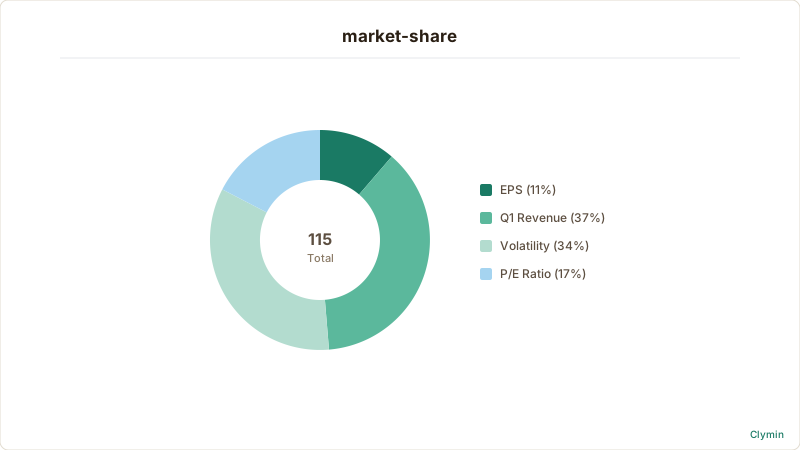
Web scraping has overtaken satellite data and credit card feeds as the most widely adopted alternative data acquisition method for investment firms. According to Opimas Research's 2025 Alternative Data Market Study, web-scraped datasets account for 38% of all alternative data spending by buy-side firms, up from 24% in 2022.
Three factors drive this growth. First, the breadth of available web data is unmatched. Pricing data, product catalogs, job postings, reviews, government filings, and corporate announcements all live on the public web. Second, web data is refreshable at any frequency, hourly, daily, or in real time, compared to satellite passes or monthly credit card aggregates. Third, web scraping costs significantly less than Bloomberg terminals and proprietary data feeds for many use cases.
Alternative data spending by acquisition method, web scraping leads at 38% of buy-side budgets in 2026
Clymin has extracted over 100 billion data points across industries, bringing the same enterprise-grade reliability to financial data extraction that it delivers for e-commerce and travel intelligence. Financial clients benefit from Clymin's ISO 27001 certification and AICPA SOC compliance, critical requirements for firms handling market-sensitive data.
How to Evaluate Alternative Data Providers for Your Fund
Choosing the right alternative data provider requires evaluating six dimensions that directly impact investment performance.
Data freshness. How frequently is the data updated? For web-scraped data, daily or intra-day delivery is the standard. Stale data produces stale signals.
Coverage breadth. Does the provider cover the geographies, platforms, and data types relevant to your strategy? A provider that only covers US e-commerce sites will not help a global macro fund.
Historical backfill. Quantitative researchers need historical data to backtest strategies. Ask whether the provider offers 2-5 years of historical data and at what cost.
Compliance and provenance. Data provenance matters. Ensure the provider can document where data comes from, confirm it was collected from public sources, and demonstrate GDPR and privacy regulation compliance. Clymin maintains full audit trails for all extraction projects.
Integration flexibility. Data delivered as a CSV attachment is not sufficient for systematic funds. Look for API access, cloud storage delivery, and database-ready formats.
Signal decay analysis. The best providers help quantify how quickly their data's predictive power decays. A pricing signal that decays within 2 hours requires real-time delivery infrastructure; a job posting signal with a 2-week decay can be delivered daily.
How Clymin Powers Alternative Data for Financial Firms
Clymin provides financial analysts and quantitative researchers with managed web scraping for investment research that eliminates the operational burden of building and maintaining custom scrapers. Rather than hiring a data engineering team to manage scraper infrastructure, firms receive clean, structured datasets delivered on their preferred schedule through API or direct database integration.
With over a decade of experience and hundreds of projects delivered, Clymin brings proven extraction capabilities across financial data sources, from SEC EDGAR filings to e-commerce pricing feeds. Decision-making speed has improved by 25% for financial services clients using Clymin's structured data extraction, according to client benchmarks.