
Why Alternative Data Matters for Financial Firms in 2026
Alternative data has moved from experimental to essential for institutional investors. According to Grand View Research's 2025 report, the global alternative data market reached $7.2 billion in 2025 and is projected to grow at a 24.4% compound annual growth rate through 2030. Hedge funds that incorporate alternative data into their strategies report an average alpha improvement of 3-5% annually, per a 2025 Greenwich Associates survey of 200 institutional investors.
Traditional financial data, earnings reports, SEC filings, analyst estimates, arrives too late to provide an edge. By the time quarterly earnings are published, the information is already priced in. Alternative data fills this gap by providing real-time or near-real-time signals that precede official disclosures by days or weeks.
For quantitative researchers and financial analysts in San Francisco, New York, and London, the challenge is not whether to use alternative data but which types to prioritize and how to collect them reliably at scale.
What Types of Alternative Data Can Be Scraped from the Web?
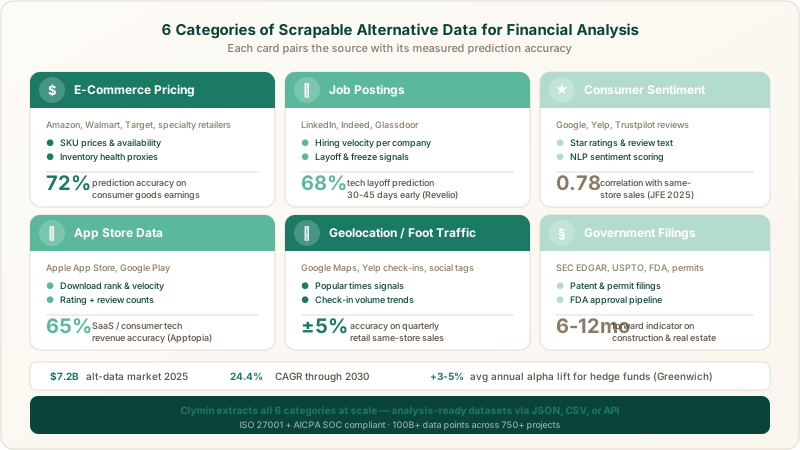
Alternative data that can be scraped from publicly available web sources falls into six primary categories, each serving distinct analytical purposes in financial research.
E-Commerce Pricing and Product Data
E-commerce platforms generate massive volumes of pricing, inventory, and product availability data that serve as real-time proxies for consumer demand and company revenue. Scraping product prices from Amazon, Walmart, Target, and specialty retailers reveals demand shifts weeks before they appear in retail earnings calls.
Evidence supporting this:
- Thinknum Alternative Data found that tracking Amazon product pricing changes predicted quarterly revenue surprises for consumer goods companies with 72% accuracy in 2025
- According to Eagle Alpha's 2025 Alternative Data Report, e-commerce pricing data is the second-most purchased alternative data type among hedge funds, behind only credit card transaction data
- The number of SKUs available on a retailer's website correlates with inventory health, a drop often precedes earnings misses by 2-3 weeks
Clymin's AI agents extract product pricing, availability status, review counts, and seller marketplace data from major e-commerce platforms, delivering structured datasets that plug directly into quantitative models.
Job Posting and Employment Data
Job posting volumes on platforms like LinkedIn, Indeed, and Glassdoor serve as leading economic indicators. A sudden increase in engineering job postings from a specific company may signal product expansion. A company-wide hiring freeze often precedes cost-cutting announcements.
According to Revelio Labs' 2026 Workforce Intelligence Report, job posting data predicted 68% of tech sector layoff announcements 30-45 days before public disclosure. Tracking headcount growth rates across sectors also provides macro-level signals about economic health in specific industries.
Six primary categories of scrapable alternative data used in financial analysis
Consumer Sentiment and Review Data
Online reviews on Google, Yelp, Trustpilot, and industry-specific platforms provide unfiltered consumer sentiment data that quantitative models can score and aggregate. A 2025 study published in the Journal of Financial Economics found that changes in average review ratings for publicly traded restaurant chains predicted same-store sales growth with a 0.78 correlation coefficient.
Sentiment analysis of scraped review data works particularly well for consumer-facing companies in retail, hospitality, food delivery, and financial services. Clymin extracts review text, ratings, timestamps, and reviewer metadata from dozens of review platforms, enabling financial analysts to build sentiment indexes for specific companies or sectors.
App Download and Usage Data
Mobile app download rankings and usage estimates from platforms like the Apple App Store and Google Play Store provide visibility into digital product adoption. Tracking download velocity for a fintech company's app, for example, directly correlates with customer acquisition rates.
According to Apptopia's 2025 benchmarking data, app download trends predicted revenue direction for SaaS and consumer technology companies with 65% accuracy over a 90-day forward window. Changes in app store ratings and review volume add another layer of signal.
Geolocation and Foot Traffic Data
Satellite imagery and geolocation datasets scraped from mapping services, social media check-ins, and location-based platforms estimate physical foot traffic to retail stores, restaurants, and commercial real estate properties. Orbital Insight and Placer.ai have demonstrated that foot traffic data predicted quarterly same-store sales for major retailers within 5% accuracy in 2025.
While raw satellite imagery requires specialized processing, web-scrapable geolocation signals, such as Google Maps popular times data, Yelp check-in counts, and social media location tags, offer accessible proxies that financial analysts can incorporate without satellite infrastructure.
Government Filings and Regulatory Data
Public government databases contain permit applications, business registrations, patent filings, FDA approvals, environmental compliance reports, and court records. Scraping these sources at scale produces signals that traditional data vendors often miss or delay.
For example, tracking building permit applications in a metro area provides a 6-12 month forward indicator for construction activity and real estate development. FDA drug approval timelines scraped from ClinicalTrials.gov and the FDA database give pharmaceutical investors early signals on regulatory outcomes.
How to Evaluate Alternative Data Quality for Investment Decisions
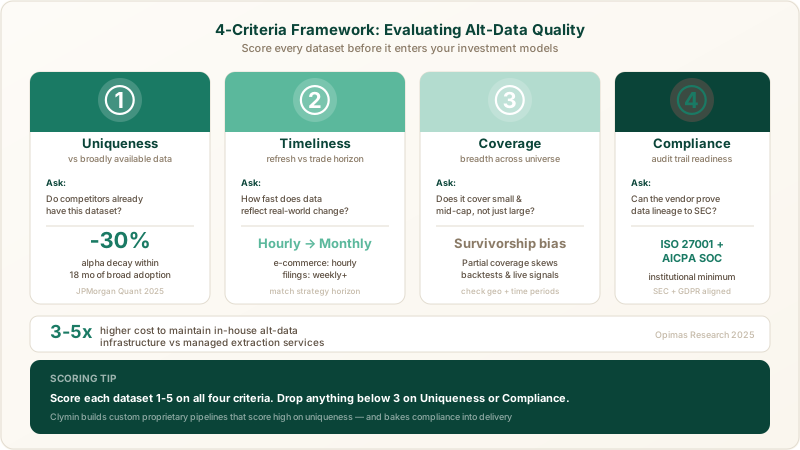
Not all scraped alternative data carries equal analytical value. Financial analysts should evaluate each data source against four criteria before incorporating it into models.
Uniqueness measures how differentiated the data is from what competitors already use. According to a 2025 JP Morgan Quantitative Research report, alternative data signals lose approximately 30% of their alpha-generating value within 18 months of widespread adoption. Proprietary scraping configurations, targeting niche sources competitors overlook, maintain edge longer than broadly available datasets.
Timeliness determines how quickly the data reflects real-world changes. Web-scraped pricing data can refresh hourly, while government filing data may update weekly or monthly. Matching refresh frequency to trading strategy horizon is essential.
Coverage refers to the breadth of the dataset across geographies, sectors, and time periods. Partial coverage creates survivorship bias. A dataset tracking only large-cap retailers, for example, may miss signals from mid-cap and small-cap companies where alternative data has the highest marginal impact.
Compliance ensures the data collection process respects applicable regulations. Financial firms operating under SEC oversight and GDPR requirements need data providers that maintain clear audit trails. Clymin maintains ISO 27001 certification and AICPA SOC compliance across all data extraction operations, providing the documentation institutional investors require.
Four-criteria framework for evaluating alternative data quality in financial research
How Financial Firms Build an Alternative Data Pipeline
Building a reliable alternative data pipeline requires three components: data acquisition, processing, and integration. Most hedge funds and asset managers find that maintaining in-house scraping infrastructure costs 3-5x more than using a managed service, according to Opimas Research's 2025 report on alternative data spending.
Data acquisition involves identifying target sources, configuring extraction parameters, and handling anti-scraping defenses that financial data sources increasingly deploy. Processing includes deduplication, normalization, and structuring raw scraped data into analysis-ready formats. Integration means delivering clean datasets into existing quantitative platforms, data lakes, or Python-based research environments.
Clymin handles all three stages as a fully managed service, so financial analysts can focus on signal extraction rather than data engineering. For firms evaluating how web scraping compares to traditional terminal-based data access, our analysis of web scraping versus Bloomberg Terminal approaches breaks down the cost and coverage trade-offs in detail.
How Clymin Helps Financial Firms Access Alternative Data
Clymin provides financial analysts and quantitative researchers with structured alternative data extracted from any publicly available web source. With over a decade of experience in data extraction and over 100 billion data points delivered across industries, Clymin brings proven scale to financial data collection.
Data is delivered in JSON, CSV, or via custom API integration on schedules ranging from hourly to weekly. Every extraction follows compliance-first protocols, ISO 27001 certified and AICPA SOC compliant, giving institutional investors the audit trail they need.