
OTA-Funded Discounting Undermines Direct Rates
OTA platforms sometimes fund discounts from their own commission margins, displaying rates below the hotel's direct channel price. These OTA-funded discounts technically violate rate parity agreements but are difficult to detect without systematic monitoring.
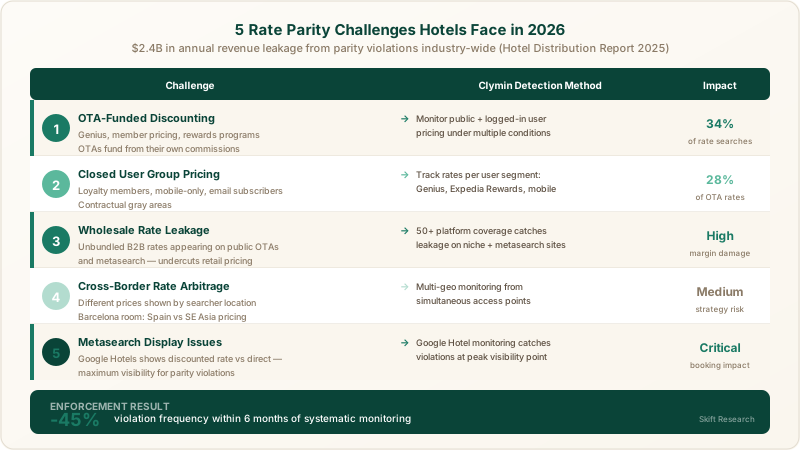
Booking.com's Genius program, Expedia's member pricing, and Hotels.com's rewards system all create situations where logged-in users see lower rates than the hotel's own website displays. The Hotel Distribution Report 2025 estimated these programs affect 34% of rate searches.
Clymin monitors both public and logged-in user pricing to detect funded discounting. The hotel rate scraping service captures rates under multiple user conditions to identify parity violations that surface-level monitoring misses.
Closed User Group Pricing Creates Gray Areas
OTAs increasingly offer discounted rates to specific user groups, loyalty members, mobile app users, email subscribers, that technically fall outside standard rate parity agreements. Revenue managers struggle to determine which discounts violate contracts and which exploit contractual loopholes.
Clymin tracks rates across user group segments, documenting the exact pricing displayed to Genius members, Expedia Rewards participants, and mobile-only users. Evidence reports include timestamps, user conditions, and rate comparisons against the hotel's direct pricing.
Phocuswright's 2025 analysis found that closed user group pricing affects 28% of OTA hotel rates, creating a significant challenge for distribution managers seeking to maintain rate integrity.
Wholesale Rate Leakage Into Public Channels
Hotels provide discounted wholesale rates to tour operators and travel agencies for packaging with flights and ground transportation. Rate leakage occurs when these wholesale rates appear unbundled on public OTA platforms, undercutting the hotel's retail pricing.
Detecting wholesale leakage requires monitoring not just major OTAs but dozens of smaller platforms and metasearch engines where leaked rates surface. Clymin's comprehensive platform coverage catches leakage that single-OTA monitoring misses entirely.
Leaked wholesale rates appearing on Google Hotel Search cause particular damage because travelers see the discounted rate alongside the hotel's full retail price. Clymin's monitoring extends to metasearch platforms to catch leakage at the point of maximum visibility.
Cross-Border Rate Arbitrage
OTA platforms display different rates based on the searcher's geographic location. A hotel room in Barcelona may show one price to users searching from Spain and a lower price to users searching from Southeast Asia. These geographic rate differences create arbitrage opportunities that undermine pricing strategies.
Clymin monitors rates from multiple geographic access points simultaneously, detecting cross-border pricing discrepancies. Revenue managers receive alerts when location-based rate differences exceed acceptable thresholds.
Enforcement Requires Systematic Evidence
Rate parity enforcement depends on documented evidence, screenshots, timestamps, rate comparisons, and access conditions. Manual monitoring produces incomplete evidence because human auditors cannot check every OTA, every rate, every day.
Clymin's automated monitoring generates comprehensive violation reports automatically. Each report includes the OTA platform, displayed rate, hotel direct rate, rate difference, access conditions, and extraction timestamp.
Distribution managers armed with systematic evidence negotiate more effectively with OTA partners. Skift Research found that hotels using automated parity monitoring reduce violation frequency by 45% within six months through consistent enforcement.
Start Protecting Rate Parity
Contact Clymin at contact@clymin.com or book a meeting to implement comprehensive rate parity monitoring across your distribution channels.