Why AI Teams Need Web-Scraped Training Data
Model quality depends on the quality, volume, and freshness of training data, and much of that data lives on the open web. According to Epoch AI's 2024 research, the stock of high-quality public text used to train large models could be effectively exhausted within a few years, which pushes teams toward carefully targeted, well-filtered collection rather than indiscriminate scraping. According to IDC's 2024 Global DataSphere research, the volume of data created worldwide keeps growing steeply, yet only a small fraction is high-quality and usable for training, so targeted collection and filtering, not raw volume, is the real bottleneck. Getting the right data, cleaned and compliant, has become a competitive edge.
Building that collection in-house pulls machine learning engineers into proxy management, parser maintenance, and cleaning work that is not their core job. Clymin removes that burden by running the extraction as a managed pipeline and delivering datasets that are ready to train on.
What Data You Can Collect for AI Training
Training and fine-tuning need different data shapes, and the open web supplies most of them. The key is collecting the right subset for the task rather than everything, then filtering hard for quality.
The data types most used for AI training:
- Text corpora from articles, documentation, forums, and reviews for language models.
- Images and metadata for computer vision and multimodal models.
- Structured and tabular data such as product catalogs and specifications.
- Domain-specific content for fine-tuning models on a niche or industry.
Clymin extracts any of these at scale and delivers them in the formats a training pipeline expects. For the underlying approach, see Clymin's main data extraction service and the explainer on what AI data extraction is.
Quality matters more than raw quantity. A smaller, well-filtered corpus that matches the task usually trains a better model than a larger, noisy one, and it costs less to collect and store. Defining the target sources and filters up front, rather than scraping everything and sorting later, is what separates a useful dataset from an expensive one.
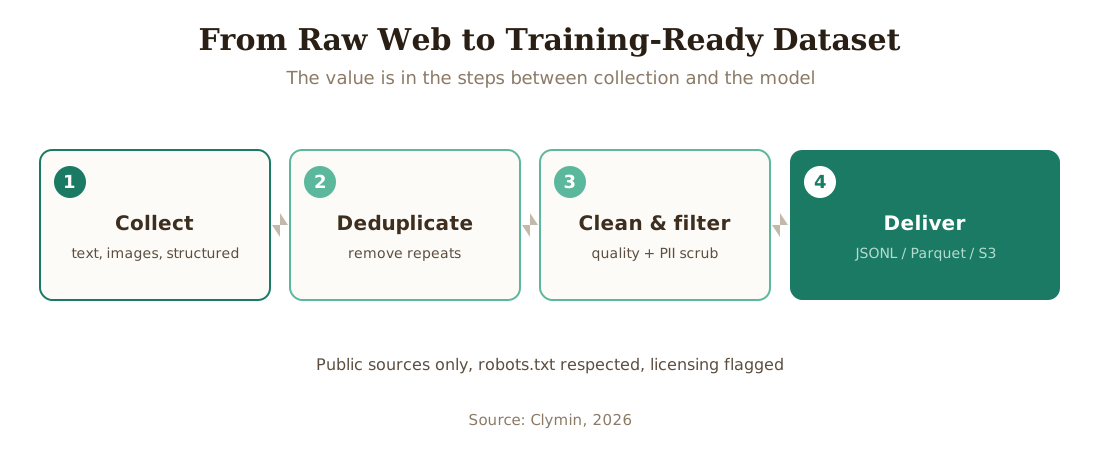 Training data is a pipeline: collect from public sources, deduplicate, clean and filter, then deliver in training-ready formats.
From Raw Web to Training-Ready Dataset
Raw scraped data is not training data. The value is in the steps between collection and the model: deduplication, boilerplate and noise removal, quality and language filtering, format normalization, and personal-data scrubbing. Skipping these steps degrades model performance and introduces risk.
Clymin folds this processing into delivery. You define the sources and filters, and receive cleaned, deduplicated datasets in formats like JSONL or Parquet, refreshed on your schedule. That means your team spends time on modeling, not on data plumbing. For how the managed model works, see what managed web scraping is.
How Teams Use Web-Scraped Training Data
Web-scraped data feeds several stages of the model lifecycle, and each stage wants a different slice. Pretraining large language models needs broad, deduplicated text at volume. Fine-tuning needs smaller, high-quality, domain-specific corpora that teach a model a task, tone, or vocabulary. Retrieval systems (RAG) need current, structured knowledge that is refreshed on a schedule rather than frozen at training time.
Computer vision and multimodal models need images paired with clean metadata and captions. Evaluation and benchmarking need held-out, well-labeled sets that do not leak into the training data. Clymin scopes collection to the stage you are working on, so you are not paying to gather data you will only filter away later.
Compliance for AI Training Data
AI training data sits in a fast-moving legal area, so compliance is central, not an afterthought. Clymin collects only publicly available data, respects robots.txt directives and rate limits, avoids authenticated sources and sensitive personal data, and flags content that likely requires licensing so you can decide how to proceed.
A simple screen keeps collection defensible. If data is publicly visible without logging in, is not personal or sensitive, and is not bulk copyrighted content, it is usually safe to collect for internal use. Anything behind a login, personal in nature, or clearly licensed should be reviewed or licensed before use. Clymin applies this screen to every source and surfaces the gray areas rather than deciding them for you.
Clymin operates under ISO 27001 certification and GDPR-ready and CCPA-aware practices. That discipline protects your organization as rules around AI and copyrighted or personal data continue to evolve. For the broader category and where extraction fits, see best data extraction services.
How Clymin Fits In
Clymin is a managed data extraction service operating from offices in San Francisco and Hyderabad, serving customers across the United States, India, and globally. With 12+ years on the hardest sources, 100 billion-plus records delivered, and 99.9% pipeline uptime, Clymin turns the public web into clean, compliant training datasets at scale.
You define the sources, data types, and filters. Clymin builds the extraction, cleans and deduplicates the output, and delivers training-ready data on your schedule, billed on one metric: cost per record delivered.
Ready to Build Your Training Dataset?
Tell us the sources and data types you need, and Clymin will run a free pilot and deliver a sample training dataset before you pay anything. Email contact@clymin.com or start a free pilot, one metric, cost per record delivered, no setup fees.