
Why Internal Booking Data Alone Falls Short
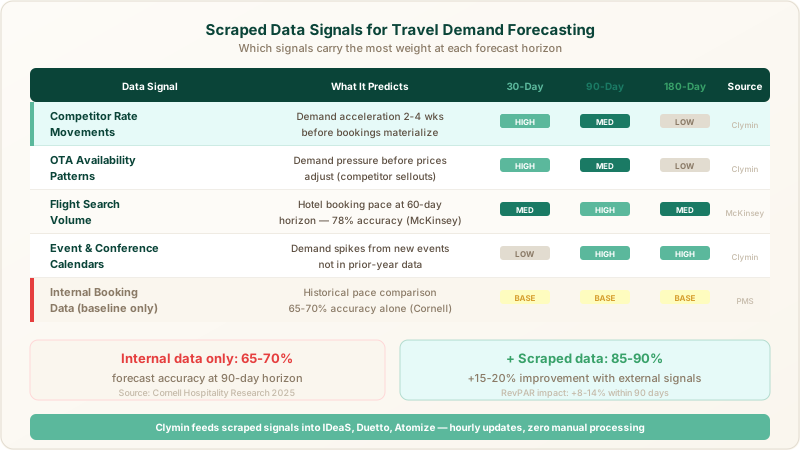
Revenue managers traditionally forecast demand using their own property's historical booking curves, comparing current pace to the same period last year and adjusting for known events. Cornell Hospitality Research's 2025 pricing study found that internal-only forecasting models achieve 65-70% accuracy at the 90-day horizon.
External data dramatically improves these predictions. When competitors raise rates or sell out specific room categories, incoming demand is accelerating. When competitors drop prices aggressively, market softening requires preemptive adjustments.
Clymin's hotel rate scraping service provides the external data layer that transforms forecasting models from reactive to predictive.
What External Data Signals Improve Forecast Accuracy?
Competitor rate movements serve as the strongest leading indicator. Rate increases across the competitive set signal rising demand 2-4 weeks before bookings materialize at your property. Clymin monitors rate changes across 10-15 competitors per market in real time.
OTA availability patterns reveal demand before price changes occur. When competitors sell out standard rooms and only suites remain, demand pressure is building. Availability monitoring catches these signals before competitors adjust published rates.
Flight search volume for destination airports correlates strongly with future hotel demand. A McKinsey 2025 Travel Analytics report found that airline search volume predicts hotel booking pace with 78% accuracy at the 60-day horizon.
Event and conference calendars create demand spikes that historical models underestimate when new events are added. Clymin scrapes event listing platforms to detect conferences and festivals not present in prior-year data.
How Do Predictive Models Use Scraped Data?
Machine learning models combine scraped external signals with internal booking data to produce demand forecasts across multiple time horizons. The models weight different signals based on their predictive power at each forecast distance.
At the 30-day horizon, competitor rate movements and OTA availability carry the highest predictive weight. At the 90-day horizon, flight search trends and event calendars become more important. At the 180-day horizon, seasonal patterns and macroeconomic indicators dominate.
Clymin delivers scraped data in formats compatible with revenue management systems including IDeaS, Duetto, and Atomize. Automated feeds update forecasting models with fresh competitor intelligence every hour without manual data processing.
What Results Can Hotels Expect From Better Forecasting?
Hotels implementing scraped-data-enhanced forecasting through Clymin report measurable improvements within 90 days. Phocuswright's 2025 analysis documented three primary gains: more accurate pricing during demand surges, earlier detection of soft periods requiring promotional intervention, and improved group pricing for events and conferences.
Revenue per available room improvements of 8-14% are typical for properties that combine Clymin's data feeds with modern revenue management platforms. The gains compound over time as models train on longer data histories and learn market-specific patterns.
Operational efficiency improves as well. Revenue managers spend less time manually researching competitor rates and more time interpreting model recommendations and making strategic decisions. Learn about automated rate monitoring for the real-time data infrastructure that powers forecasting.
Getting Started With Data-Driven Forecasting
Clymin configures scraped data feeds for demand forecasting within 5 business days. Contact the team at contact@clymin.com or book a meeting to discuss your forecasting requirements and competitive set.