
Why Real-Time Stock Data Scraping Matters in 2026
Financial markets generate massive volumes of data every second, and the firms that capture and structure this data fastest gain a measurable edge. According to Greenwich Associates' 2025 Market Structure report, 78% of institutional investors now use alternative data sources alongside traditional market feeds to inform trading decisions. Manual data collection cannot keep pace with this demand.
The alternative data market reached $7.4 billion in 2025 and is projected to grow to $9.1 billion by end of 2026, according to Grand View Research. Hedge funds, asset managers, and fintech companies in San Francisco, New York, and London are increasingly relying on automated stock data scraping to supplement expensive terminal subscriptions and build proprietary datasets.
Real-time stock data scraping fills a critical gap between premium exchange feeds (which cost $50,000-$500,000 annually) and free delayed data (which arrives 15-20 minutes late). Managed extraction services from providers like Clymin deliver near-real-time structured data at a fraction of the cost of direct exchange subscriptions.
What Are the Main Real-Time Stock Data Scraping Methods?
Four primary methods dominate stock data extraction in 2026, each with distinct advantages for different financial use cases.
REST API Polling. Financial data providers like Yahoo Finance, Alpha Vantage, and Polygon.io expose REST APIs that return JSON-formatted stock data. Polling these endpoints at intervals of 1-60 seconds provides reliable coverage for most quantitative research workflows. API rate limits typically range from 5-500 requests per minute depending on the provider and subscription tier.
WebSocket Streaming. WebSocket connections to exchange data providers deliver continuous tick-level updates with sub-second latency. Platforms like Alpaca, Interactive Brokers, and Tradier offer WebSocket feeds covering US equities, options, and crypto markets. According to a 2025 Tabb Group study, WebSocket-based data delivery reduces median latency to 12 milliseconds compared to 800 milliseconds for REST polling.
AI-Powered Web Extraction. Financial portals, regulatory filings, and analyst report platforms often lack public APIs. AI-driven scraping agents navigate these sources, extract structured data from HTML tables and PDFs, and normalize it into analysis-ready formats. Clymin's AI-agentic scraping approach adapts automatically when source websites change their layouts, a critical advantage given that financial sites update their DOM structures an average of 3-4 times per quarter.
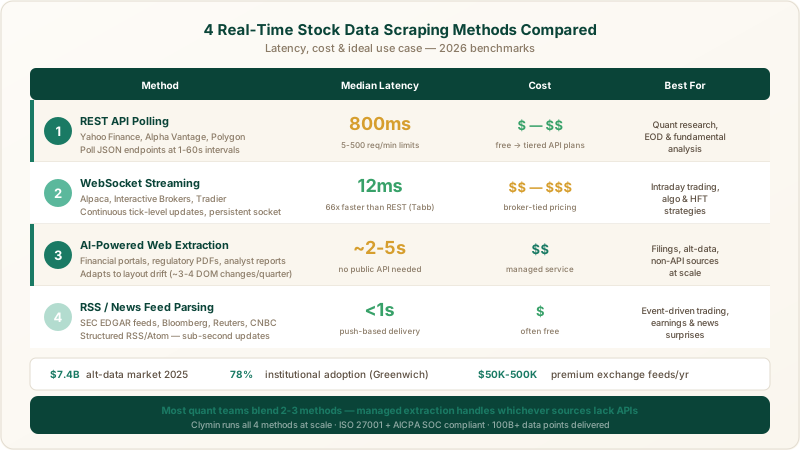
Four primary stock data scraping methods compared by latency, cost, and ideal use case
RSS and News Feed Parsing. Financial news outlets, SEC EDGAR filings, and earnings announcement feeds publish structured RSS/Atom feeds that can be parsed in real time. Combining news feed parsing with stock price extraction enables event-driven trading strategies that react to earnings surprises, regulatory actions, and macroeconomic announcements within seconds of publication.
Which Data Sources Do Financial Analysts Scrape Most?
Financial data scraping targets fall into five categories, each requiring different extraction techniques and compliance considerations.
Exchange and Market Data Sources. Nasdaq, NYSE, and CBOE publish delayed quotes freely, while real-time data requires exchange agreements. According to the SEC's 2025 Market Data Infrastructure report, consolidated tape revenues exceeded $450 million annually, reflecting strong demand for authoritative exchange data. Scraping delayed public quotes remains the most common starting point for firms building alternative data pipelines.
Regulatory Filings. SEC EDGAR hosts over 21 million filings including 10-K annual reports, 13F institutional holdings, and Form 4 insider transaction disclosures. EDGAR data is fully public and machine-readable. Extracting and structuring EDGAR data enables analysts to track insider buying patterns, institutional portfolio shifts, and corporate financial metrics weeks before they appear in aggregated databases.
Financial News and Sentiment. Bloomberg, Reuters, CNBC, and Seeking Alpha publish thousands of market-moving articles daily. Natural language processing applied to scraped news content generates sentiment scores that correlate with short-term price movements. A 2025 Journal of Financial Economics study found that news sentiment signals predicted next-day returns with 58% directional accuracy for S&P 500 stocks.
Options and Derivatives Data. Options chain data including strike prices, implied volatility, open interest, and Greeks provide insight into market expectations. Cboe, Nasdaq, and broker platforms publish options data that can be extracted to build volatility surface models and identify unusual options activity.
Earnings Call Transcripts. Quarterly earnings calls contain forward-looking guidance and management commentary. Extracting and analyzing these transcripts with NLP models enables systematic tracking of management sentiment shifts. Firms seeking structured earnings call data extraction increasingly rely on managed services to handle the complexity of audio transcription and text normalization.
How to Build a Real-Time Stock Data Pipeline
Building a reliable stock data scraping pipeline requires addressing five technical challenges that most financial teams encounter.
Source Selection and Prioritization
Identify which data sources provide the signals your models need. Prioritize sources by latency requirements, data freshness, and legal accessibility. Free public sources like SEC EDGAR and Yahoo Finance delayed quotes cover 60-70% of fundamental analysis needs. Premium API subscriptions fill gaps for intraday and real-time requirements.
Rate Limit Management
Every financial data API enforces rate limits. Exceeding limits results in IP blocks that can disrupt live trading systems. Implement exponential backoff, request queuing, and IP rotation strategies. Clymin manages rate limit compliance automatically across hundreds of financial data sources, preventing the IP bans that typically derail in-house scraping projects.
Data Normalization
Stock data arrives in inconsistent formats across sources, different ticker symbologies (CUSIP, ISIN, FIGI), varying timestamp formats, and conflicting price adjustments for splits and dividends. Normalizing this data into a unified schema is essential before feeding it to analytical models.
Evidence supporting the complexity of financial data normalization:
- The average quant fund integrates data from 15-25 distinct sources, according to Opimas Research's 2025 Alternative Data Survey
- Data cleaning and normalization consume 60-70% of total time in financial data projects, per a 2025 McKinsey analytics workforce study
- Ticker symbol mismatches cause an estimated 3-5% error rate in multi-source financial datasets when normalization is not automated
Storage and Access Layer
Time-series databases like TimescaleDB, InfluxDB, or kdb+ provide the query performance required for financial data analysis. Design your storage layer to handle both historical backtesting queries and real-time streaming ingestion simultaneously.
Monitoring and Alerting
Source websites change layouts, APIs deprecate endpoints, and data quality degrades silently. Automated monitoring that detects schema changes, missing fields, and anomalous values prevents corrupted data from reaching production models.
What Compliance Rules Apply to Stock Data Scraping?
Financial data scraping operates within a specific regulatory framework that varies by source type and intended use.
Publicly available financial data, including SEC EDGAR filings, delayed exchange quotes, and published news articles, can generally be scraped under the hiQ Labs v. LinkedIn precedent established by the Ninth Circuit. The 2024 Supreme Court decision reinforced that scraping publicly accessible data does not violate the Computer Fraud and Abuse Act.
Real-time exchange data carries additional restrictions. NYSE, Nasdaq, and CBOE require display agreements and licensing fees for redistribution of real-time quotes. According to SIFMA's 2025 Market Data Pricing Guide, non-display licensing for algorithmic use of real-time exchange data starts at $2,000-$10,000 per month per exchange.
Compliance best practices include maintaining audit logs of all scraped sources, respecting robots.txt directives, implementing reasonable request rates, and storing data in access-controlled environments. Clymin operates under ISO 27001 certification and AICPA SOC compliance standards, ensuring that financial data extraction meets institutional security requirements.
How Clymin Helps Financial Firms Extract Stock Data
Clymin delivers managed real-time stock data scraping for hedge funds, asset managers, and fintech companies that need structured market data without building and maintaining extraction infrastructure in-house. Rather than assembling a team of data engineers to handle anti-bot detection, rate limiting, and source maintenance, firms can rely on Clymin's managed scraping approach to deliver clean datasets on any schedule.
With over a decade of experience and hundreds of projects delivered across industries including financial services, Clymin's AI agents handle source changes, data normalization, and delivery in structured JSON, CSV, or via custom API, ready to plug into existing quantitative models and analytics platforms.