Why Unstructured Earnings Calls Cost Analysts Millions
Financial professionals spend an estimated 40% of their research time gathering and organizing data rather than analyzing it. Earnings calls represent one of the richest sources of forward-looking corporate intelligence, yet the data locked inside them remains stubbornly difficult to use at scale.
According to McKinsey's 2025 Global Institute report, firms using structured alternative data in investment decisions outperform peers by 15-20% on risk-adjusted returns. Earnings call transcripts sit at the intersection of public availability and analytical complexity, making them a prime target for structured extraction.
The core challenge is volume and speed. During peak earnings season, over 3,000 U.S. companies report within a three-week window. Manually processing even a fraction of these calls creates bottlenecks that delay investment decisions. Analysts covering 30-50 names cannot physically listen to every call, read every transcript, and extract every relevant data point before the market prices in the information.
What Does an Earnings Call Transcript Extraction Service Actually Deliver?
An earnings call transcript extraction service transforms raw audio and text transcripts into structured datasets that integrate directly into quantitative models, NLP pipelines, and research workflows. Clymin's extraction covers several distinct data layers that most manual processes miss entirely.
Speaker attribution and segmentation identifies every speaker by name, title, and affiliation. Clymin tags each statement to its source, distinguishing between CEO commentary, CFO financial guidance, and analyst questions. Deloitte's 2025 Alternative Data Survey found that 72% of quantitative funds now incorporate speaker-level sentiment analysis into their models, a process that requires clean speaker attribution as a foundation.
Financial metric extraction pulls specific numbers from narrative context: revenue figures, margin percentages, subscriber counts, unit economics, and guidance ranges. Clymin normalizes these values into consistent formats and maps them to standardized financial taxonomies, eliminating the manual reconciliation that typically consumes analyst hours.
Forward-looking statement identification flags guidance language, management expectations, and strategic commitments. Regulatory filings capture some of this data with a delay, but earnings calls contain real-time management sentiment that filings do not.
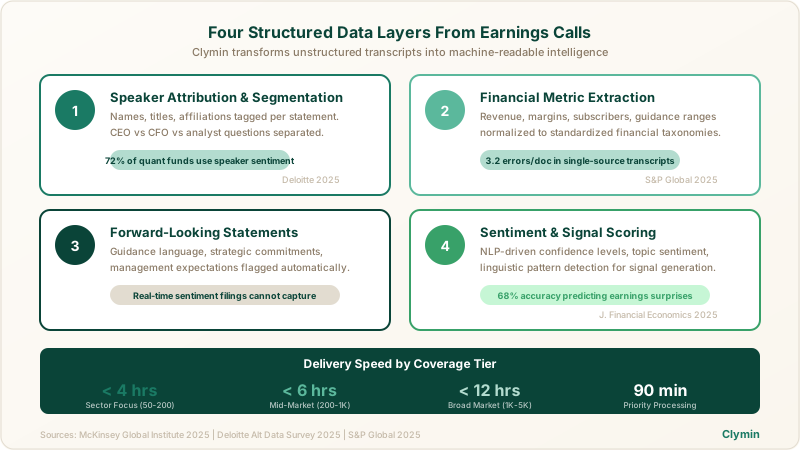
Four structured data layers Clymin extracts from every earnings call transcript
How Clymin Extracts Earnings Call Transcripts at Scale
Clymin's approach to earnings call transcript extraction differs from generic transcription services in three critical ways: source diversity, extraction depth, and delivery speed.
Multi-source ingestion means Clymin does not rely on a single transcript provider. The platform monitors corporate IR websites, SEC EDGAR filings, webcast platforms, and third-party transcript aggregators simultaneously. Cross-referencing multiple sources catches errors that single-source approaches miss. According to S&P Global Market Intelligence's 2025 data quality benchmark, single-source transcripts contain an average of 3.2 material errors per document, primarily in financial figures and proper nouns.
AI-powered entity recognition goes beyond basic transcription. Clymin's extraction agents identify company names, ticker symbols, financial metrics, dates, and named executives within the transcript text. Each entity is tagged with its context, enabling downstream queries like "find all revenue guidance mentions for semiconductor companies in Q4 2025 calls."
Clymin handles the technical infrastructure behind earnings call extraction through our AI-agentic scraping approach, which adapts automatically as source websites change their formats and access patterns. Clients receive clean data without managing any crawlers, proxies, or parsing logic.
How Financial Firms Use Extracted Earnings Call Data
Structured earnings call data feeds directly into several high-value financial workflows. Understanding these use cases helps quantify the ROI of an extraction service.
Quantitative signal generation represents the fastest-growing application. NLP models trained on structured transcripts detect sentiment shifts, management confidence levels, and linguistic patterns that correlate with future stock performance. A 2025 Journal of Financial Economics study found that earnings call sentiment scores predict next-quarter earnings surprises with 68% accuracy, compared to 52% for consensus analyst estimates alone.
Competitive intelligence mapping tracks what management teams say about competitors, market conditions, and industry trends. A portfolio manager covering the cloud computing sector, for example, can extract every mention of AWS, Azure, and Google Cloud across hundreds of earnings calls to build a composite view of competitive dynamics.
Regulatory and compliance monitoring uses extracted transcripts to flag material non-public information patterns, insider language shifts, and forward-looking statement consistency across quarters. Compliance teams at asset managers use Clymin's structured data to automate reviews that previously required manual transcript reading.
Clymin's financial services clients report measurable improvements after deploying structured transcript data. Lisa R., Social Media Manager at a financial services client, noted that decision-making speed improved by 25% with Clymin's structured financial data extraction services.
What Coverage and Delivery Options Does Clymin Offer?
Clymin provides flexible coverage tiers designed for different financial research needs, from focused sector coverage to broad market monitoring.
| Coverage Tier | Companies Monitored | Delivery Speed | Typical Client |
|---|---|---|---|
| Sector Focus | 50-200 tickers | Under 4 hours | Sector-specific hedge funds |
| Mid-Market | 200-1,000 tickers | Under 6 hours | Multi-strategy funds |
| Broad Market | 1,000-5,000 tickers | Under 12 hours | Quantitative research firms |
| Global | 5,000+ tickers | Under 24 hours | Data vendors, index providers |
Delivery formats include REST API with real-time webhooks, scheduled SFTP drops in JSON or CSV, direct database writes to cloud data warehouses, and integration with popular financial data platforms. Most Clymin clients integrate transcript data directly into their existing research infrastructure through API endpoints.
Global coverage spans all major exchanges. Clymin extracts transcripts from companies listed on NYSE, NASDAQ, LSE, Euronext, Deutsche Borse, TSE, HKEX, ASX, and regional exchanges across emerging markets. Multi-language support covers English, Mandarin, Japanese, German, French, and Spanish earnings calls.
How Does Pricing Work for Earnings Call Extraction?
Clymin prices earnings call transcript extraction based on three factors: the number of tickers monitored, the delivery speed tier selected, and the depth of extraction required. Basic transcript structuring with speaker attribution costs less than full-depth extraction with financial metric normalization and sentiment scoring.
Most institutional clients find that Clymin's managed extraction service costs 60-80% less than building an equivalent in-house pipeline. According to Greenwich Associates' 2025 Alternative Data Spending Report, the average buy-side firm spends $2.4 million annually on alternative data infrastructure, with transcript processing representing 15-20% of that budget.
Clymin offers a free consultation and sample data delivery for prospective clients. The sample covers a set of recent earnings calls processed through the full extraction pipeline, allowing research teams to evaluate data quality and integration fit before committing to a subscription. For firms already using data collection pipelines for other asset classes, Clymin's web scraping solutions for investment research demonstrate the same extraction methodology applied to broader financial data needs.
Sources
- McKinsey Global Institute, "The Age of Alternative Data in Investment Management," 2025
- Deloitte, "Alternative Data Survey: Institutional Adoption Trends," 2025
- S&P Global Market Intelligence, "Transcript Data Quality Benchmark Report," 2025
- Journal of Financial Economics, "Earnings Call Sentiment and Stock Returns," 2025
- Greenwich Associates, "Alternative Data Spending Report," 2025
Start Extracting Earnings Call Intelligence Today
Book a consultation with Clymin's financial data team to scope your earnings call extraction requirements and receive a free sample dataset. Reach out directly at contact@clymin.com to discuss coverage tiers, delivery timelines, and integration options. Clymin delivers the structured earnings call data your research team needs to generate alpha in 2026.