
Why New York Real Estate Requires Specialized Data Extraction
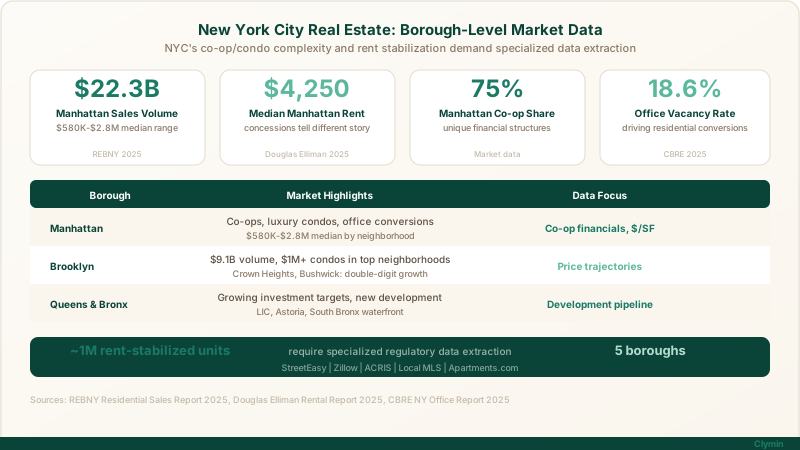
New York City's real estate market is the largest and most complex in the United States. The co-op versus condo distinction alone creates analytical challenges that generic property data tools cannot handle. Co-ops represent roughly 75% of Manhattan's housing stock, yet their financial structures, maintenance fees, underlying mortgages, flip taxes, and board approval processes, require specialized data fields that national platforms routinely omit or misclassify.
According to the Real Estate Board of New York's 2025 Residential Sales Report, Manhattan residential sales volume reached $22.3 billion, with median sale prices varying from $580,000 in Upper Manhattan to $2.8 million on the Upper East Side. Brooklyn's market added another $9.1 billion in transaction volume. Effective analysis across these markets demands neighborhood-level data that captures local dynamics invisible in borough-wide averages.
NYC's rental market adds further complexity. Rent stabilization covers approximately one million apartments. The Housing Stability and Tenant Protection Act of 2019 introduced permanent restrictions on rent increases and eliminated vacancy decontrol. For investors and property managers, distinguishing rent-stabilized from market-rate inventory is essential for accurate revenue modeling.
What NYC Real Estate Data Does Clymin Extract?
Clymin's AI-agentic technology navigates New York's fragmented real estate data landscape, extracting structured intelligence from platforms that restrict API access and frequently update their interfaces.
Sales and listing data captures asking prices, closing prices, price-per-square-foot, days on market, and listing history across co-ops, condos, townhouses, and multi-family buildings. Clymin distinguishes co-op shares from condo units, extracting maintenance fees, common charges, and building financial health indicators that affect true ownership costs.
NYC rental market intelligence extracts asking rents, concessions (months free, reduced broker fees), unit features, and building amenities from StreetEasy, Apartments.com, and local NYC rental platforms. According to Douglas Elliman's 2025 Manhattan Rental Report, median rents reached $4,250 per month, but concession rates and net effective rents tell a very different story than asking prices alone. Clymin captures both dimensions.
Public records and transaction data from ACRIS (Automated City Register Information System) provides deed transfers, mortgage filings, and tax lot information. Clymin extracts and structures this data for investment firms building transaction databases and brokerages tracking market velocity.
With over 100 billion data points extracted across all verticals, Clymin delivers NYC real estate intelligence at institutional scale.
Manhattan vs. Brooklyn: How Scraped Data Reveals Market Divergence
New York's borough-level data tells stories that citywide statistics cannot. Clymin's structured extraction enables comparative analysis that reveals where capital is flowing and why.
Manhattan's office-to-residential conversion pipeline is reshaping Midtown and Lower Manhattan's property landscape. According to CBRE's 2025 New York Office Report, Manhattan office vacancy reached 18.6%, driving a wave of conversion applications. Clymin tracks these conversions alongside residential listing volumes to forecast future inventory impacts on pricing.
Brooklyn's continued price appreciation in neighborhoods like Park Slope, DUMBO, and Williamsburg has pushed median condo prices above $1 million in multiple zip codes. Meanwhile, emerging Brooklyn neighborhoods, Crown Heights, Bushwick, Bed-Stuy, show double-digit year-over-year price growth. Clymin's neighborhood-level extraction captures these divergent trajectories independently.
Queens and the Bronx represent growing investment targets as Manhattan and Brooklyn pricing pushes buyers outward. Long Island City, Astoria, and the South Bronx waterfront are attracting new development. Clymin's multi-borough coverage ensures investors tracking these shifts have complete data rather than Manhattan-centric snapshots.
For firms already using Clymin for broad property listing extraction across multiple markets, adding NYC-specific coverage delivers the regulatory and structural nuance that national datasets lack. Integration with Clymin's comprehensive real estate data platform enables side-by-side analysis of New York against other major metros.
NYC Real Estate Data for Investment Analysis and Portfolio Management
Institutional investors, family offices, and REITs focused on New York use Clymin's structured data to power underwriting models and portfolio monitoring dashboards. The data feeds include cap rates, NOI estimates, comparable sales, and rental yield calculations across asset classes.
Emily W., a Real Estate Consultant working with Clymin, reported that data collection efficiency improved by 35% with automated property listing extraction, a productivity gain that compounds significantly when applied to New York's high-volume, high-complexity market.
For proptech companies building New York-focused platforms, Clymin eliminates the engineering burden of maintaining extraction pipelines across StreetEasy, Zillow, ACRIS, and dozens of local brokerages. Clymin handles source monitoring, anti-blocking technology, and data normalization while clients focus on building analytical products that their end users value.
Ready to Access New York Real Estate Data at Scale?
Clymin's managed service extracts New York City real estate data from setup through ongoing delivery, covering sales, rentals, co-ops, condos, commercial properties, and public records across all five boroughs. With 40+ customers served, hundreds of projects delivered, and over a decade of data extraction expertise, Clymin brings institutional-grade capabilities to NYC real estate intelligence.
Contact us at contact@clymin.com or get a free consultation to discuss your New York real estate data requirements.