
What Are Proptech Data Services?
Proptech data services cover the extraction, normalization, and delivery of property-related datasets that power real estate technology products. A proptech data provider collects listing data, rental rates, historical transactions, neighborhood demographics, and market trend signals from public web sources and structures them into ready-to-use feeds. According to McKinsey, real estate companies that embed data-driven intelligence into their products see 15–20% higher customer retention compared to those relying on manual data workflows.
For proptech CTOs, the challenge is not finding data, it is collecting it reliably at scale, keeping it fresh, and integrating it without building a full data engineering function. Clymin's managed service eliminates that overhead entirely.
Why Proptech Startups Need a Dedicated Data Provider
The global proptech market is projected to exceed $32 billion by 2028, according to Allied Market Research, driven by platforms that surface hyper-local property intelligence. Competing in that market requires data velocity, the ability to update property valuations, track listing changes, and benchmark rental prices faster than manually possible.
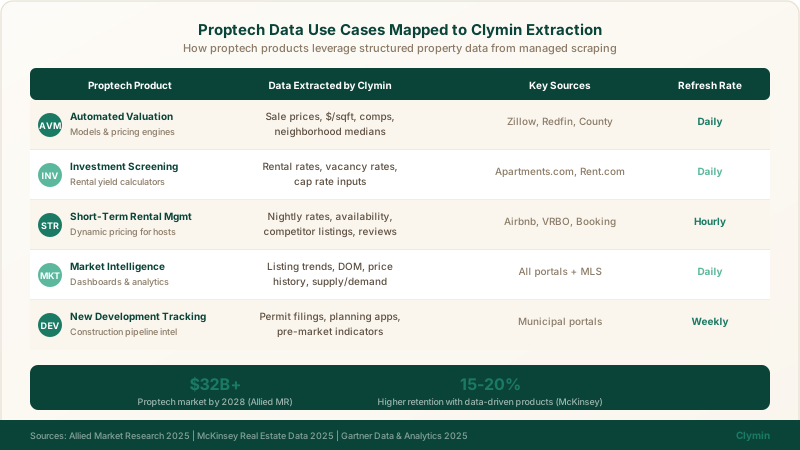
Property listing portals like Zillow, Realtor.com, and Redfin update inventory continuously. A proptech startup that refreshes its data weekly is working with stale signals. Clymin's AI agents run continuous extraction pipelines that deliver near-real-time data updates, so your AVM models, investment algorithms, or market dashboards always reflect current conditions.
Static scraping tools also fail silently when a portal updates its front-end. Clymin's agentic infrastructure detects layout changes and adapts automatically, ensuring your data pipeline stays healthy without engineering intervention.
What Data Can You Extract for a Proptech Product?
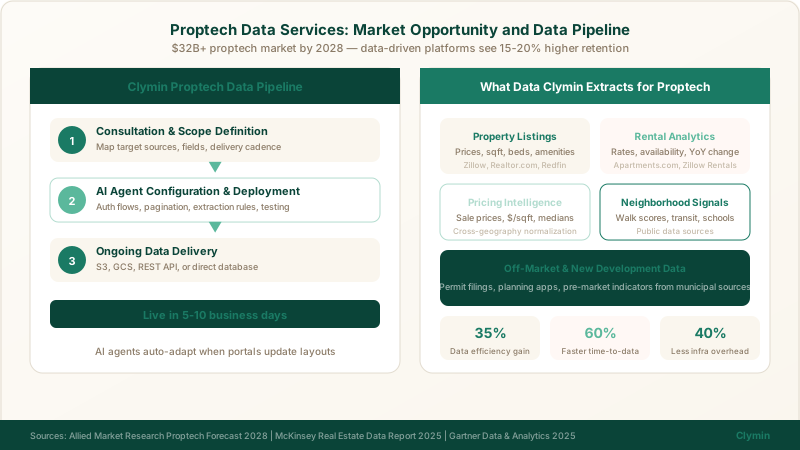
Clymin's proptech data services cover the full spectrum of structured real estate datasets that power modern proptech platforms:
Property Listings Data Active listings, price history, days on market, square footage, bedroom/bathroom count, and amenity flags from major portals and regional MLS-equivalent sites. See our real estate data scraping service for a full breakdown of supported sources.
Rental Market Analytics Current rental rates, availability rates, year-over-year rent change, and landlord-level data from Apartments.com, Rent.com, Zillow Rentals, and short-term rental platforms. Useful for rental yield calculators, tenant-facing search tools, and investment screening engines.
Property Pricing Intelligence Historical sale prices, price per square foot benchmarks, and neighbourhood-level median pricing across geographies. Clymin normalizes data across inconsistent source schemas to deliver a unified pricing dataset.
Neighbourhood and Market Signals Walk scores, transit proximity, school ratings, crime indices, and economic indicators scraped from public data sources and aggregated per geography. These signals power valuation models and location intelligence layers.
Off-Market and New Development Data Permit filings, planning applications, and pre-market listing indicators from public municipal sources, valuable for early-mover investment platforms and new development tracking tools.
How Clymin's AI-Agentic Approach Outperforms Traditional Proptech Data Providers
Most proptech data providers deliver static database exports updated monthly. Clymin's approach is architecturally different. Our AI agents are trained to navigate property portals the way a human researcher would, handling pagination, dynamic rendering, anti-scraping defenses, and session management automatically.
Clymin has delivered hundreds of data projects across 40+ customers and extracted more than 100 billion data points since 2012. That scale means our extraction infrastructure has handled virtually every anti-blocking pattern used by major real estate portals.
Emily W., a Real Estate Consultant who uses Clymin's property extraction pipeline, reports: "Data collection efficiency improved by 35% with Clymin's automated property listing extraction."
For a detailed explanation of how our AI agents work and the end-to-end process, see our AI-agentic scraping methodology and how it works.
How Clymin Delivers Proptech Data: The Process
Step 1, Consultation and Scope Definition Clymin's team meets with your CTO or data lead to map your target data sources, required fields, delivery cadence, and downstream integration requirements. Most proptech pipelines start producing data within 5–10 business days.
Step 2, AI Agent Configuration and Deployment Clymin engineers configure AI agents for each target portal, handling authentication flows, pagination logic, and structured data extraction rules. Agents are tested against historical data for accuracy before going live.
Step 3, Ongoing Data Delivery and Maintenance Clean, normalized datasets are delivered to your preferred destination, S3, GCS, REST API, or direct database, on your defined schedule. Clymin monitors for source changes, updates agents proactively, and maintains delivery SLAs without requiring any input from your team.
Proptech Data Coverage: Key Sources Clymin Extracts
Clymin's proptech data extraction covers all major U.S. property portals and extends to regional and international sources based on your product's geographic scope:
- Residential Portals: Zillow, Realtor.com, Redfin, Trulia, Homes.com
- Rental Platforms: Apartments.com, Rent.com, Zillow Rentals, HotPads
- Short-Term Rental: Airbnb, VRBO, Booking.com (STR-listed properties)
- Commercial Real Estate: LoopNet, CoStar public listings, CBRE market data pages
- Public Records: County assessor portals, planning department databases, permit filings
For a deeper comparison of sourcing strategies, read our guide on MLS data vs. web scraping for property data to understand when each approach is appropriate for your proptech use case.
Why Proptech CTOs Choose Clymin Over Build-or-Buy Alternatives
Building an in-house scraping infrastructure for a proptech product typically requires a dedicated data engineering team, proxy management infrastructure, ongoing maintenance cycles, and anti-blocking expertise. According to Gartner's 2025 Data & Analytics report, engineering teams that outsource data acquisition to managed providers reduce time-to-data by an average of 60% and cut infrastructure overhead by 40%.
Clymin functions as an embedded data engineering partner, not a self-serve tool. Your CTO gets a dedicated point of contact, proactive issue resolution, and a pipeline that scales as your product grows. 40+ customers across nine industries trust Clymin to manage data pipelines that power production systems.
For proptech startups at the evaluation stage, Clymin's model de-risks the build decision: there is no infrastructure to stand up, no proxy budget to manage, and no engineering cycles lost to scraper maintenance. The data arrives structured, normalized, and ready for your database or model training pipeline.
Proptech Data Services vs. Off-the-Shelf Data Subscriptions
Pre-packaged real estate data subscriptions from providers like CoreLogic or ATTOM Data deliver broad coverage but come with significant trade-offs: they aggregate and normalize data on their own schedule, restrict geographic or field-level access by pricing tier, and charge per-record fees that become prohibitive at scale.
Clymin extracts exactly the fields your proptech product needs, from exactly the sources that matter for your market, at the frequency your product requires. Custom extraction also means you can capture data points, like agent phone numbers, open house schedules, or listing description keywords, that packaged providers do not include. For investment-focused proptech platforms, that granularity is a direct competitive advantage.
For context on how data sourcing strategies compare, our guide on using web scraping for real estate investment walks through decision frameworks for choosing between MLS feeds, third-party databases, and direct web extraction.
Compliance and Security for Proptech Data
Data compliance is non-negotiable for proptech companies that handle property records and transaction data. Clymin is ISO 27001 certified and AICPA SOC compliant, and operates under a GDPR-ready data handling framework. All extraction workflows are designed to target publicly accessible listing data, respect robots.txt configurations, and enforce rate limits that align with responsible access standards.
Proptech platforms operating in regulated real estate markets, particularly those touching MLS data or licensed agent information, should verify jurisdiction-specific usage rights with their legal team. Clymin provides transparency documentation for all extraction pipelines to support compliance reviews.
Ready to Power Your Proptech Product with Reliable Data?
Proptech platforms are only as good as the data they run on. Clymin delivers the structured, real-time property datasets your product needs to compete in 2026's proptech market, without the infrastructure cost or engineering overhead of building it yourself.
Get a Free Consultation to discuss your proptech data requirements, or reach out directly at contact@clymin.com. Clymin's team will scope your data pipeline and have a proposal ready within 48 hours.