
Understanding MLS Data: Strengths and Limitations
The Multiple Listing Service system consists of over 580 regional MLS organizations across the United States, each maintaining a database of properties listed by member brokers and agents. MLS data is considered the gold standard for active listing information because it comes directly from listing agents at the point of listing creation.
MLS strengths:
- Listing data is authoritative and verified by the listing agent
- Updates propagate within minutes of agent changes
- Comprehensive listing details including agent remarks, showing instructions, and commission structures not available publicly
- Standardized through RESO (Real Estate Standards Organization) data dictionary
- Historical transaction data including sold prices, days on market, and concessions
MLS limitations:
- Coverage limited to properties listed by MLS member agents (excludes FSBO, off-market, and pocket listings)
- Access restricted to members or licensed data recipients, proptech companies and investors need formal data licensing agreements
- Each regional MLS operates independently with varying data standards despite RESO normalization efforts
- No automated property valuations (Zestimates or equivalent)
- Limited rental market data in most MLS systems
- Licensing costs range from $5,000 to $50,000+ annually per MLS region
Understanding Web Scraping: Strengths and Limitations
Web scraping extracts property data from consumer-facing real estate platforms including Zillow, Realtor.com, Redfin, Trulia, Apartments.com, and dozens of regional property sites.
Web scraping strengths:
- No access restrictions or licensing negotiations required for publicly available data
- Covers off-market properties, FSBO listings, rental properties, and foreclosures
- Captures automated valuations, neighborhood analytics, school ratings, and walkability scores
- Scales across all markets simultaneously without per-region licensing
- Includes price history, tax records, and valuation trends not in MLS
- Cost-effective at scale, one extraction system covers all platforms
Web scraping limitations:
- Data freshness lags MLS by 12-48 hours for new listings (platforms receive MLS feeds with delay)
- Some listing details (agent remarks, commission info) not available on consumer platforms
- Requires ongoing engineering to maintain extraction reliability as platforms change
- Quality varies by platform and requires cross-source validation
- Anti-scraping measures require sophisticated extraction infrastructure
Clymin's real-estate data scraping service overcomes scraping limitations through AI-powered extraction agents, continuous platform monitoring, and multi-source validation.
Head-to-Head Comparison
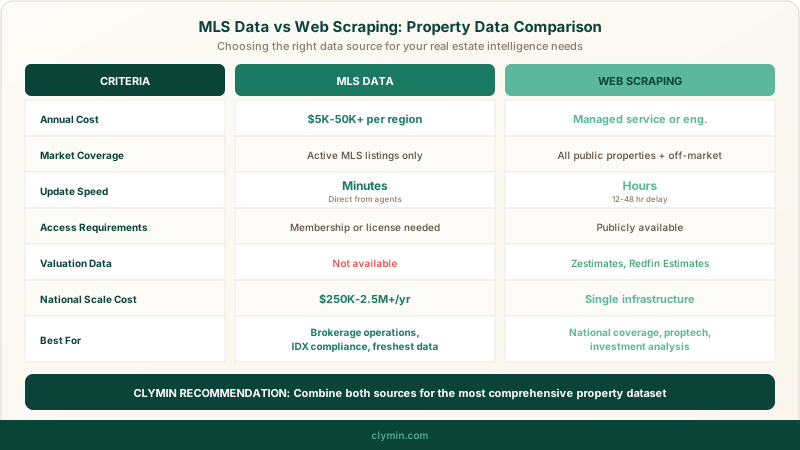
| Criteria | MLS Data | Web Scraping |
|---|---|---|
| Listing accuracy | Highest (direct from agents) | High (12-48hr delay) |
| Update speed | Minutes | Hours |
| Market coverage | Active MLS listings only | All publicly listed properties |
| Off-market data | Limited | Available (Zillow, FSBO) |
| Valuation data | Not available | Zestimates, Redfin Estimates |
| Rental data | Limited | Comprehensive |
| Tax/assessment data | Some regions | Available (Zillow, county) |
| Setup cost | $5K-50K+ per MLS region | Engineering or managed service |
| Ongoing cost | Annual licensing fees | Extraction infrastructure |
| Access restrictions | Membership/licensing required | Publicly available |
| Data standardization | RESO standards | Requires normalization |
| Historical data | Transaction records | Price history, valuation trends |
| Geographic scope | Per-region licensing | National/international |
When to Choose MLS Data
MLS data is the right primary source when:
You need the freshest listing data. Real estate teams competing for listings or representing buyers need new listings the moment they hit the market. MLS feeds provide this with minutes of latency, scraping typically adds 12-48 hours of delay.
You require agent-only information. Commission structures, showing instructions, agent remarks, and lockbox codes are MLS-exclusive data fields essential for brokerage operations.
Your use case involves IDX compliance. Consumer-facing property search portals that display MLS data must comply with IDX (Internet Data Exchange) rules. MLS membership and licensing provide the legal framework for this display.
You operate in a single metro market. If your business focuses on one metro area, a single MLS license may provide sufficient coverage at reasonable cost without the engineering overhead of scraping.
When to Choose Web Scraping
Web scraping becomes the better option when:
You need national or multi-market coverage. Licensing 50+ regional MLS systems to cover the US market costs $250,000-2,500,000+ annually. Scraping provides national coverage through a single extraction infrastructure at a fraction of the cost.
Off-market and valuation data matters. Investment firms, proptech companies, and market researchers need property data beyond active listings. Scraping captures Zestimates, tax assessments, rental yields, and off-market property information MLS cannot provide.
You lack MLS membership eligibility. Non-brokerage technology companies, hedge funds, and international firms often cannot obtain direct MLS access. Scraping publicly available platforms provides an alternative data acquisition path.
Rental market analysis is required. MLS systems historically underserve the rental market. Scraping Apartments.com, Zillow Rentals, and regional rental platforms provides the rental data MLS lacks.
Why Clymin Recommends Combining Both Sources
The most comprehensive property data strategy uses both MLS feeds and web scraping. Each source fills gaps in the other:
MLS provides the freshest active listing data. New listings appear within minutes through MLS feeds. Clymin reconciles this with scraped data to identify when platforms display MLS data inaccurately or with delay.
Scraping adds dimensions MLS cannot. Automated valuations, price history trends, tax assessment data, rental yields, and off-market coverage enrich the MLS listing foundation with context essential for investment decisions and market analysis.
Cross-source validation improves accuracy. When Zillow, Realtor.com, and MLS all report different square footage for the same property, the discrepancy flags a data quality issue worth investigating. Single-source reliance misses these errors.
Clymin's managed service handles the integration complexity. Property records from MLS feeds, Zillow, Realtor.com, Redfin, county assessor records, and additional sources are matched, merged, and normalized into a single property-level record with clear source attribution.
Implementation Considerations
MLS integration requires RETS/Web API development, data mapping per MLS region, compliance monitoring for IDX rules, and ongoing maintenance as MLS organizations update their systems. Budget 3-6 months and $100,000-200,000 in engineering for multi-MLS integration.
Web scraping implementation requires browser rendering infrastructure, proxy management, anti-detection engineering, data normalization, and continuous maintenance as platforms change. Building internally costs $200,000-500,000 annually in engineering resources.
Clymin's managed approach eliminates both engineering burdens. Clients specify their data requirements, markets, property types, data fields, update frequency, and receive structured data via API or file delivery within 5-7 business days. No internal engineering needed.
Start Building Your Property Data Infrastructure
Clymin configures comprehensive property data extraction combining the best of MLS and web scraping, tailored to your specific market coverage and data requirements.
Contact the team at contact@clymin.com or book a meeting to discuss your property data needs.