
Key Legal Precedents Supporting Public Data Collection
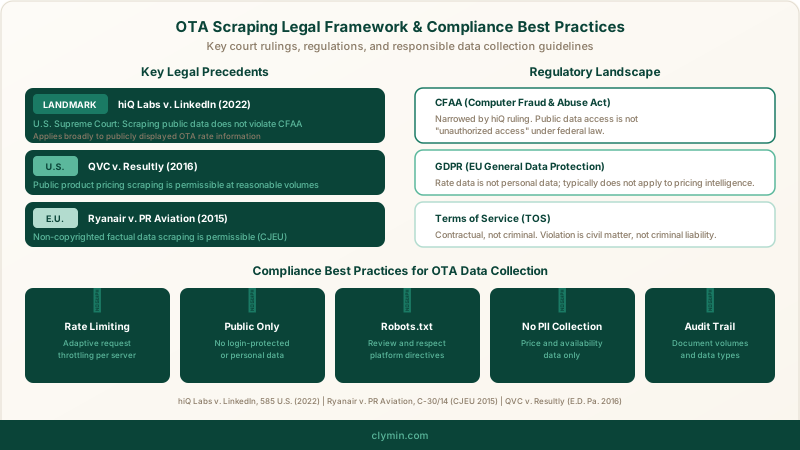
The legal landscape for web scraping has clarified significantly through several landmark court decisions:
hiQ Labs v. LinkedIn (2022), The U.S. Supreme Court's ruling established that scraping publicly available data does not violate the Computer Fraud and Abuse Act (CFAA). This precedent applies broadly to publicly displayed OTA rate information that any user can access without authentication.
Ryanair v. PR Aviation (EU, 2015), The European Court of Justice ruled that scraping non-copyrighted data from websites without database protection is permissible. Rate information displayed on OTAs falls into this category as factual data rather than creative works.
QVC v. Resultly (2016), A U.S. court ruled that scraping publicly available product pricing does not constitute trespass to chattels when done at reasonable volumes. This directly parallels hotel rate monitoring from OTA platforms.
These rulings collectively support the position that collecting publicly visible pricing data for competitive intelligence is a lawful business practice. Clymin's legal team monitors ongoing regulatory developments across all operating jurisdictions.
Terms of Service Considerations
Most OTA platforms include restrictions on automated data collection in their terms of service. Understanding the distinction between legal exposure types matters:
Terms of service are contracts, not laws. Violating an OTA's TOS may constitute a breach of contract, a civil matter between the parties, but does not create criminal liability. The hiQ ruling specifically addressed this distinction.
Enforcement varies significantly. OTA platforms rarely pursue legal action against hotels monitoring their own rate parity compliance. The practice serves the platform's interest in maintaining healthy supplier relationships and accurate rate displays.
Business justification strengthens position. Hotels checking that OTAs display their contracted rates correctly have a legitimate business interest supported by their distribution agreements. This is fundamentally different from mass commercial data harvesting.
Clymin structures all extraction activity around legitimate competitive intelligence purposes, helping hotels verify rate accuracy, monitor parity compliance, and understand market dynamics. The hotel rate scraping service operates within these business-justified parameters.
Compliance Best Practices for OTA Data Collection
Responsible extraction protects both the data collector and the platform:
Rate limiting ensures extraction requests do not burden OTA servers. Clymin distributes requests across time windows and uses adaptive rate limiting that reduces frequency when server response times increase.
Respect robots.txt guidance. While robots.txt is a suggestion rather than a legal requirement, following its directives demonstrates good faith. Clymin reviews robots.txt for each monitored platform and adjusts extraction behavior accordingly.
Avoid authenticated content. Only collect data visible to unauthenticated users. Login-protected rates, member-exclusive pricing viewed through authenticated sessions, and personal guest data are off-limits.
No personal data collection. Rate monitoring should capture pricing, availability, and property information, never guest names, email addresses, payment details, or booking histories. Clymin's extraction filters exclude personal data fields automatically.
Reasonable request volumes. Extraction frequency should reflect legitimate monitoring needs, not exhaustive data harvesting. Checking competitor rates hourly is reasonable; hitting the same page every 5 seconds is not.
Jurisdiction-Specific Considerations
Legal frameworks vary by country, and OTA data collection intersects with multiple regulatory regimes:
United States provides the clearest legal support through the hiQ precedent. The CFAA's scope has been narrowed to exclude access to publicly available data. State-level computer fraud statutes vary but generally follow federal interpretation.
European Union imposes additional considerations through GDPR (for personal data, which rate monitoring typically does not involve) and the Database Directive (which protects substantial database investments). Factual rate data generally falls outside database protection when collected for competitive analysis rather than database reproduction.
Asia-Pacific markets vary widely. Japan's Unfair Competition Prevention Act protects trade secrets but not publicly displayed pricing. Australia's Privacy Act applies to personal information, not commercial rate data. Singapore's Computer Misuse Act focuses on unauthorized access to computer systems.
Clymin's operations comply with local regulations in each market where clients operate. The legal team reviews jurisdiction-specific requirements and configures extraction parameters accordingly.
How Clymin Ensures Compliant Data Collection
Clymin's managed service model means clients delegate compliance responsibility to a team with deep expertise in responsible data extraction:
Legal review of extraction targets occurs during onboarding. The team assesses each OTA platform's terms, applicable jurisdiction regulations, and appropriate extraction parameters before monitoring begins.
Technical safeguards including rate limiting, proxy rotation, and personal data filtering are built into every extraction pipeline. These controls operate automatically without client configuration.
Audit trail documentation records extraction volumes, frequencies, and data types collected. This documentation supports compliance reviews and provides evidence of responsible practices if questions arise.
Ongoing monitoring of legal developments ensures extraction practices evolve with the regulatory landscape. When courts issue new rulings or jurisdictions update data protection laws, Clymin adjusts operations proactively.
For hotels concerned about the compliance aspects of competitive intelligence, Clymin's how to monitor hotel competitor rates automatically guide covers the operational framework alongside compliance considerations.
Protect Your Revenue While Staying Compliant
Clymin provides legally compliant competitive intelligence that hotels need to maintain rate parity, optimize pricing, and protect revenue. The managed service handles all compliance considerations so revenue teams focus on strategy.
Contact the team at contact@clymin.com or book a meeting to discuss compliant rate monitoring for your properties.