Why Financial Data Scraping Costs Vary So Widely
Financial data scraping pricing depends on several technical and operational factors that make flat-rate comparisons misleading. A single-source extraction pulling daily closing prices from one exchange costs a fraction of what a multi-source real-time feed covering SEC filings, earnings transcripts, and sentiment data requires.
According to Grand View Research's 2025 Alternative Data Market report, the global alternative data market reached $7.2 billion in 2025 and is projected to grow at 24.6% CAGR through 2030. Financial firms are spending more on alternative data every year, but the cost of acquiring that data varies by an order of magnitude depending on scope.
Clymin works with financial services clients to scope projects precisely, ensuring firms pay only for the data they actually use in their models. With hundreds of projects delivered across industries, Clymin tailors extraction pipelines to each client's specific data requirements rather than forcing a one-size-fits-all pricing model.
How Much Does Financial Data Scraping Cost by Source Type?
Different financial data sources carry different extraction costs based on their technical complexity and the value of the data they contain.
Public Market Data (Exchanges, Indices). Extracting stock prices, trading volumes, and index compositions from publicly accessible financial sites typically costs $500 to $2,000 per month. These sources have relatively stable structures and moderate anti-bot protections.
SEC Filings and Regulatory Documents. Scraping EDGAR filings, 10-K/10-Q reports, and insider trading disclosures costs between $1,500 and $5,000 per month depending on the number of companies tracked. The challenge lies in parsing unstructured PDF and HTML documents into clean, structured datasets.
Alternative Data Sources (Sentiment, Reviews, Job Postings). Extracting financial sentiment from news sites, Glassdoor reviews, or job posting platforms for investment signals costs $3,000 to $10,000 per month. These sources change frequently and require sophisticated anti-blocking infrastructure.
Real-Time Market Intelligence. Continuous extraction of pricing data, order book snapshots, or commodity prices with sub-hourly refresh rates costs $8,000 to $25,000+ per month. Real-time feeds demand dedicated infrastructure and 24/7 monitoring.
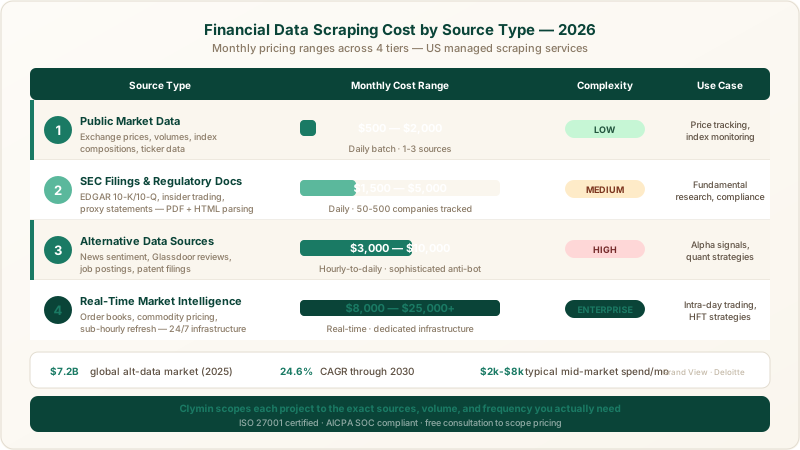
Financial data scraping cost breakdown by source type and complexity level in 2026
What Drives the Cost of Financial Data Extraction?
Six primary factors determine what a financial firm will pay for data scraping services in 2026.
1. Number of Data Sources. Each additional source requires a separate extraction pipeline, anti-blocking strategy, and maintenance protocol. A firm tracking 5 sources pays significantly less than one monitoring 50.
2. Extraction Frequency. Daily batch extraction costs 40-60% less than hourly or real-time streaming. According to Deloitte's 2025 Alternative Data Survey, 68% of hedge funds prefer daily delivery for fundamental research, while quantitative trading firms require intra-day feeds.
3. Data Volume. Pricing scales with the number of records extracted per month. Extracting 10,000 SEC filings monthly costs more than pulling 500. Most managed services, including Clymin, offer volume-based pricing tiers.
4. Anti-Bot Complexity. Financial websites like Bloomberg, Reuters, and major exchanges invest heavily in bot detection. Bypassing these protections ethically and reliably requires rotating proxy infrastructure and AI-driven request patterns, which increase costs.
5. Data Cleansing and Structuring. Raw HTML extraction is cheaper than delivering clean, normalized datasets ready for model ingestion. Financial firms typically need structured JSON or CSV with standardized ticker symbols, date formats, and numerical precision, Clymin's AI-agentic approach handles this cleansing automatically.
6. Compliance Requirements. Financial services clients operating under SEC, FINRA, or MiFID II regulations often need audit trails, data lineage documentation, and SOC compliance from their data vendors. Clymin is ISO 27001 certified and AICPA SOC compliant, which meets the security standards most financial institutions require.
How Does Financial Data Scraping Compare to Traditional Data Vendors?
Traditional financial data vendors like Bloomberg, Refinitiv, and FactSet charge premium prices for comprehensive terminal access. Financial data scraping offers an alternative path to specific datasets at lower cost, but the comparison depends on what data a firm actually needs.
Evidence supporting this:
- Bloomberg Terminal subscriptions cost approximately $24,000 per year per user seat, according to Bloomberg's 2025 enterprise pricing disclosures
- Refinitiv Eikon pricing starts at roughly $22,000 per year per user, based on LSEG's published rate cards
- A 2025 Greenwich Associates survey found that 43% of buy-side firms now supplement terminal data with alternative data from web scraping and other non-traditional sources
Financial data scraping does not replace terminals for firms that need real-time order execution, proprietary analytics tools, or Bloomberg chat functionality. Scraping excels when firms need specific, customized datasets that terminals do not cover, such as competitor job postings, patent filing trends, or regional pricing from niche financial platforms.
For quantitative researchers building proprietary models, scraped data offers a competitive edge precisely because it is not available through standard terminal feeds that every competitor also accesses.
How to Calculate ROI on Financial Data Scraping
Measuring the return on financial data scraping investment requires comparing extraction costs against the value of the insights generated. A structured approach helps financial analysts justify the expense to stakeholders.
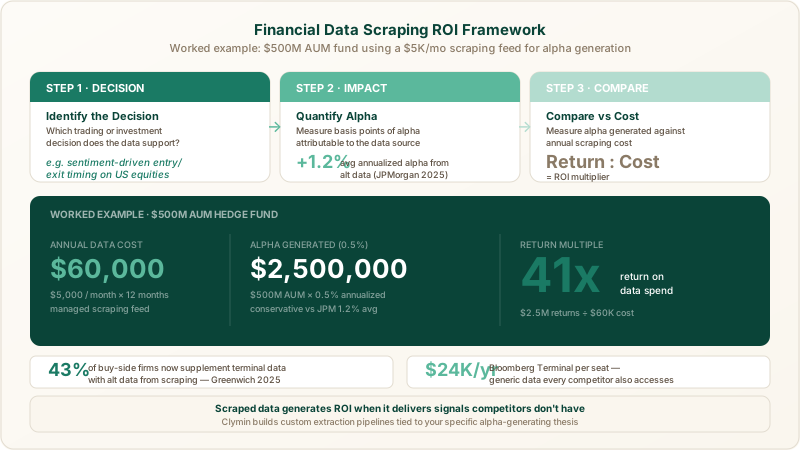
Identify the Decision the Data Supports
A hedge fund using scraped sentiment data to time entry and exit points can attribute specific basis points of alpha to that data source.
Quantify the Data's Impact
According to a 2025 JPMorgan Quantitative Research report, alternative data signals contributed an average of 1.2% annualized alpha for systematic equity strategies that incorporated them effectively.
Compare Against Acquisition Cost
A firm managing $500 million in AUM that gains even 0.5% alpha from a $5,000/month data scraping service generates $2.5 million in additional returns against $60,000 in annual data costs, a 41x return.
Lisa R., a Social Media Manager at a Clymin financial services client, noted that decision-making speed improved by 25% after implementing Clymin's structured financial data extraction services.
ROI framework comparing financial data scraping costs against alpha generation potential
How Clymin Helps Financial Firms Access Alternative Data
Clymin delivers managed financial data scraping that eliminates the technical overhead of building and maintaining extraction infrastructure in-house. Rather than hiring a team of engineers to manage proxies, handle anti-bot systems, and maintain scrapers that break when sites update, financial firms outsource the entire pipeline to Clymin's AI-agentic platform.
With over a decade of experience and over 100 billion data points extracted, Clymin provides enterprise-grade reliability that financial institutions require. Data is delivered in structured JSON, CSV, or via custom API integration, ready to feed directly into quantitative models, risk systems, and research dashboards. For firms evaluating web scraping versus traditional data terminals, Clymin offers a free consultation to scope the exact data requirements and provide transparent pricing.