
What Determines Scraping Data Accuracy?
Accuracy in hotel rate scraping depends on three factors: extraction completeness (did the scraper capture all rendered data), data normalization (are currencies, taxes, and fees handled consistently), and freshness (how recently was the data collected).
Extraction completeness fails when JavaScript rendering is incomplete. OTA platforms load pricing through multi-stage JavaScript execution. Scrapers that capture data before rendering finishes return incorrect or missing rates. Clymin's AI agents wait for full page rendering and verify data completeness before recording results.
Data normalization errors occur when scrapers mix tax-inclusive and tax-exclusive rates, misidentify currencies, or confuse per-night and per-stay pricing. Clymin standardizes all rates to a consistent format during extraction.
How Does Clymin Validate Extracted Data?
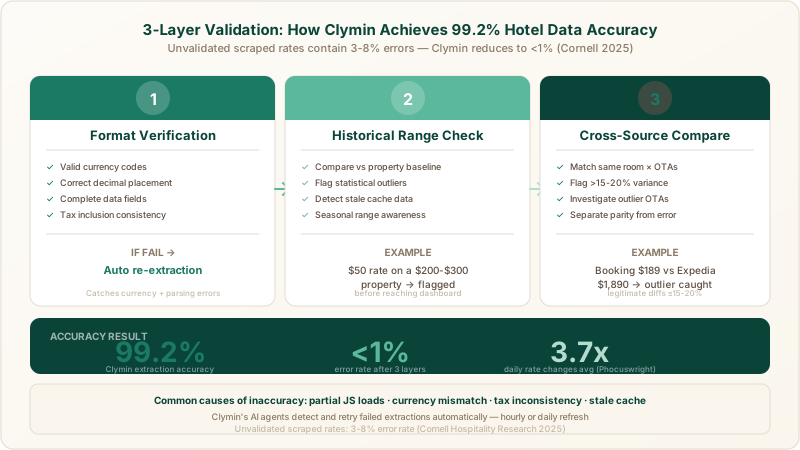
Layer 1, Format verification checks that every extracted rate matches expected patterns: valid currency codes, reasonable decimal placement, and complete data fields. Malformed entries trigger automatic re-extraction.
Layer 2, Historical range checks compare each extracted rate against the property's historical pricing band. A $50 rate for a property that typically charges $200-$300 flags as a potential extraction error. Clymin investigates anomalies before delivering data.
Layer 3, Cross-source comparison matches rates for the same property across multiple OTAs. When Booking.com shows $189 and Expedia shows $1,890 for an identical room, the outlier triggers investigation. Legitimate rate differences between OTAs rarely exceed 15-20%.
Cornell Hospitality Research's 2025 data quality study found that unvalidated scraped rates contain 3-8% errors. Clymin's three-layer validation reduces error rates to below 1%.
Common Accuracy Issues and Solutions
Partial page loads cause the most frequent extraction failures. Clymin's agents monitor DOM readiness signals and wait for specific pricing elements to render before capturing data. Retry logic handles intermittent load failures automatically.
Currency and tax inconsistencies require careful normalization. European OTAs typically display tax-inclusive rates while US platforms show pre-tax pricing. Clymin identifies and standardizes tax treatment for every extraction source.
Cached pricing from OTA content delivery networks sometimes displays outdated rates. Clymin's agents bypass CDN caches when possible and flag data when cache-busting is not achievable.
Data Freshness and Update Frequency
Hotel rates change an average of 3.7 times per day on major OTA platforms according to Phocuswright's 2025 analysis. Data accuracy degrades with age, rates extracted 24 hours ago may not reflect current market conditions.
Clymin's hotel rate scraping service supports hourly extraction for properties requiring near-real-time competitive intelligence. Daily extraction serves markets with lower rate volatility.
Revenue managers can configure automated alerts that trigger when competitor rates change significantly, ensuring pricing decisions always use the freshest available data.
Accuracy Guarantees
Contact Clymin at contact@clymin.com or book a meeting to discuss data accuracy requirements and validation customization for your competitive set.