
Why ESG Data Collection Is Broken for Financial Firms
Environmental, social, and governance (ESG) investing has moved from niche strategy to mainstream mandate. According to Bloomberg Intelligence's 2025 report, global ESG assets surpassed $40 trillion, representing more than a third of total assets under management worldwide. Yet the data infrastructure supporting ESG investment decisions remains fragmented and unreliable.
Financial analysts building ESG models face a fundamental problem: the data they need is scattered across hundreds of disparate sources. Corporate sustainability reports use inconsistent formats. Regulatory filings vary by jurisdiction. ESG rating agencies apply proprietary methodologies that produce conflicting scores for the same company.
Manual ESG data collection cannot scale to meet institutional requirements. A single analyst can review perhaps 20-30 corporate sustainability reports per week. A mid-size asset manager tracking ESG metrics across a 500-company portfolio needs continuous monitoring of thousands of data points across dozens of source types.
What ESG Data Can You Extract With Web Scraping?
ESG data scraping covers a broad spectrum of structured and unstructured sources that traditional financial data terminals do not aggregate effectively. Clymin's ESG data scraping service targets the alternative data layer that gives investment teams an information advantage.
Environmental data points include carbon emissions disclosures (Scope 1, 2, and 3), energy consumption and renewable energy percentages, water usage and waste management metrics, environmental regulatory violations, and climate risk disclosures filed with the SEC and CDP.
Social data points include workforce diversity statistics, employee safety incident rates, supply chain labor audit results, community impact disclosures, and product safety recall records from regulatory databases such as the CPSC and FDA.
Governance data points include board composition and independence ratios, executive compensation structures, shareholder proposal outcomes, related-party transaction disclosures, and regulatory enforcement actions from the SEC, DOJ, and equivalent international bodies.
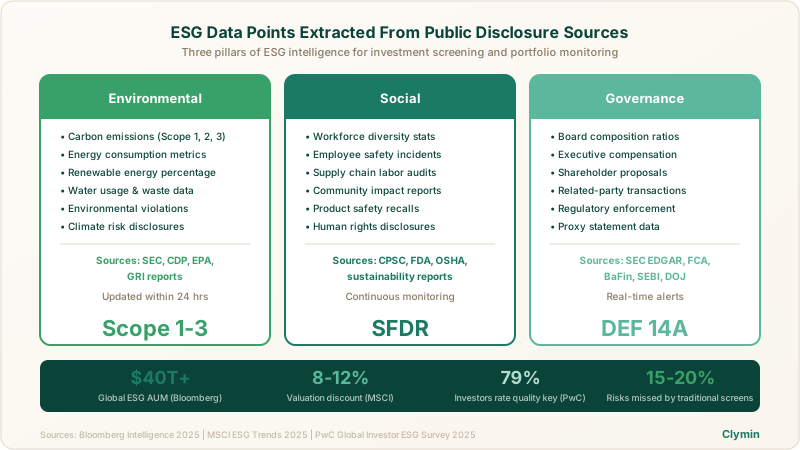
Environmental, social, and governance data points extracted by Clymin from public disclosure sources
According to MSCI's 2025 ESG Trends report, companies with incomplete ESG disclosures face an average valuation discount of 8-12% compared to peers with comprehensive reporting. For investment firms, the ability to fill disclosure gaps with scraped alternative data translates directly into alpha generation.
How ESG Data Scraping Delivers an Investment Edge
Traditional ESG data providers like MSCI, Sustainalytics, and ISS compile ratings that update quarterly at best. Regulatory filings and corporate disclosures, however, publish continuously. The lag between a material ESG event and its reflection in consensus ratings creates an information asymmetry that systematic scraped data can exploit.
Clymin's financial services clients use ESG data scraping for three primary investment workflows.
Pre-investment screening involves building comprehensive ESG profiles for target companies before committing capital. Scraped data fills gaps in commercial ESG databases, particularly for mid-cap and small-cap companies where rating coverage is thin. Quantitative researchers at Clymin's hedge fund clients report that scraped ESG data identifies material risks missed by traditional screens in approximately 15-20% of portfolio candidates.
Continuous portfolio monitoring tracks ESG risk signals across existing holdings in near real-time. Rather than waiting for quarterly rating updates, investment teams receive alerts when a portfolio company publishes a new environmental violation, faces a regulatory enforcement action, or materially changes its governance structure.
Thematic research supports ESG-focused investment strategies by aggregating sector-wide data on specific metrics. Carbon transition readiness scores, diversity benchmarks, and supply chain resilience indicators can all be constructed from scraped public data at a fraction of the cost of commercial ESG analytics platforms.
Lisa R., a financial services client at Clymin, reported that decision-making speed improved by 25% after implementing structured ESG data extraction workflows. The ability to monitor regulatory databases and corporate filings continuously eliminated the manual bottleneck that previously delayed ESG risk assessments.
Key ESG Data Sources Clymin Monitors
Clymin's ESG data scraping infrastructure covers the full spectrum of public disclosure sources that financial analysts need. Each source type requires specialized extraction logic to handle format variations, anti-bot protections, and data quality challenges.
SEC EDGAR and global regulatory filings represent the highest-authority ESG data source. Clymin monitors 10-K, 10-Q, DEF 14A proxy statements, and 8-K filings for ESG-relevant disclosures. The platform also covers equivalent filings from the FCA (United Kingdom), BaFin (Germany), and SEBI (India) for global portfolios.
CDP and GRI disclosure databases contain standardized environmental reporting from thousands of companies. Clymin extracts structured metrics from these platforms as new disclosures are published, typically within 24 hours of availability.
Corporate sustainability reports are published in PDF and HTML formats with no standardized structure. Clymin's AI-powered extraction agents parse these documents to identify and structure quantitative metrics, converting unstructured disclosures into machine-readable datasets.
Regulatory enforcement databases including EPA enforcement records, OSHA violation databases, and international equivalents provide leading indicators of ESG risk. Clymin monitors these sources continuously and delivers alerts when portfolio companies appear in new enforcement actions.
The Sustainable Finance Disclosure Regulation (SFDR) in Europe and the SEC's proposed climate disclosure rules in the United States are expanding mandatory reporting requirements. According to PwC's 2025 Global Investor ESG Survey, 79% of institutional investors consider ESG data quality a significant factor in investment decisions. Clymin helps financial firms stay ahead of these regulatory shifts by capturing new disclosure types as they emerge.
ESG Data Quality and Compliance Standards
Data quality is non-negotiable for financial services applications. Clymin maintains a rigorous validation pipeline specifically designed for ESG data, where inconsistencies between sources are common and the consequences of errors are material.
Every extracted ESG data point passes through automated cross-referencing against at least two independent sources. Carbon emissions figures reported in a sustainability report are validated against CDP disclosures and regulatory filings. Board composition data from proxy statements is cross-checked against corporate governance databases.
Clymin's anomaly detection system flags statistically improbable changes in ESG metrics. A sudden 50% drop in reported carbon emissions without a corresponding operational change triggers a manual review before the data reaches client systems.
Clymin is ISO 27001 certified and AICPA SOC compliant, meeting the security requirements of institutional investors and regulated financial entities. All data handling processes are GDPR ready, which matters for firms operating across the United States and European markets. Learn more about Clymin's AI-agentic approach to data extraction and how it maintains accuracy at scale.
Clymin's multi-stage ESG data validation ensures 99.7% accuracy for investment-grade datasets
How Clymin's ESG Scraping Compares to Commercial ESG Data Vendors
Commercial ESG data providers serve an important role, but they have structural limitations that web scraping addresses. Understanding these trade-offs helps financial teams build optimal data strategies.
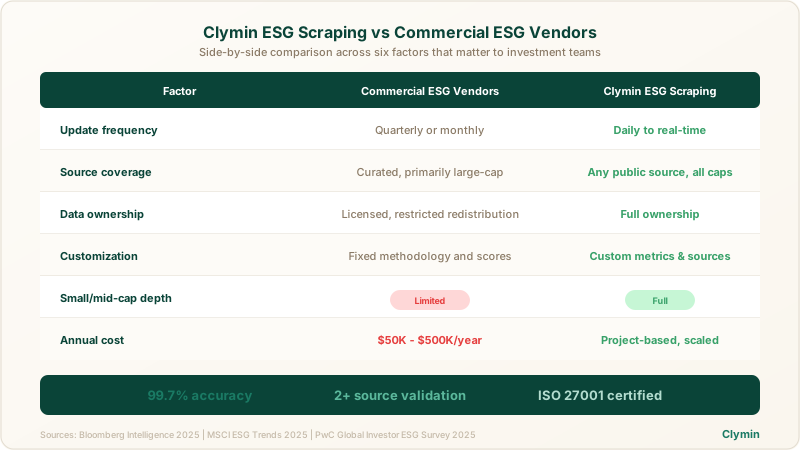
| Factor | Commercial ESG Vendors | Clymin ESG Scraping |
|---|---|---|
| Update frequency | Quarterly or monthly | Daily to real-time |
| Source coverage | Curated, primarily large-cap | Any public source, all market caps |
| Data ownership | Licensed, restricted redistribution | Full ownership of extracted data |
| Customization | Fixed methodology and scores | Custom metrics and source selection |
| Small/mid-cap depth | Limited coverage | Full coverage of public filings |
| Cost structure | Per-seat licensing, $50K-$500K/year | Project-based, scaled to scope |
Clymin does not replace commercial ESG data providers. Instead, Clymin's ESG data scraping service complements existing subscriptions by filling coverage gaps, providing faster updates, and delivering custom metrics that standard platforms do not offer. Many of Clymin's financial clients use scraped data alongside MSCI or Sustainalytics ratings to build proprietary composite scores.
For firms exploring alternative data strategies more broadly, Clymin's dynamic pricing data collection service demonstrates how similar extraction infrastructure applies across financial data use cases beyond ESG.
Sources
- Bloomberg Intelligence, "Global ESG Assets Surpass $40 Trillion," 2025
- MSCI, "ESG Trends to Watch," 2025
- PwC, "Global Investor ESG Survey," 2025
- SEC, "Climate-Related Disclosures Proposed Rule," 2024
Start Extracting ESG Data for Your Investment Team
Book a consultation with Clymin's financial data team to scope your ESG data extraction requirements. Whether you need comprehensive portfolio monitoring or targeted thematic research data, Clymin delivers structured, investment-grade ESG datasets on your schedule. Reach out directly at contact@clymin.com or visit clymin.com to learn how Clymin's 12 years of data extraction expertise can strengthen your ESG investment process.