
Data Coverage and Quality Comparison
The fundamental difference between Zillow and Realtor.com lies in their data sourcing models:
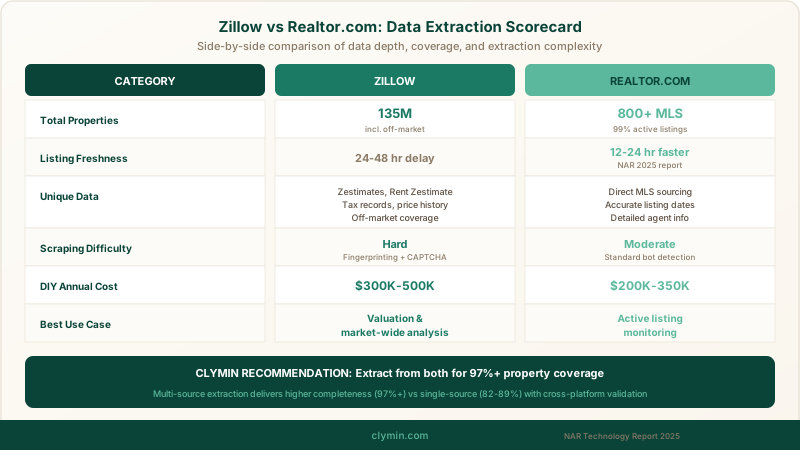
Zillow maintains a database of approximately 135 million properties including both listed and off-market homes. Its data comes from MLS feeds, public records, user submissions, and proprietary algorithms. This breadth makes Zillow valuable for market-wide analysis, but the variety of sources introduces accuracy inconsistencies, particularly for off-market property valuations.
Realtor.com is operated by Move, Inc. and sources data directly from over 800 MLS organizations. This direct MLS connection means active listing data on Realtor.com is typically more accurate and updated faster than Zillow. New listings appear on Realtor.com an average of 12-24 hours sooner than on Zillow according to a 2025 NAR technology report.
For active listing monitoring, Realtor.com provides superior freshness. For market-wide valuation analysis including off-market properties, Zillow offers broader coverage.
Clymin's real-estate data scraping service extracts from both platforms simultaneously, combining Zillow's depth with Realtor.com's listing accuracy into a single unified dataset.
Data Fields Available From Each Platform
| Data Field | Zillow | Realtor.com |
|---|---|---|
| Listing price | ✅ | ✅ |
| Property address | ✅ | ✅ |
| Bedrooms/bathrooms | ✅ | ✅ |
| Square footage | ✅ | ✅ |
| Lot size | ✅ | ✅ |
| Year built | ✅ | ✅ |
| Automated valuation (Zestimate) | ✅ | ❌ |
| Price history | ✅ (extensive) | ✅ (limited) |
| Tax assessment data | ✅ | ❌ |
| Days on market | ✅ | ✅ (more accurate) |
| Listing agent info | ✅ | ✅ (more detailed) |
| MLS number | Sometimes | ✅ |
| Open house schedule | ✅ | ✅ |
| Neighborhood stats | ✅ (Walk Score, schools) | ✅ (basic) |
| Rental estimates | ✅ (Rent Zestimate) | ❌ |
| Foreclosure status | ✅ | ✅ |
Clymin extracts all available fields from both platforms and normalizes them into a consistent schema. When the same property appears on both sites, Clymin merges records and flags any data discrepancies for quality review.
Technical Extraction Challenges
Both platforms implement measures to prevent automated access, but the challenges differ:
Zillow's anti-scraping defenses include advanced fingerprinting technology that detects automated browsers, rate limiting that blocks IPs after relatively few requests, CAPTCHA challenges triggered by access patterns, and dynamic page rendering that varies HTML structure between visits. Zillow's engineering team actively updates these defenses, requiring extraction systems to adapt continuously.
Realtor.com's protections include standard bot detection, JavaScript-rendered listings that require full browser emulation, geographic access restrictions for some data, and API rate limiting. These measures are less aggressive than Zillow's but still prevent basic scraping scripts from working reliably.
Clymin's AI-powered extraction agents handle both platforms through adaptive browser rendering that mimics human browsing patterns, residential proxy rotation across 190+ locations, automatic CAPTCHA resolution, and continuous monitoring that detects and adapts to platform changes within hours.
Use Cases: When to Scrape Which Platform
Market valuation analysis → Prioritize Zillow. Zestimate data, tax records, and price history provide the foundation for automated valuation models and market trend analysis. Zillow's off-market property database supports comprehensive market sizing.
Active listing monitoring → Prioritize Realtor.com. Faster MLS-sourced updates mean new listings appear sooner, and listing accuracy is higher. For real estate teams that need first-mover advantage on new inventory, Realtor.com is the primary source.
Investment analysis → Use both. Combine Zillow's valuation estimates and rental yield data with Realtor.com's accurate listing prices to identify undervalued properties. The gap between Zestimate and listing price can signal investment opportunities.
Competitive intelligence → Use both. Track how listing agents price properties relative to automated valuations, monitor days-on-market trends across neighborhoods, and analyze price reduction patterns to understand market momentum.
Proptech product development → Use both. Property data APIs for real estate applications benefit from the combined coverage of both platforms, normalized into a consistent format through Clymin's extraction pipeline.
Cost and Scalability Comparison
Building internal scraping for either platform requires significant investment:
DIY Zillow scraping demands advanced anti-detection engineering, continuous maintenance against Zillow's evolving defenses, and residential proxy infrastructure. Teams typically need 2-3 dedicated engineers at a cost of $300,000-500,000 annually. Extraction reliability averages 85-92% without specialized tooling.
DIY Realtor.com scraping requires similar browser rendering capabilities and proxy infrastructure, though with less anti-detection complexity. Engineering cost runs $200,000-350,000 annually for reliable extraction at scale.
Clymin's managed service covers both platforms (plus 30+ additional sources) at a fraction of DIY cost. Extraction reliability exceeds 99% because Clymin's team of 50+ engineers maintains extraction adapters as a core business function, not a side project. Clients receive structured data without managing any extraction infrastructure.
Why Clymin Recommends Extracting From Both
Single-source reliance creates data gaps. Zillow may have incomplete listing data for certain markets. Realtor.com lacks valuation estimates and off-market coverage. By extracting from both platforms and cross-referencing results, Clymin delivers:
- Higher data completeness: 97%+ property coverage across monitored markets versus 82-89% from any single source
- Better accuracy: Cross-platform validation catches errors that single-source extraction misses
- Richer data: Combined fields from both platforms provide more dimensions for analysis
Clymin's multi-source approach extends beyond Zillow and Realtor.com to include Redfin, Trulia, county assessor records, and MLS direct feeds where available, creating the most comprehensive property dataset available as a managed service.
Get Comprehensive Property Data From Both Platforms
Clymin configures multi-platform property data extraction within 5-7 business days. The managed service handles all extraction engineering, anti-detection measures, data normalization, and ongoing maintenance.
Contact the team at contact@clymin.com or book a meeting to discuss your real estate data requirements.