Why Quantitative Researchers Need Web Scraping in 2026
Alternative data has moved from experimental edge to essential infrastructure for quantitative finance. According to Grand View Research's 2025 Alternative Data Market Report, the global alternative data market reached $7.2 billion in 2025 and is projected to grow at 24.6% CAGR through 2030. Web scraping is the primary acquisition method for more than 60% of alternative datasets, making it foundational to modern quantitative research.
Traditional financial data providers like Bloomberg, Refinitiv, and FactSet deliver the same data to every subscriber simultaneously. Quantitative researchers who rely exclusively on these feeds compete on identical information. Web scraping bridges this gap by sourcing unique, non-consensus data points that arrive before they show up in quarterly earnings reports or analyst estimates.
The shift toward alternative data adoption accelerated sharply in 2025 and 2026. A 2025 Greenwich Associates survey found that 78% of systematic hedge funds now allocate budget specifically for alternative data, up from 52% in 2022. Funds that fail to incorporate web-scraped alternative data risk falling behind competitors who use these signals to anticipate earnings surprises, detect supply chain disruptions, and track consumer demand shifts in real time.
What Types of Alternative Data Can You Scrape for Quant Research?
Web scraping for quantitative research spans dozens of data categories, each generating distinct investment signals depending on the strategy.
Job posting data scraped from LinkedIn, Indeed, and Glassdoor reveals hiring momentum and headcount trends months before they appear in financial statements. A company aggressively hiring engineers may signal product launches or expansion. Mass layoff postings can indicate restructuring. According to Thinknum's 2025 Alternative Data Benchmark, job posting data ranks as the second most predictive alternative dataset for equity long/short strategies.
Consumer pricing data extracted from e-commerce platforms, airline booking sites, and retail aggregators provides real-time signals on inflation, demand elasticity, and competitive positioning. Quantitative researchers tracking price changes across 50,000+ SKUs can detect category-level pricing trends weeks before CPI reports confirm them.
App store data from Apple App Store and Google Play, including download rankings, rating trends, and review sentiment, serves as a leading indicator for consumer tech companies. A sudden spike in negative reviews or a ranking drop can predict revenue misses before the next earnings call.
Key alternative data sources that quantitative researchers extract through web scraping
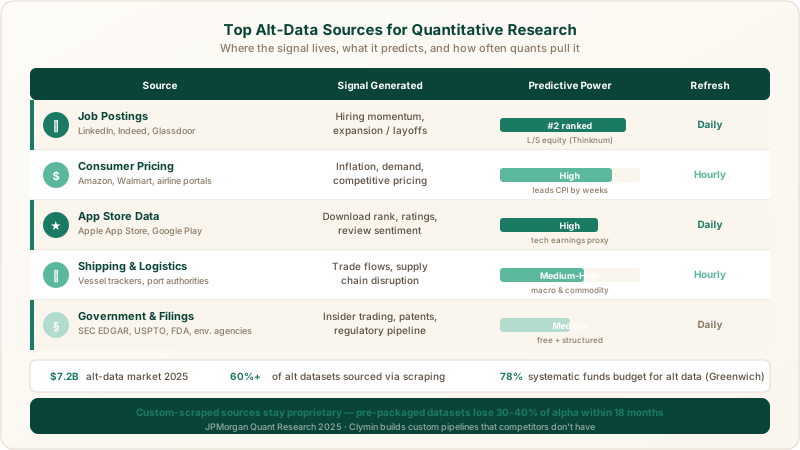
Shipping and logistics data scraped from vessel tracking platforms and port authority databases measures global trade flows in near real-time. Commodity traders and macro funds use this data to forecast supply imbalances before official trade statistics are published.
Government and regulatory filings from the SEC EDGAR database, patent offices, and environmental agencies contain structured signals about corporate activity. While EDGAR data is freely available, extracting and structuring it at scale requires automated pipelines that transform raw HTML filings into queryable datasets.
How Do Quant Teams Build Web Scraping Data Pipelines?
Building reliable data pipelines for quantitative research requires a different approach than standard web scraping. Financial-grade pipelines demand strict data quality controls, point-in-time accuracy, and audit trails that withstand compliance review.
Source identification and feasibility
Quantitative researchers first identify which web sources contain signals relevant to their strategy. A long/short equity fund focused on retail might prioritize foot traffic proxies, e-commerce pricing, and job posting data. A macro fund might focus on shipping data, government economic indicators, and commodity pricing aggregators.
Schema design and normalization
Raw scraped data is messy. Financial researchers need consistent schemas that normalize data across sources, handle missing values, and maintain historical point-in-time snapshots. Point-in-time accuracy is critical for backtesting, using data that was available at the time of each historical decision, not data that was retroactively revised.
Quality assurance and anomaly detection
Quantitative datasets must flag anomalies before they corrupt models. Automated QA checks verify record counts, detect schema drift, flag statistical outliers, and validate data freshness. A single corrupted data delivery can generate false signals and trigger costly trading errors.
Delivery and integration
Clean datasets flow into quantitative research platforms via API, cloud storage (S3, GCS), or direct database integration. Clymin delivers structured data in JSON, CSV, or via custom API solutions that plug directly into existing quantitative research workflows, eliminating the engineering overhead of maintaining extraction infrastructure in-house.
What Compliance Rules Apply to Web Scraping for Finance?
Compliance is non-negotiable in quantitative finance. Funds that scrape data without proper legal review risk regulatory action, reputational damage, and potential violations of securities law.
Evidence supporting this:
- The 2022 hiQ Labs v. LinkedIn Supreme Court decision affirmed that scraping publicly available data does not violate the Computer Fraud and Abuse Act (CFAA), establishing important legal precedent for alternative data sourcing
- The SEC's 2024 guidance on alternative data emphasized that funds must document their data sourcing processes and ensure scraped data does not contain material non-public information (MNPI)
- GDPR and CCPA impose strict requirements on collecting personal data, even from public sources, requiring anonymization or explicit consent for any personally identifiable information
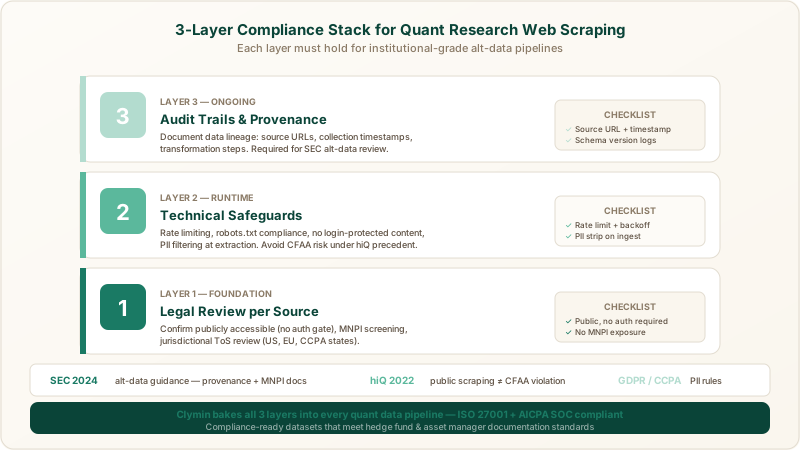
Quantitative researchers should implement a three-layer compliance framework. First, legal review of each data source before scraping begins, confirming that the data is publicly available and does not require authentication to access. Second, technical safeguards including rate limiting, robots.txt compliance, and avoidance of any login-protected content. Third, ongoing audit trails documenting data provenance, collection timestamps, and transformation steps.
Clymin operates under ISO 27001 certification and AICPA SOC compliance, providing the security infrastructure that institutional investors require. With over a decade of experience in data extraction, Clymin builds compliance-ready data pipelines that meet the documentation standards hedge funds and asset managers demand from their alternative data vendors.
Three-layer compliance framework for web scraping in quantitative finance
How Does Web Scraping Compare to Buying Alternative Data from Vendors?
Quantitative researchers face a build-versus-buy decision when sourcing alternative data. Purchasing pre-packaged datasets from vendors like Quandl (Nasdaq), Bloomberg Second Measure, or Thinknum provides convenience but comes with significant trade-offs.
Pre-packaged alternative datasets are available to every subscriber simultaneously, eliminating any informational edge. According to a 2025 J.P. Morgan quantitative research note, alpha decay for widely distributed alternative datasets accelerates by approximately 30-40% within 18 months of broad commercial availability. Custom web scraping, by contrast, produces proprietary datasets that competitors do not have access to.
Cost is another factor. Enterprise alternative data subscriptions typically range from $50,000 to $500,000 annually per dataset. A managed web scraping service like Clymin can extract equivalent data from the same underlying sources at a fraction of that cost, while also allowing full customization of the data schema, refresh frequency, and coverage universe.
The primary advantage of buying from established vendors is speed to deployment and pre-built compliance documentation. Funds with limited engineering resources may prefer this trade-off. However, funds seeking genuine alpha from alternative data increasingly invest in custom extraction pipelines, either built in-house or through managed AI-powered scraping services that handle the technical complexity.
How Clymin Powers Quantitative Research Data Pipelines
Clymin serves as the data infrastructure layer for quantitative research teams that need reliable, structured alternative data without the burden of maintaining scraping infrastructure. Rather than hiring a team of data engineers to build and maintain custom scrapers, researchers can leverage Clymin's fully managed service to focus on signal generation and model development.
With hundreds of projects delivered and 100 billion+ data points extracted across industries, Clymin brings enterprise-scale extraction capabilities to financial services. Data is delivered on custom schedules, hourly, daily, or weekly, in formats that integrate directly with popular quantitative research platforms. Lisa R., a client in financial services, reported that decision-making speed improved by 25% after implementing Clymin's structured financial data extraction services.