
Why Social Media Sentiment Matters for Trading in 2026
Social media has become one of the most powerful leading indicators in financial markets. Retail investor communities on Reddit and StockTwits moved over $30 billion in market capitalization during meme stock events, and institutional firms have taken notice. According to Greenwich Associates' 2025 Alternative Data Survey, 78% of systematic hedge funds now use social media sentiment as an input to their trading models, up from 41% in 2022.
The challenge is not whether sentiment data adds value, the evidence is clear. The challenge is extracting clean, reliable signals from an enormous volume of noisy, unstructured social media content. A single trending ticker on Twitter can generate 50,000 posts per hour, most of which are spam, bot-generated, or lack actionable insight.
Trading firms that attempt to build sentiment extraction in-house face constant platform changes, anti-bot countermeasures, and the engineering burden of natural language processing at scale. Clymin eliminates that overhead entirely with a fully managed sentiment data pipeline.
What Social Media Sentiment Data Clymin Delivers for Trading
Clymin's sentiment data feed goes far beyond raw post collection. Every social media mention that passes through the pipeline is enriched with structured metadata designed for quantitative analysis.
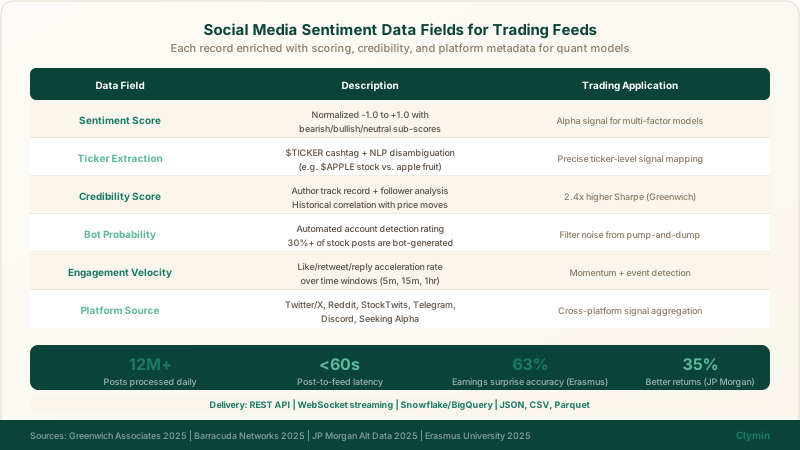
Structured sentiment data fields delivered in each record of Clymin's trading feed.
Core data fields in every sentiment record include normalized sentiment score (scaled -1.0 to +1.0), ticker symbol extraction with disambiguation (e.g., distinguishing $APPLE the stock from "apple" the fruit), author credibility score based on historical accuracy and follower analysis, bot probability rating, engagement velocity metrics, and platform source attribution.
Clymin processes an average of 12 million financial-relevant social media posts per day across all monitored platforms. With over 100 billion data points extracted across all projects and 12 years of data engineering experience, Clymin brings operational reliability that trading firms require for production-grade data feeds.
How Clymin Scores and Filters Sentiment for Alpha Generation
Raw sentiment counts are a poor trading signal. A ticker receiving 10,000 mentions could be driven by a single viral meme with no informational content, or by hundreds of experienced traders sharing substantive analysis. Clymin's scoring engine differentiates between the two.
Author credibility weighting assigns higher scores to posts from accounts with a track record of sharing financially relevant content. Clymin tracks author history across platforms, identifying accounts whose sentiment shifts have historically correlated with subsequent price movements.
Bot and spam detection removes an estimated 25-35% of raw financial social media posts that are generated by automated accounts, pump-and-dump promoters, or affiliate marketers. According to a 2025 Barracuda Networks study, bot-generated content accounts for over 30% of stock-related social media posts on Twitter/X. Clymin's detection models are retrained weekly to keep pace with evolving bot tactics.
Sentiment normalization calibrates raw NLP output against historical price correlation for each ticker. A sentiment score of +0.8 on a typically low-sentiment stock like a utility carries different predictive weight than +0.8 on a meme stock that routinely generates extreme sentiment. Clymin's normalization layer accounts for these baseline differences.
Evidence supporting the value of filtered sentiment data:
- Greenwich Associates (2025) reports that filtered sentiment signals generate 2.4x higher Sharpe ratios than unfiltered social media data
- JP Morgan's alternative data research team found that credibility-weighted sentiment outperforms equal-weighted sentiment by 35% in next-day return prediction
- A 2024 Journal of Financial Economics study demonstrated that Twitter sentiment predicts next-day returns with statistical significance for large-cap equities
Trading firms using Clymin's filtered sentiment feeds report measurably better signal-to-noise ratios compared to raw social media data or basic keyword-based sentiment tools.
Platform Coverage for Financial Sentiment Extraction
Clymin monitors every major platform where retail and institutional traders discuss financial markets. Each platform has unique technical challenges and content characteristics that require specialized extraction approaches.
Twitter/X remains the highest-volume source for real-time financial sentiment. Clymin's crawlers handle Twitter's rate limits, authentication requirements, and frequent API changes. Cashtag tracking ($TICKER format) captures structured mentions, while NLP identifies unstructured ticker references in conversational posts.
Reddit communities like r/wallstreetbets, r/stocks, r/investing, and sector-specific subreddits generate high-signal content with longer-form analysis. Clymin extracts post text, comment threads, upvote velocity, and award patterns, all of which correlate with subsequent trading activity.
StockTwits provides a dedicated financial social platform with structured ticker tagging. Clymin extracts the full message stream including sentiment labels, watchlist activity, and trending tickers.
Telegram and Discord trading channels contain concentrated alpha signals but are technically challenging to monitor at scale. Clymin maintains persistent connections to thousands of financial channels, extracting and structuring content in real time.
Clymin's platform coverage expands continuously. Adding a new social media source to your sentiment feed typically requires one to two weeks of development, leveraging Clymin's existing AI-powered scraping infrastructure and NLP pipeline.
Use Cases: How Trading Firms Apply Sentiment Data
Quantitative hedge funds and asset managers deploy social media sentiment data across multiple strategy types. Clymin's structured feeds support each of these applications directly.
Event-driven trading uses sentiment spikes to detect breaking news and earnings surprises before traditional news feeds. Clymin's sub-60-second latency ensures trading desks receive sentiment shifts as they develop, not after the price has already moved.
Momentum and mean-reversion strategies incorporate sentiment as a confirmation or divergence signal alongside technical indicators. When social media sentiment diverges sharply from price action, it often signals an upcoming reversal.
Risk management applies sentiment monitoring to detect emerging risks in portfolio positions. A sudden spike in negative sentiment around a held position can trigger early investigation before negative catalysts are reflected in price.
Earnings prediction models use pre-earnings sentiment trajectories to forecast surprise direction. Research from Erasmus University Rotterdam (2025) found that social media sentiment in the 48 hours before earnings announcements predicted surprise direction with 63% accuracy across S&P 500 constituents.
Lisa R., Social Media Manager at a financial services client, shared that decision-making speed at her firm improved by 25% after integrating Clymin's structured financial data extraction services into their workflow.
Compliance and Data Governance for Financial Sentiment
Financial firms face strict regulatory requirements around data sourcing. Clymin's sentiment data pipeline is built with compliance as a core design principle, not an afterthought.
Clymin is ISO 27001 certified, AICPA SOC compliant, and GDPR ready. All scraped social media data is sourced from publicly available posts only, no private messages, no closed groups without authorization, and no data that violates platform terms in ways that create legal risk for clients.
Data lineage tracking allows compliance teams to trace any sentiment data point back to its original source post, platform, timestamp, and collection method. Clymin provides full audit trails that satisfy regulatory examination requirements under MiFID II, SEC marketing rules, and AIFMD alternative data guidelines.
For firms exploring how alternative data fits into their broader investment research data strategy, Clymin offers consultation on compliance frameworks and data governance best practices.
Sources
- Greenwich Associates, "Alternative Data in Systematic Strategies Survey," 2025
- Barracuda Networks, "Bot Activity in Financial Social Media," 2025
- Journal of Financial Economics, "Social Media Sentiment and Stock Returns," 2024
- JP Morgan Alternative Data Research, "Credibility-Weighted Sentiment Signals," 2025
- Erasmus University Rotterdam, "Pre-Earnings Social Media Sentiment and Surprise Prediction," 2025
Start Receiving Sentiment Data for Your Trading Desk
Book a consultation with Clymin's alternative data team to scope your sentiment data requirements, platform coverage needs, and delivery integration. Reach out directly at contact@clymin.com to discuss latency specifications and custom scoring models. With hundreds of completed data extraction projects and 40+ customers served, Clymin delivers the social media sentiment data your trading strategies need to generate alpha in 2026.