
Why Traditional Rate Shopping Falls Short
Traditional rate shopping tools capture competitor prices once or twice per day through scheduled crawls. Revenue managers receive a snapshot, not a continuous picture, of their competitive landscape. Between snapshots, competitors adjust rates, launch flash sales, or sell out room categories without detection.
The gap creates blind spots. A 2025 Phocuswright study found that 43% of meaningful competitor rate changes occur outside standard rate shopping windows. Hotels relying solely on daily snapshots miss nearly half the pricing signals that should inform their strategy.
Manual rate shopping compounds the problem. Revenue managers at mid-size hotel groups spend 15-25 hours per week checking OTA platforms individually, time that should go toward analysis and strategy rather than data collection.
Clymin's hotel rate scraping service eliminates these gaps by monitoring competitor rates continuously. Detection happens within 15-30 minutes of any price change, giving revenue teams actionable intelligence rather than stale snapshots.
Step 1: Define Your Competitive Set and Data Requirements
Effective revenue management starts with the right competitive intelligence scope. Identify three tiers of competitors:
Direct competitors include properties within your star rating, price range, and geographic proximity. These are the hotels guests compare against yours during the booking process. Most properties have 5-8 direct competitors.
Aspirational competitors represent properties one tier above yours in pricing or quality. Monitoring their rates reveals pricing ceilings and upgrade opportunities.
Market indicators are high-volume properties (large chain hotels, airport properties) whose occupancy and pricing reflect overall market demand. Rate movements at these properties signal demand shifts before they appear in your booking curve.
For each competitor, define the data fields you need: base room rate, room category rates, package prices, length-of-stay restrictions, cancellation policy terms, and promotional offers. Clymin extracts all these fields automatically and delivers them in a structured format ready for analysis.
Step 2: Establish Continuous Data Collection
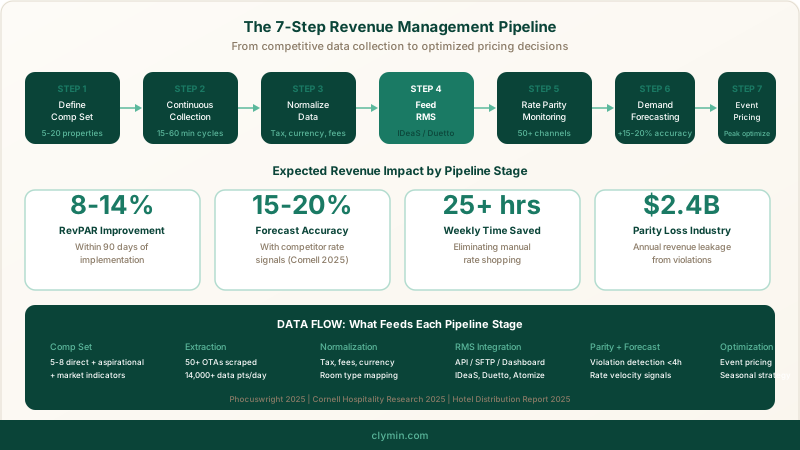
Switch from scheduled snapshots to continuous monitoring. The extraction frequency should match your market's rate volatility:
High-volatility markets (resort destinations, convention cities, urban markets with 4+ major events monthly) benefit from 15-minute extraction cycles during peak demand periods. Clymin automatically increases monitoring frequency when it detects elevated rate movement across your competitive set.
Standard markets perform well with 30-60 minute cycles. This frequency captures the vast majority of meaningful rate changes while maintaining efficient data processing.
Low-season periods can operate on 2-4 hour cycles when rate movement is minimal. Clymin adjusts frequency dynamically based on detected market activity.
The key infrastructure requirements include proxy rotation to avoid blocking, browser rendering for JavaScript-heavy OTA sites, and data validation to catch extraction errors before they reach your RMS. Clymin handles all of these through its managed service model, no internal engineering resources required.
Step 3: Normalize and Structure Rate Data
Raw scraped data from different OTAs arrives in inconsistent formats. Booking.com displays rates with taxes included in some markets and excluded in others. Expedia bundles resort fees differently than Hotels.com. Agoda shows member-only rates that standard rate shoppers miss.
Normalization transforms raw extractions into comparable data points:
- Tax standardization: Convert all rates to a consistent tax treatment (typically pre-tax for internal analysis)
- Fee inclusion: Account for resort fees, destination fees, and service charges that vary by platform
- Currency conversion: Apply real-time exchange rates for international competitive sets
- Room type mapping: Match competitor room categories to your own (a "Deluxe King" at one property may equal a "Superior Room" at another)
Clymin's normalization engine handles these transformations automatically using property-specific mapping rules configured during onboarding. Revenue managers receive clean, comparable data without manual cleanup.
Step 4: Feed Intelligence Into Your Revenue Management System
The highest-impact integration point is your revenue management system (RMS). Modern platforms like IDeaS, Duetto, and Atomize accept external competitive rate feeds that enhance their pricing algorithms.
Clymin delivers data through three integration methods:
API integration provides real-time access to competitive rate data. Your RMS queries Clymin's API for the latest rates whenever it runs a pricing optimization cycle. This method offers the freshest data with minimal latency.
Scheduled file delivery via SFTP works for RMS platforms that import competitive data on fixed schedules. Clymin generates formatted files matching your system's import specifications at your required frequency.
Dashboard access through Clymin's web interface gives revenue managers visual competitive analysis alongside raw data exports. Use the dashboard for strategic analysis and the API/SFTP feeds for automated RMS integration.
Most Clymin hotel clients use a combination: API feeds for automated RMS optimization plus dashboard access for human strategic oversight.
Step 5: Implement Rate Parity Monitoring
Rate parity violations cost hotel groups an estimated $2.4 billion annually according to the Hotel Distribution Report 2025. Web scraping provides the detection capability that manual auditing cannot match.
Monitor every OTA displaying your rates for unauthorized discounting. When a platform shows rates below your contracted minimum, automated alerts trigger immediate investigation. Clymin's OTA price monitoring service captures violation evidence including screenshots, timestamps, and rate comparisons for contract enforcement.
Rate parity monitoring should cover:
- All contracted OTA partners (typically 10-15 platforms)
- Meta-search engines (Google Hotel Ads, TripAdvisor, Trivago)
- Wholesale and opaque channels where rate leakage commonly occurs
- Mobile-specific rates that may differ from desktop pricing
Clymin monitors 50+ distribution channels simultaneously, detecting parity violations within hours rather than the days or weeks typical of manual auditing.
Step 6: Build Demand Forecasting Models
Competitor rate movements serve as leading demand indicators. When competitors raise rates or restrict availability, incoming demand is increasing. When competitors drop rates aggressively, market softening may require preemptive adjustments.
Build forecasting models that incorporate:
Competitor rate velocity: The speed and magnitude of rate changes across your competitive set. Rapid upward movement signals booking surges that your property should capture.
Availability signals: When competitors sell out specific room categories or close dates to sale, demand exceeds supply. Your pricing should reflect this compression.
Promotional activity: An increase in competitor promotional offers (flash sales, package deals, loyalty bonuses) indicates weakening demand where proactive pricing adjustments prevent occupancy losses.
Cornell Hospitality Research's 2025 pricing study found that hotels incorporating competitor rate signals into demand forecasts improve accuracy by 15-20% compared to models relying solely on internal booking data.
Clymin feeds these signals into your forecasting workflow through travel data extraction services that cover both rate data and availability indicators across your market.
Step 7: Optimize Event and Seasonal Pricing
High-demand events represent the most significant revenue opportunities, and the highest cost of getting pricing wrong. During major conventions, concerts, or sporting events, competitor rates may change multiple times per day.
Historical scraped data from previous events provides pricing benchmarks. Review how competitors priced during last year's event:
- What was the peak rate achieved?
- How far in advance did rates start climbing?
- What was the rate trajectory in the final 72 hours?
- Which competitors held firm on pricing versus discounting unsold inventory?
Clymin stores 12+ months of historical rate data for every monitored competitor. Revenue managers access this history through the dashboard to inform future event pricing strategy.
Real-time monitoring during events enables tactical adjustments. If competitors sell out faster than expected, there is room to push rates higher. If the market softens unexpectedly, early detection prevents holding prices too high and losing bookings.
Step 8: Measure and Iterate
Track the revenue impact of data-driven pricing decisions:
RevPAR improvement is the primary metric. Compare monthly RevPAR against the same period in the prior year, controlling for market-wide changes using STR data. Hotels using Clymin typically see 8-14% RevPAR gains within 90 days.
Rate positioning accuracy measures how often your rates align with your strategic intent relative to competitors. If your strategy targets the 75th percentile of your competitive set, measure how frequently you achieve that positioning.
Response time tracks the gap between a competitor rate change and your adjustment. Before Clymin, this gap averages 24+ hours. After implementation, it drops to under 2 hours for most properties.
Parity compliance rate measures the percentage of time your rates display correctly across all distribution channels. Improvement here directly reduces revenue leakage from unauthorized discounting.
Review these metrics monthly and adjust your competitive set, monitoring parameters, and pricing strategies accordingly. Clymin's account team provides quarterly strategic reviews to optimize your hospitality competitive intelligence data program.
Get Started With Data-Driven Revenue Management
Clymin configures a complete competitive intelligence solution within 5 business days for most hotel properties. The team handles all technical setup, proxy infrastructure, extraction configuration, data normalization, and RMS integration, so your revenue managers focus on strategy rather than data engineering.
Contact the team at contact@clymin.com or book a meeting to discuss your competitive set, integration requirements, and revenue management goals.