
Why Web Scraping Matters for Financial Analysis in 2026
Alternative data has moved from a competitive edge to a baseline requirement for institutional investors. According to Grand View Research's 2025 Alternative Data Market report, the global alternative data market reached $7.1 billion in 2025 and is projected to grow at 24.4% CAGR through 2030. Financial analysts who rely solely on traditional data feeds from Bloomberg, Refinitiv, or FactSet are working with the same information as every other firm.
Web scraping fills this gap by collecting non-consensus data points that are publicly available but not packaged into standard financial data products. Job posting volumes on LinkedIn and Indeed can signal hiring acceleration or layoffs weeks before quarterly earnings. Product pricing changes on Amazon and Walmart reveal consumer demand shifts in real time. Shipping container tracking data from port authority websites provides supply chain visibility that traditional feeds miss entirely.
For quantitative researchers and financial analysts in San Francisco, New York, and London, web scraping has become essential infrastructure for generating differentiated investment signals.
What Types of Financial Data Can You Scrape?
Web scraping for financial analysis covers five primary data categories, each offering unique analytical value.
Pricing and Transaction Data. Extracting real-time product prices from e-commerce platforms, commodity prices from exchange websites, and real estate transaction data from listing sites provides forward-looking indicators of consumer spending and asset valuations. According to a 2025 Greenwich Associates survey, 63% of buy-side firms now use scraped pricing data in their quantitative models.
Sentiment and Review Data. Consumer reviews on platforms like Yelp, Google Reviews, and Trustpilot serve as proxies for brand health and revenue trajectory. Natural language processing applied to scraped reviews can quantify sentiment shifts before they appear in earnings reports.
Employment and Hiring Data. Job postings scraped from Indeed, Glassdoor, and LinkedIn provide leading indicators of company growth or contraction. A 2025 Deloitte study found that changes in job posting volume predict revenue growth with 71% accuracy when tracked over rolling 90-day windows.
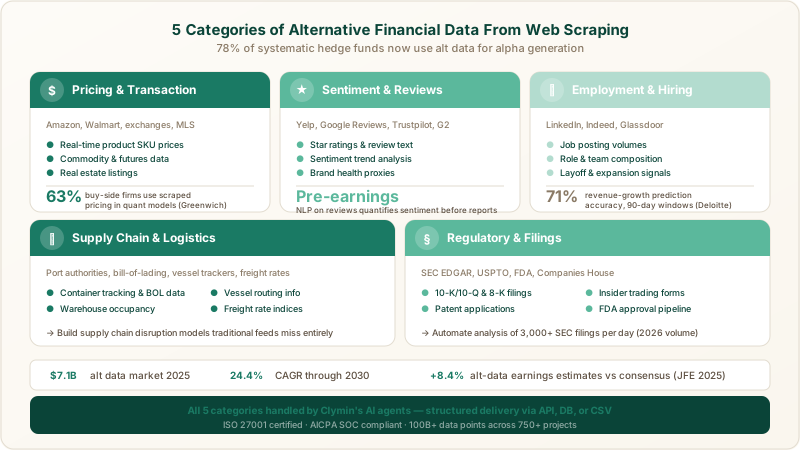
Five categories of alternative financial data accessible through web scraping
Supply Chain and Logistics Data. Port authority filings, shipping tracker websites, and freight rate platforms offer visibility into global trade flows. Analysts scrape bill of lading data, vessel tracking information, and warehouse occupancy rates to build supply chain disruption models.
Regulatory and Filing Data. SEC EDGAR filings, patent applications from USPTO, and FDA approval databases contain structured data that can be extracted and parsed faster than manual review. Scraping these sources at scale enables systematic analysis of insider trading patterns, patent trends, and regulatory pipeline activity.
How to Build a Web Scraping Pipeline for Financial Data
Building an effective financial data scraping pipeline requires five key steps, each with specific considerations for the financial industry.
Define Your Investment Thesis
Start with the analytical question, not the data. A clear hypothesis, such as "job posting volume at SaaS companies predicts quarterly revenue growth", determines which sources to scrape and what data points to extract. Unfocused scraping produces noise, not signal.
Identify and Prioritize Data Sources
Map each hypothesis to specific public web sources. For consumer spending analysis, prioritize e-commerce platforms and review sites. For macro indicators, target government statistics portals and central bank publications. Clymin's AI agents can evaluate source reliability and data freshness across hundreds of financial data sources simultaneously.
Handle Anti-Scraping Infrastructure
Financial data sources, especially job boards and e-commerce platforms, use sophisticated anti-bot measures including CAPTCHAs, rate limiting, and browser fingerprinting. According to Imperva's 2025 Bot Management Report, 47% of all web traffic is now automated, which has driven platforms to implement increasingly aggressive detection. Managed scraping services handle these challenges without requiring in-house engineering resources.
Clean and Normalize Extracted Data
Raw scraped data requires significant transformation before it enters financial models. Price fields need currency normalization. Date formats vary across sources. Duplicate records must be deduplicated. Clymin's data cleansing and transformation services handle this processing so analysts receive model-ready datasets.
Integrate with Analytical Workflows
Deliver cleaned data via REST API, direct database integration, or cloud storage (S3, GCS) to feed existing quantitative models, dashboards, and backtesting frameworks. The delivery format and frequency should match your analytical cadence, daily for trading signals, weekly for fundamental research.
What Compliance Rules Apply to Financial Data Scraping?
Compliance is the most critical consideration when using web scraping for financial analysis. Financial institutions face regulatory scrutiny that general-purpose scraping projects do not.
Evidence supporting this:
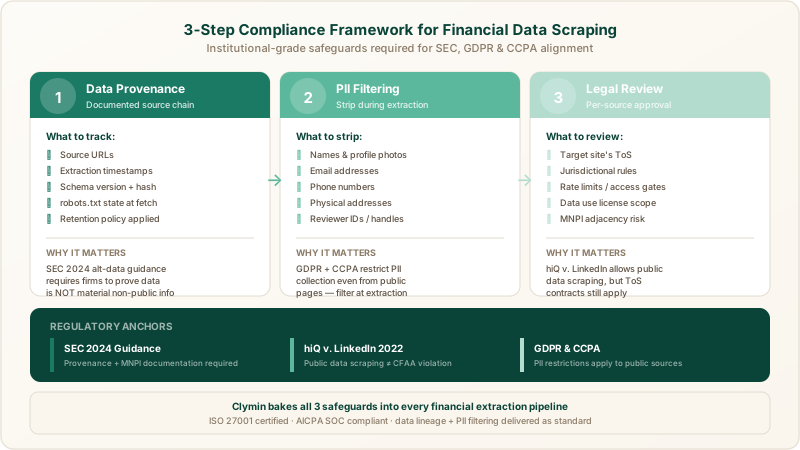
- The SEC's 2024 guidance on alternative data usage requires firms to document data provenance and demonstrate that scraped data does not constitute material non-public information (MNPI)
- The 2022 hiQ Labs v. LinkedIn Supreme Court decision established that scraping publicly available data is not a violation of the Computer Fraud and Abuse Act, but does not override contractual terms of service
- GDPR and CCPA regulations restrict collection of personally identifiable information even from public sources, requiring careful filtering during the extraction process
Financial analysts should implement three compliance safeguards. First, maintain a documented data provenance chain showing exactly which public sources were scraped and when. Second, filter out all personally identifiable information during extraction, names, email addresses, and phone numbers should never enter financial datasets. Third, establish a legal review process for new data sources before scraping begins. Clymin maintains ISO 27001 certification and AICPA SOC compliance, ensuring that data handling meets institutional-grade security standards.
Three-step compliance framework for financial data scraping
Real-World Use Cases: How Financial Firms Use Scraped Data
Financial institutions apply web scraping across multiple analytical disciplines, each generating measurable returns.
Earnings Estimate Refinement. Quantitative analysts scrape product pricing from major retailers to build bottom-up revenue models. By tracking SKU-level pricing changes across Amazon, Walmart, and Target, analysts can estimate quarterly revenue for consumer-facing companies 2-3 weeks before official earnings releases. A 2025 Journal of Financial Economics study found that alternative data-derived earnings estimates outperformed consensus estimates by 8.4% on average.
Credit Risk Assessment. Fintech lenders scrape business review data, social media activity, and web traffic metrics to supplement traditional credit scoring models. Scraped data signals, such as declining review sentiment or reduced job posting activity, provide early warning of financial distress that balance sheet analysis alone misses.
Real Estate Investment Analysis. Property listing data scraped from Zillow, Redfin, and regional MLS sites enables real-time market valuations that traditional appraisal methods cannot match. Clymin has delivered structured property data extraction projects for investment firms that need daily coverage across thousands of markets.
Macro Economic Indicators. Central bank publications, government statistics portals, and trade data from customs authorities provide macro signals when extracted and normalized systematically. Analysts scrape these sources to build proprietary economic indicators that update faster than official releases.
How Clymin Powers Financial Data Extraction
Clymin provides financial institutions with a fully managed alternative data extraction service built for institutional-grade requirements. Rather than hiring data engineers to build and maintain fragile scraping infrastructure, financial analysts can focus on analysis while Clymin handles extraction, cleansing, and delivery.
With hundreds of projects delivered across industries and 100 billion+ data points extracted, Clymin brings proven scale to financial data challenges. Data is delivered via REST API, custom API integration, or direct database feeds, ready to plug into quantitative models, risk dashboards, and backtesting frameworks. Lisa R., a client in financial services, reported that decision-making speed improved by 25% after implementing Clymin's structured data extraction pipeline.