
The Pricing Intelligence Gap Hotels Face Today
Revenue managers make hundreds of pricing decisions weekly. Each decision, whether to raise rates for a specific date, close a discount tier, or launch a promotional offer, depends on understanding what competitors charge, how demand is trending, and where rates sit relative to perceived value.
Most hotels operate with incomplete information. Traditional rate shopping captures prices once or twice daily, missing the 43% of competitor rate changes that occur between snapshots according to Phocuswright's 2025 hospitality data study. Manual OTA checks consume 15-25 hours per week for mid-size hotel teams, time spent on data collection rather than strategic analysis.
The result: pricing decisions based on yesterday's data in a market where rates change hourly. Hotels that close this gap with continuous scraped data consistently outperform their competitive set.
Step 1: Map Your Pricing Decision Framework
Before collecting data, clarify the pricing decisions scraped data needs to support:
Daily rate setting requires competitor rates by room category for the next 90-365 days. Revenue managers need to see where their rates sit relative to 5-8 direct competitors across standard, deluxe, and suite categories.
Promotional timing needs visibility into competitor promotional activity. When competitors launch weekend packages or extended-stay discounts, your promotional calendar should respond, either by matching offers or differentiating with alternative value propositions.
Length-of-stay optimization benefits from competitor restriction data. Knowing that competitors require 2-night minimums during a specific event allows you to capture single-night demand at premium rates, or match their restrictions to protect ADR.
Channel pricing requires rate parity monitoring across all distribution partners. Your own rates on Booking.com, Expedia, and direct channels must align with your strategy.
Clymin configures extraction parameters around your specific decision framework during onboarding, ensuring the data you receive maps directly to the decisions you make.
Step 2: Collect Competitive Rate Data at Scale
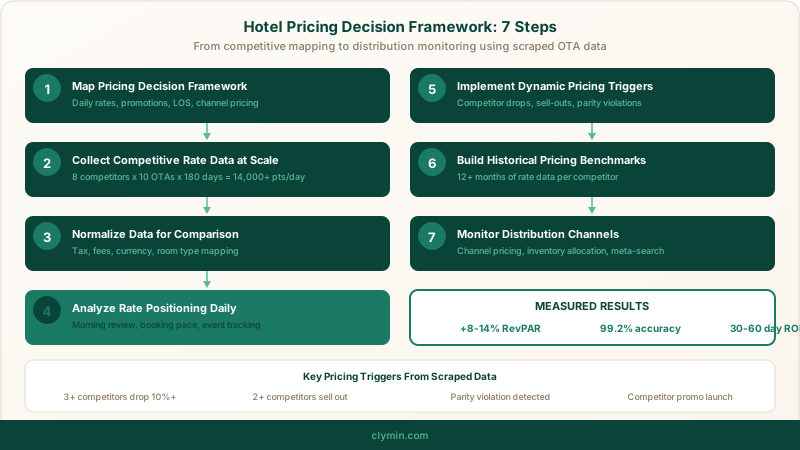
Effective pricing intelligence requires data from multiple sources simultaneously. A single competitor's rate on a single OTA tells you little. The same competitor's rates across 5 platforms, combined with 7 other competitors, reveals market positioning and demand signals.
Clymin's hotel rate scraping service extracts the following data points per competitor per OTA:
- Base room rate by category (standard, deluxe, suite, etc.)
- Rate with taxes and fees (for true cost comparison)
- Package rates (room + breakfast, room + parking, etc.)
- Member and loyalty rates (where visible)
- Cancellation policy terms and penalties
- Availability status (open, limited, sold out)
- Minimum/maximum length-of-stay restrictions
- Promotional flags and discount percentages
This extraction runs continuously across your defined competitive set. For a typical hotel monitoring 8 competitors across 10 OTAs for the next 180 days, Clymin processes over 14,000 rate data points daily.
Step 3: Normalize Data for Accurate Comparison
Raw scraped data requires normalization before it supports pricing decisions. OTA platforms display rates inconsistently:
Tax treatment varies by market. Booking.com shows tax-inclusive rates in European markets but tax-exclusive in most US markets. Expedia handles resort fees differently than Agoda. Without normalization, you compare rates that represent different total costs to the guest.
Room type naming differs by property. Your "Deluxe King" maps to a competitor's "Superior Room" or "Premium King." Clymin builds property-specific room type mappings during setup so comparisons reflect equivalent products.
Currency and fee structures complicate international competitive sets. Clymin applies real-time currency conversion and standardizes fee inclusion to produce genuinely comparable rates.
The normalization layer is where managed services like Clymin differentiate from DIY scraping. Building and maintaining normalization rules across 50+ OTAs and dozens of competitors requires ongoing engineering that distracts from revenue management priorities.
Step 4: Analyze Rate Positioning Daily
With normalized data flowing into your workflow, establish a daily analysis routine:
Morning competitive review examines overnight rate changes across your competitive set for the next 7-14 days. Identify any significant movements, a competitor dropping rates 15% for next weekend signals potential demand softening or a targeted promotion.
Booking pace comparison overlays your internal booking pace against competitor availability signals. If competitors are selling out faster than you, your rates may be too high or your distribution strategy needs adjustment. If you are pacing ahead while competitors still have inventory, there may be room to push rates up.
Event-period rate tracking monitors pricing trends for specific high-demand dates. Track competitor rates for major events starting 90+ days out to understand rate trajectories and set your own pricing strategy accordingly.
Clymin's dashboard surfaces these analyses automatically, highlighting meaningful rate movements and positioning shifts rather than requiring manual comparison across dozens of data points.
Step 5: Implement Dynamic Pricing Triggers
Convert analysis into automated pricing responses. Define rules that trigger rate adjustments based on scraped competitive data:
Competitor rate drop triggers: When 3+ competitors in your set drop rates for a specific date by 10%+ within 24 hours, evaluate whether to follow (demand is weakening) or hold (competitors may be panicking prematurely).
Sell-out triggers: When 2+ competitors sell out a room category, increase your rates for the equivalent category. Reduced market supply supports higher pricing.
Parity violation triggers: When your rates appear below contracted minimums on any OTA, flag for immediate investigation and correction through Clymin's OTA price monitoring service.
Promotional matching triggers: When a competitor launches a package offer that undercuts your positioning, evaluate whether to respond with a comparable offer or differentiate with alternative inclusions.
These triggers can feed directly into your RMS through Clymin's API integration, enabling semi-automated pricing responses that execute within hours rather than days.
Step 6: Build Historical Pricing Benchmarks
Scraped data accumulates into a historical database that becomes increasingly valuable over time. After 12 months of continuous monitoring, you have a complete picture of:
- How competitors priced during every major event in your market
- Seasonal rate patterns across your competitive set
- Rate elasticity indicators (how much rates moved relative to demand changes)
- Distribution strategy shifts (which OTAs competitors prioritize during different periods)
Clymin stores 12+ months of historical rate data for every monitored competitor. This archive transforms from a cost into an asset as it grows, providing benchmarks that inform pricing decisions for recurring events and seasonal patterns.
Use historical data to set rate floors and ceilings for upcoming periods. If competitors peaked at $299 during last year's convention, that provides a market-validated ceiling for your own pricing strategy.
Step 7: Monitor Distribution Channel Performance
Scraped data reveals how competitors distribute inventory across channels, information that should influence your own distribution strategy:
Channel pricing differentiation shows which competitors offer exclusive rates on specific OTAs. If a competitor consistently offers 5% lower rates on Agoda, they are likely participating in a preferred partner program that you might evaluate for your own distribution mix.
Inventory allocation signals become visible when competitors sell out on one platform while maintaining availability on others. This indicates strategic inventory allocation that prioritizes certain channels.
Meta-search positioning reveals competitor bidding strategies on Google Hotel Ads and TripAdvisor. Clymin captures which competitors appear in meta-search results and at what price points, informing your own meta-search investment.
Clymin's travel data extraction services cover distribution intelligence alongside rate data, giving revenue managers a complete picture of competitive behavior across all channels.
Step 8: Measure Revenue Impact
Track specific KPIs to quantify the return on your pricing intelligence investment:
RevPAR improvement against the prior year and against your competitive set's average. Clymin clients typically see 8-14% RevPAR gains within the first 90 days of implementation.
ADR positioning accuracy measures how frequently your average daily rate aligns with your strategic target relative to competitors. If your strategy targets the 80th percentile of your comp set, measure compliance monthly.
Booking pace improvement tracks whether data-driven pricing decisions increase forward bookings during targeted periods.
Revenue leakage reduction quantifies savings from parity violation detection. Each violation caught and corrected prevents direct booking erosion worth multiples of the monitoring cost.
Start Building Your Pricing Intelligence Stack
Clymin configures a complete competitive pricing intelligence solution within 5 business days. The managed service handles all extraction engineering, data normalization, and system integration so revenue managers focus on strategy.
Contact the team at contact@clymin.com or book a meeting to discuss your competitive set and pricing intelligence needs.