
Why Financial Teams Need Web Data Extraction in 2026
Traditional financial data terminals from Bloomberg and Refinitiv cover standard market feeds, but the fastest-growing edge in finance comes from alternative and unstructured web data. According to Grand View Research's 2025 Alternative Data Market report, the global alternative data market reached $7.2 billion in 2025 and is projected to grow at 24.4% CAGR through 2030, driven by institutional demand for non-traditional alpha signals.
Financial analysts at hedge funds and asset managers increasingly rely on web-sourced data to supplement conventional feeds. Job posting volumes signal hiring momentum before earnings reports. E-commerce pricing shifts reveal consumer demand trends weeks ahead of official retail sales data. Satellite imagery and web traffic metrics provide real-time proxies for foot traffic and revenue.
The challenge is operational: extracting, cleansing, and structuring this data from hundreds of websites, each with different formats, anti-bot protections, and update frequencies, requires significant engineering resources that most financial teams lack internally.
How to Extract Financial Data From Websites: 5 Proven Methods
Financial data extraction spans a range of approaches, from manual techniques to fully managed AI-powered services. Choosing the right method depends on data volume, refresh frequency, and compliance requirements.
Method 1: Direct API Access. Many financial data providers offer REST APIs for structured access. SEC EDGAR provides free API endpoints for company filings. Yahoo Finance, Alpha Vantage, and Polygon.io offer market data APIs with varying rate limits. APIs deliver clean, structured data but cover only sources that choose to offer programmatic access.
Method 2: Custom Web Scrapers. Python libraries like Scrapy, BeautifulSoup, and Selenium allow teams to build custom scrapers targeting specific financial websites. According to a 2025 Stack Overflow Developer Survey, Python remains the dominant language for data extraction tasks, used by 68% of developers building scraping solutions. Custom scrapers offer full control but require ongoing maintenance as source websites change their structure.
Method 3: Browser Automation for Dynamic Content. Financial websites increasingly use JavaScript-heavy interfaces that static scrapers cannot parse. Headless browsers like Playwright and Puppeteer render pages fully before extracting data, capturing dynamically loaded stock charts, real-time tickers, and interactive financial tables.
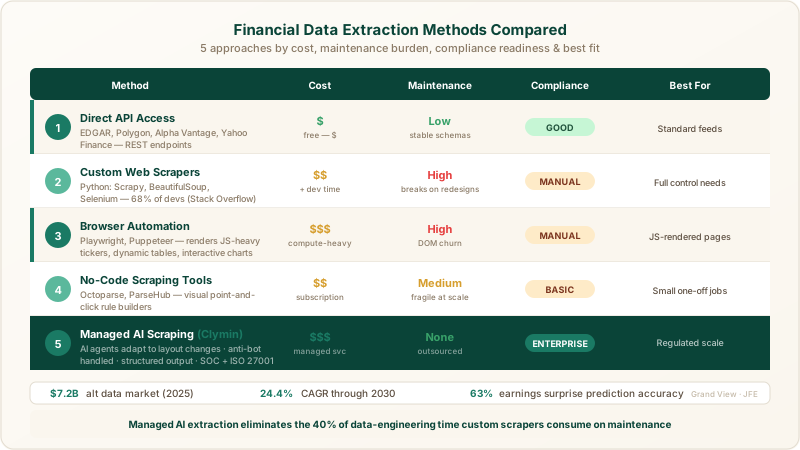
Comparison of financial data extraction methods by cost, maintenance burden, and compliance readiness
Method 4: No-Code Scraping Tools. Platforms like Octoparse and ParseHub offer visual point-and-click interfaces for non-technical users to define extraction rules. These tools work well for small-scale, one-time extractions but struggle with anti-bot protections and complex financial data formats at scale.
Method 5: Managed AI-Powered Scraping Services. Fully managed services handle the entire extraction pipeline, from source identification and scraper configuration to anti-blocking, data cleansing, and scheduled delivery. Clymin's AI-agentic scraping approach deploys intelligent agents that adapt automatically when financial websites change their layouts, eliminating the maintenance burden that breaks custom scrapers.
What Financial Data Sources Are Worth Scraping?
Not all financial websites deliver equal value. The highest-ROI sources for web data extraction fall into four categories, each serving different analytical use cases.
Public Regulatory Filings. SEC EDGAR, Companies House (UK), and SEDAR (Canada) provide free access to 10-K annual reports, 10-Q quarterly filings, 8-K event disclosures, and insider trading forms. According to the SEC, EDGAR processes over 3,000 filings per day as of 2026, making automated extraction essential for comprehensive coverage.
Alternative Data Signals. Job boards (LinkedIn, Indeed, Glassdoor), review platforms (G2, Trustpilot), app stores (Apple App Store, Google Play), and e-commerce marketplaces generate signals that correlate with company financial performance. A 2024 study published in the Journal of Financial Economics found that job posting volume changes predicted earnings surprises with 63% accuracy when combined with traditional fundamental signals.
Economic Indicator Sources. Government statistical agencies (Bureau of Labor Statistics, Eurostat, Reserve Bank of India) publish economic data on fixed schedules. Extracting and structuring these releases into machine-readable formats within minutes of publication gives quantitative researchers a speed advantage over manual data entry.
Industry-Specific Pricing Data. Commodity prices, real estate listings, freight rates, and energy costs published across industry portals provide valuable inputs for sector-specific financial models. Clymin has extracted over 100 billion data points across industries, including structured financial datasets for hedge funds and fintech companies operating in the United States, India, and global markets.
How to Handle Compliance When Scraping Financial Data
Compliance is the single biggest concern for financial teams extracting web data, and failing to address it properly can result in regulatory penalties and reputational damage.
Evidence supporting this:
- The 2022 Ninth Circuit ruling in hiQ v. LinkedIn affirmed that scraping publicly available data does not violate the Computer Fraud and Abuse Act (CFAA) in most circumstances
- The EU's Digital Services Act (2024) and GDPR impose strict requirements on collecting personally identifiable information, even from public profiles
- SEC Rule 10b-5 prohibits trading on material non-public information, which creates boundaries around what scraped data can be used for in investment decisions
Financial teams should follow three compliance principles when extracting web data. First, only scrape publicly accessible pages, never bypass paywalls, login gates, or access controls. Second, avoid collecting personally identifiable information (PII) unless explicitly authorized and GDPR-compliant. Third, document data provenance for every dataset, including source URLs, extraction timestamps, and retention policies.
Clymin builds compliance controls into every financial data extraction project, including data lineage documentation, PII filtering, and adherence to source-specific terms of service. With ISO 27001 certification and AICPA SOC compliance, Clymin meets the security standards that institutional financial clients require.
Best Practices for Structuring Extracted Financial Data
Raw scraped financial data is only valuable after it has been cleansed, normalized, and structured for analysis. Quantitative researchers and data engineers should follow these practices to maximize data quality.
Standardize date formats and timezones. Financial websites publish timestamps in dozens of formats. Normalize all dates to ISO 8601 (YYYY-MM-DD) and store timezone metadata to avoid misalignment between data sources across global markets.
Deduplicate across sources. The same company filing or price data point may appear on multiple aggregator sites. Implement entity resolution using ticker symbols, LEI codes, or CIK numbers to deduplicate records and create a single source of truth.
Version and timestamp every extraction. Financial data changes continuously. Store extraction timestamps alongside every data point so analysts can reconstruct historical states and audit data quality. Clymin delivers every dataset with full extraction metadata including source URL, timestamp, and schema version.
Validate against known benchmarks. Cross-reference extracted stock prices against official exchange feeds and verify filing data against SEC EDGAR originals. Automated validation catches extraction errors before they propagate into models. According to Gartner's 2025 Data Quality report, organizations that implement automated data validation reduce analytical errors by 40% compared to those relying on manual review.
How Clymin Helps Financial Teams Extract Web Data
Clymin provides financial analysts and quantitative researchers with a fully managed extraction service that eliminates the engineering overhead of building and maintaining custom scrapers. Rather than hiring a dedicated data engineering team to handle anti-bot challenges, source monitoring, and schema changes, financial teams get clean, structured data delivered via API, CSV, or direct database integration.
Lisa R., Social Media Manager at a Financial Services Client, reports that decision-making speed improved by 25% with Clymin's structured financial data extraction services. With hundreds of projects delivered across industries and over a decade of data extraction experience, Clymin brings enterprise-grade reliability to financial data pipelines operating in San Francisco, Hyderabad, and global markets.