Why Hedge Funds Are Turning to Web Scraping in 2026
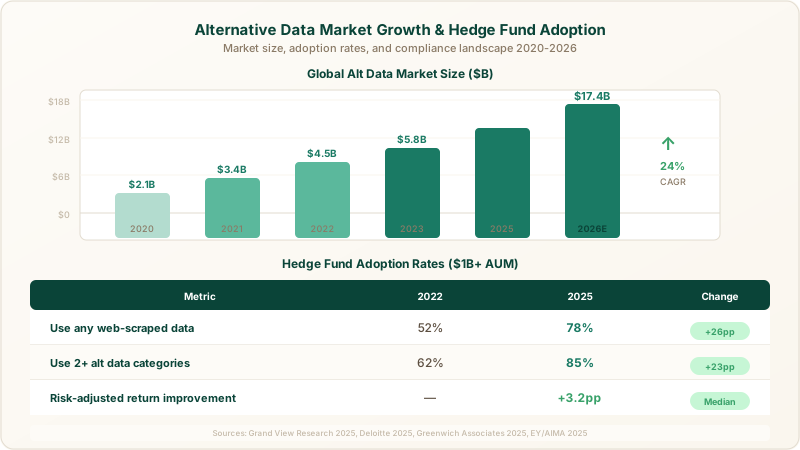
The alternative data market has exploded as hedge funds search for informational edges in increasingly efficient markets. According to Grand View Research's 2025 Alternative Data Market Report, the sector reached $7.5 billion in revenue and is growing at 24% annually through 2030. Traditional financial data feeds, earnings reports, analyst estimates, price feeds, are available to every market participant simultaneously, eliminating any timing advantage.
Web scraping allows hedge funds to build proprietary datasets that competitors cannot easily replicate. A fund scraping real-time job postings from 50,000 company career pages gains hiring trend signals weeks before those trends appear in official Bureau of Labor Statistics reports. A fund monitoring consumer product pricing across 200 e-commerce sites detects demand shifts before quarterly earnings calls.
Deloitte's 2025 Alternative Data in Asset Management survey found that 78% of hedge funds with over $1 billion in assets under management now use at least one form of web-scraped data in their investment process, up from 52% in 2022.
What Alternative Data Do Hedge Funds Scrape?
Hedge funds extract a wide range of web-based datasets, each targeting specific investment signals. The most common categories include consumer behavior data, corporate activity signals, and macroeconomic indicators sourced from publicly available websites.
Consumer Sentiment and Product Data. Funds scrape product reviews from Amazon, Walmart, and specialty retailers to gauge consumer satisfaction before earnings reports. A 2025 study by the Journal of Financial Economics found that aggregated review sentiment predicted quarterly revenue surprises with 63% accuracy for consumer discretionary stocks.
Job Postings and Hiring Trends. Scraping career pages across thousands of companies reveals expansion and contraction signals. When a company posts 40% more engineering roles in a quarter, that signals product investment. When job listings drop sharply, it often precedes layoffs or revenue headwinds.
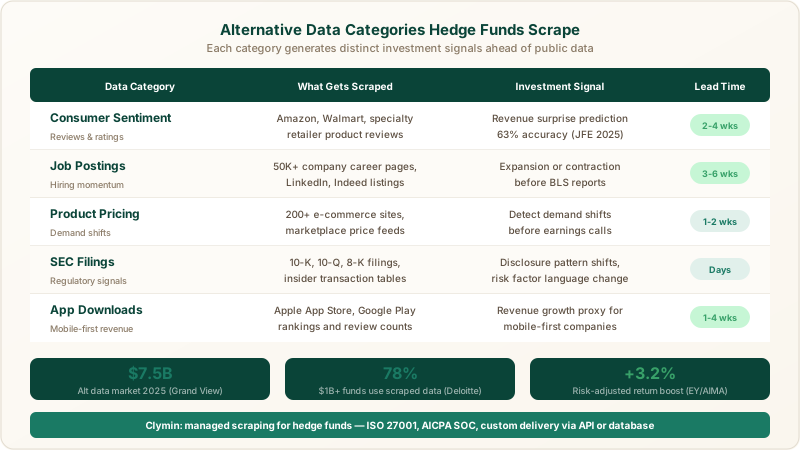
Key alternative data categories that hedge funds extract through managed web scraping services
SEC Filings and Regulatory Data. While SEC EDGAR is publicly available, extracting structured data from thousands of 10-K, 10-Q, and 8-K filings requires automated parsing. Funds scrape filing metadata, insider transaction tables, and risk factor language changes to detect shifts in corporate disclosure patterns.
App Download and Usage Estimates. Scraping app store rankings, review counts, and rating changes across Apple App Store and Google Play provides proxy metrics for mobile-first companies. A surge in app downloads for a food delivery platform can signal revenue growth before the company reports.
How Do Hedge Funds Build Web Scraping Pipelines?
Building a reliable web scraping pipeline for financial alternative data requires infrastructure that goes far beyond writing a basic Python script. Hedge funds need systems that handle anti-bot protections, deliver data on precise schedules, maintain data quality over time, and scale across thousands of sources simultaneously.
Data Freshness Requirements. Financial markets move in milliseconds. Quantitative funds typically need scraped data delivered within minutes to hours of extraction, not days. Pricing data for consumer goods might need hourly updates, while job posting data may be sufficient on a daily cadence. According to Greenwich Associates' 2025 Market Data Study, 67% of systematic funds require alternative data delivery within 4 hours of collection.
Anti-Bot and Rate Limiting Challenges. Major e-commerce platforms, job boards, and social networks deploy sophisticated anti-scraping measures. Maintaining consistent data extraction across these sources requires rotating proxies, browser fingerprint management, and adaptive crawling strategies. Clymin's AI-agentic scraping approach handles these challenges automatically, using intelligent agents that adapt to site changes without manual intervention.
Data Quality and Deduplication. Raw scraped data is noisy. Duplicate entries, format inconsistencies, missing fields, and stale records can produce false investment signals. Cleaning and normalizing alternative data before it enters a quantitative model is critical. Clymin delivers structured, deduplicated datasets in JSON, CSV, or via API, ready for direct integration into analytics pipelines.
What Are the Compliance Risks of Web Scraping for Hedge Funds?
Compliance is a top-of-mind concern for any hedge fund using web-scraped data. The legal landscape has clarified significantly in recent years, but funds must still navigate material non-public information (MNPI) rules, terms of service restrictions, and data privacy regulations.
The 2022 hiQ Labs v. LinkedIn Supreme Court decision affirmed that scraping publicly accessible data does not violate the Computer Fraud and Abuse Act. However, this does not give unlimited permission. Funds must ensure they are only scraping data that is genuinely public, not behind authentication walls, paywalls, or access-controlled APIs.
Evidence supporting careful compliance:
- The SEC fined a hedge fund $10 million in 2024 for trading on scraped data that included material non-public information obtained through a vendor's improper access to a private portal
- The EU's Digital Services Act (2024) introduced new obligations around automated data collection from platforms operating in Europe
- FINRA's 2025 guidance on alternative data explicitly requires documented due diligence on how web-scraped data was collected before using it in investment decisions
Hedge funds working with Clymin benefit from a compliance-first approach to data extraction. With ISO 27001 certification and AICPA SOC compliance, Clymin's processes are designed to ensure that all scraped data comes from legitimate, publicly accessible sources.
How Much Alpha Can Web-Scraped Data Generate?
Quantifying the investment edge from alternative data is the ultimate question for hedge funds. While specific fund returns are proprietary, industry research provides meaningful benchmarks.
According to a 2025 report by EY and the Alternative Investment Management Association (AIMA), funds that actively incorporate alternative data into their strategies reported a median 3.2 percentage point improvement in annual risk-adjusted returns compared to peers relying solely on traditional data. The report surveyed 120 hedge funds managing a combined $340 billion in assets.
Alternative data market growth and hedge fund adoption rates, 2020-2026
The advantage is particularly pronounced for funds operating in less liquid markets, small-cap equities, emerging markets, and private credit, where traditional data coverage is thinner and proprietary web-scraped signals carry more informational value.
How Clymin Supports Hedge Fund Data Operations
Clymin provides hedge funds and financial institutions with fully managed alternative data extraction that eliminates the need to build and maintain in-house scraping infrastructure. Rather than hiring a team of data engineers to manage proxies, handle site changes, and maintain extraction scripts, funds can rely on Clymin's AI-powered scraping services to deliver clean, structured datasets on any schedule.
With hundreds of projects delivered, 100 billion data points extracted, and over a decade of experience in data extraction, Clymin brings enterprise-grade reliability to financial data operations. Data is delivered via REST API, cloud storage integration, or direct database feeds, formatted and ready for quantitative models.