
Why Grocery Pricing Intelligence Demands Real-Time Data
Online grocery retail reached $187 billion in the United States in 2025, according to Brick Meets Click and Mercatus. As more grocery purchases move online, the pricing transparency available to consumers has intensified competitive pressure on every retailer and CPG brand.
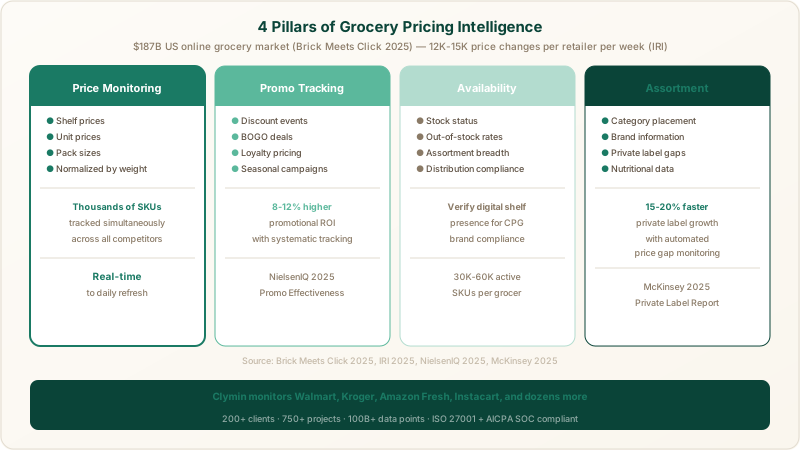
Grocery pricing changes faster than most retail categories. A single supermarket may adjust prices on thousands of SKUs weekly in response to supply chain costs, competitor moves, and promotional calendars. According to IRI's 2025 Pricing Survey, the average grocery retailer makes 12,000-15,000 price changes per week across its online catalog. Manual monitoring of even a fraction of these changes is impractical.
For pricing analysts at grocery chains, the challenge compounds across multiple competitors and product categories. Missing a competitor's flash sale on a high-velocity category like dairy or produce means losing price-sensitive shoppers who compare across two or three apps before placing an order.
What Grocery Data Feeds Pricing and Assortment Decisions?
Clymin's AI-agentic extraction delivers granular grocery data that goes beyond headline prices. Each data category supports specific analytical workflows that manual collection and limited third-party tools cannot address.
Competitive price monitoring captures shelf prices, unit prices, and pack sizes across thousands of SKUs simultaneously. Clymin normalizes pricing data by unit weight and volume, enabling accurate price comparisons even when competitors use different packaging formats. Pricing analysts use these datasets to identify pricing gaps and opportunities within specific categories.
Promotional intelligence tracks discount events, coupon offers, BOGO deals, loyalty member pricing, and seasonal campaigns across competitor platforms. NielsenIQ's 2025 Promotion Effectiveness Report found that grocery retailers who track competitor promotions systematically achieve 8-12% higher promotional ROI than those using ad-hoc monitoring. Clymin delivers historical promotion data that reveals competitor discount patterns and timing.
Product availability tracking monitors stock status, out-of-stock rates, and assortment breadth across online grocery platforms. CPG brands use this data to verify distribution compliance and identify where their products are missing from digital shelves.
With over 100 billion data points extracted across all verticals, Clymin applies the same enterprise-grade extraction capability to grocery retail intelligence.
How Grocery Chains and CPG Brands Use Price Intelligence
Grocery price scraping supports decisions across pricing strategy, category management, and competitive positioning, functions where stale data directly impacts margin performance.
Dynamic pricing optimization uses real-time competitor price data to adjust prices algorithmically across thousands of SKUs. A regional grocery chain monitoring five competitors on 8,000 shared SKUs can identify where it is overpriced, underpriced, or competitively positioned. Clymin feeds this data into pricing engines through API integration or scheduled data deliveries.
Private label strategy relies on price gap analysis between national brands and store brands. Clymin tracks the price differential across competitors, helping private label teams set pricing that maximizes the perceived value advantage. McKinsey's 2025 Private Label Report found that retailers with automated price gap monitoring grow private label revenue 15-20% faster than peers.
Market basket analysis uses assortment and pricing data across competitors to understand how product bundles and cross-category pricing strategies differ by retailer. CPG brands entering new retail channels use this analysis to optimize their trade promotion investments.
For grocery retailers also tracking digital shelf presence, Clymin's retail shelf monitoring service covers product placement, search rank visibility, and review data across online platforms.
Real-Time Extraction for a Fast-Moving Category
Grocery e-commerce presents unique technical scraping challenges. Product catalogs are large, a typical online grocery store lists 30,000-60,000 active SKUs. Prices and availability change throughout the day. Retailer websites implement aggressive bot detection to protect pricing data.
Clymin's AI agents handle these challenges through adaptive crawling that adjusts pace and patterns to avoid detection while maintaining comprehensive coverage. Unlike static scraping tools that fail when retailers update their site architecture, Clymin agents learn new structures automatically.
Lisa R., a Social Media Manager at a financial services client, reported that decision-making speed improved by 25% with Clymin's structured data extraction, the same speed advantage that grocery pricing teams gain when competitor data arrives in real time rather than days late.
Ready to Monitor Grocery Prices at Scale?
Clymin's managed service handles setup, retailer adaptation, and ongoing delivery so your pricing team focuses on analysis and strategy. With 40+ customers served across nine industries and hundreds of projects delivered, Clymin brings proven AI-agentic expertise to grocery retail intelligence.
Contact us at contact@clymin.com or get a free consultation to discuss your grocery data requirements.